

The S-5-PVKIT HUR 2.0 is a rail-less solar mounting solution designed to attach photovoltaic modules directly to compatible metal roof systems. HUR stands for High Uplift Resistance, reflecting the system’s focus on resisting strong wind uplift forces and supporting heavy snow loads.
Unlike conventional solar installations that use rails and numerous intermediate components, the S-5-PVKIT HUR 2.0 attaches solar modules directly to compatible S-5! clamps or brackets. This direct-attachment approach can reduce the number of mounting components and added dead load while creating a low-profile solar installation.
S-5! states that the S-5-PVKIT HUR 2.0 is designed for high-wind applications and is approved to FM 4478. The system is available for standing seam, exposed-fastened, and corrugated metal roof applications when paired with the appropriate attachment hardware.
Key Takeaways
- S-5-PVKIT HUR 2.0 is a rail-less solar mounting system for metal roofs.
- HUR means High Uplift Resistance.
- The system is designed for applications exposed to strong wind uplift forces and heavy snow loads.
- S-5! lists a 150 psf wind uplift rating and 120 psf gravity-load rating for the HUR 2.0 system.
- The system is approved to FM 4478 according to S-5!.
- It can be used on standing seam, exposed-fastened, and corrugated metal roofs with compatible S-5! attachment hardware.
- The system uses EdgeGrab and MidGrab components to attach solar modules.
- The longer 6-inch overhead grab provides greater contact with the solar module frame.
- S-5! states that the design improves load distribution by 25% and reduces point loads.
- Roof structure, panel capacity, attachment spacing, wind conditions, and solar module specifications must all be evaluated before installation.
Why High-Uplift Solar Mounting Matters on Metal Roofs
Solar panels add a new load path to an existing roof.
The solar module itself may not weigh an extreme amount, but wind can create substantial uplift forces on a rooftop array. In areas exposed to hurricanes, coastal storms, or other high-wind conditions, the attachment system becomes particularly important.
A solar mounting system must transfer these forces from the module into the roof and ultimately into the building’s supporting structure.
The S-5-PVKIT HUR 2.0 was developed specifically with these high-uplift conditions in mind.
S-5! describes the product as an enhanced version of its original PVKIT rail-less solar mounting solution, with design changes intended to improve module-to-roof attachment performance under extreme uplift forces.
The system uses a longer overhead grab with a larger contact area against the solar module frame. This helps maintain engagement with the module frame when the frame experiences deformation under high uplift forces.
What Makes S-5-PVKIT HUR 2.0 Different?
Traditional rooftop solar systems commonly use rails that run beneath the solar modules. The rails then connect to roof attachments distributed across the roof.
The S-5-PVKIT HUR 2.0 takes a different approach.
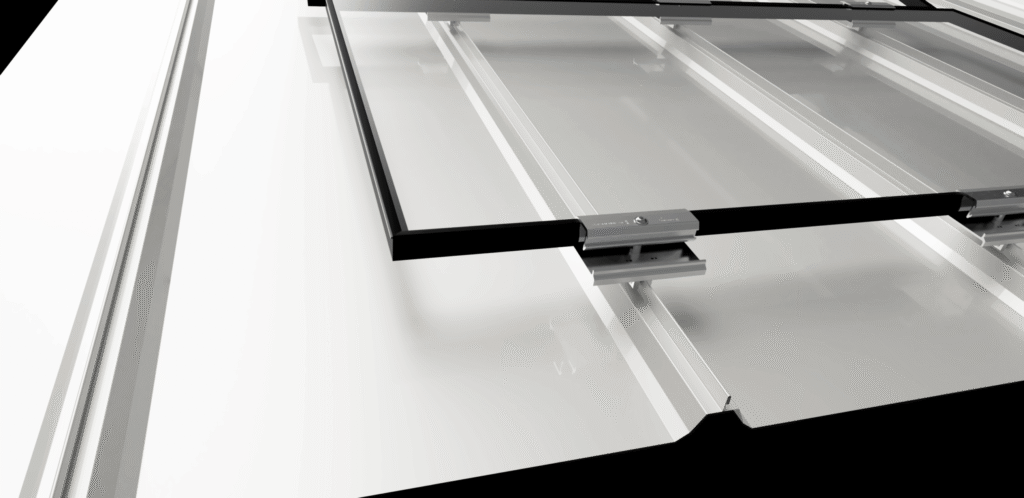
The solar modules are attached directly to compatible roof clamps or brackets using the PVKIT HUR components.
The basic assembly is:
Solar module → PVKIT HUR 2.0 → S-5! clamp or bracket → metal roof → building structure
By eliminating conventional rails, the system can reduce the amount of additional material installed on the roof.
S-5! specifically identifies reduced added dead load and improved load distribution as benefits of the HUR 2.0 design.
This can be particularly useful when designing solar arrays for metal buildings where minimizing additional rooftop components is desirable.
High-Uplift Performance of S-5-PVKIT HUR 2.0
The primary purpose of the HUR 2.0 design is improved performance under high uplift conditions.
S-5! lists the following system ratings:
| Performance Factor | S-5-PVKIT HUR 2.0 |
|---|---|
| Wind uplift resistance | 150 psf |
| Gravity/snow load | 120 psf |
| Load distribution improvement | 25% |
| Mounting approach | Rail-less |
| Roof applications | Standing seam, exposed-fastened, corrugated |
| FM approval | FM 4478 |
These values describe the product/system ratings published by S-5!, but they should not be interpreted as automatically applicable to every roof, solar module, or installation configuration.
The actual design still depends on the roof panel, attachment hardware, solar module, building structure, wind exposure, snow conditions, and attachment spacing.
How the HUR 2.0 Design Improves Module Attachment
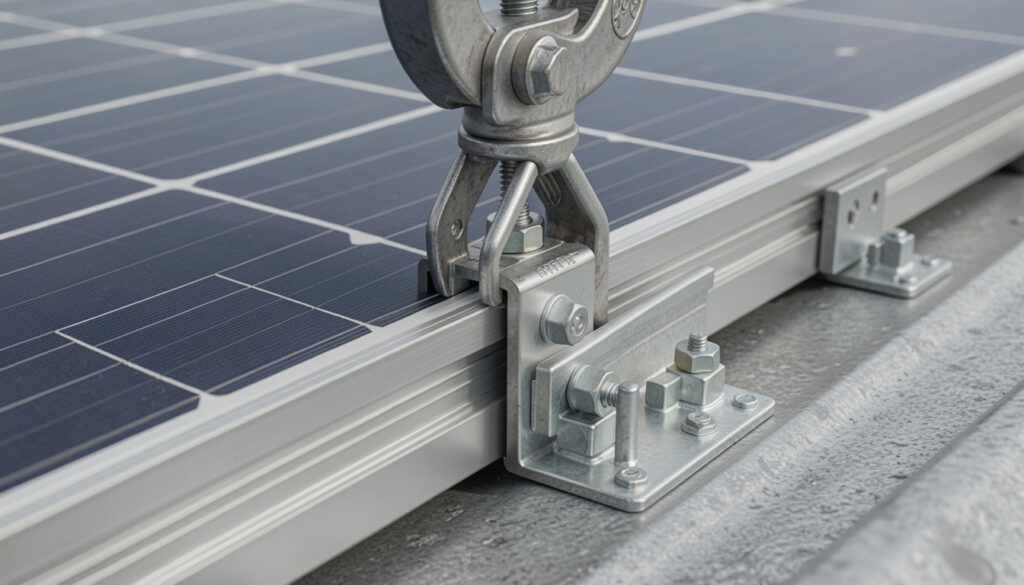
One of the major design changes in HUR 2.0 is the longer overhead grab.
The grab is approximately 6 inches (152 mm) long, providing a larger contact area against the solar module frame.
S-5! explains that this larger contact area helps prevent the grab from releasing when the module frame bows under extreme uplift forces. The redesigned contact surface and angle are also intended to improve grip on the module frame.
The baseplate design was also modified to help prevent the solar module from bending and disengaging under high uplift forces.
Together, these features are intended to improve the structural connection between the solar module and the roof attachment.
PVKIT HUR 2.0 Components
The S-5-PVKIT HUR 2.0 system uses several key components depending on the location of the solar module within the array.
PVKIT HUR Mid 2.0
The MidGrab is used between adjacent solar modules.
It can attach the frames of two neighboring modules to a single connection point, helping reduce the number of individual attachment points required across the array.
S-5! also states that the MidGrab can be used at an edge condition when desired.
PVKIT HUR 2.0 Edge
The EdgeGrab is used around the perimeter of the solar array.
It attaches the module frame to the appropriate rooftop clamp or bracket while providing a finished edge appearance.
Compatible S-5! Clamps
For standing seam metal roofs, the PVKIT HUR 2.0 works with compatible S-5! clamps selected according to the specific roof seam profile.
This is important because standing seam roofs have different seam shapes, dimensions, materials, and construction methods.
Compatible S-5! Brackets
For exposed-fastened and corrugated metal roofs, compatible S-5! brackets provide the connection between the PVKIT HUR system and the roof.
The correct bracket depends on the specific roof profile and application.
Which Metal Roofs Can Use PVKIT HUR 2.0?
The S-5-PVKIT HUR 2.0 is designed for three primary metal roof categories:
- Standing seam metal roofs
- Exposed-fastened metal roofs
- Corrugated metal roofs
However, the mounting hardware differs depending on the roof system.
Standing Seam Metal Roofs
Standing seam roofs use concealed attachment methods and raised seams that run continuously along the roof.
For these systems, compatible S-5! clamps attach to the standing seam without penetrating the roof panel.
S-5! emphasizes that the correct clamp must be selected based on the specific seam profile.
Exposed-Fastened Metal Roofs
Exposed-fastened roofs have visible screws running through the roof panels.
These roofs generally use brackets rather than standing seam clamps.
S-5! offers engineered brackets for trapezoidal-rib and other exposed-fastened profiles.
Corrugated Metal Roofs
Corrugated metal roofs have repeating wave-shaped profiles.
Compatible S-5! brackets can provide the roof connection for solar applications using the PVKIT HUR system.
The exact bracket must be selected based on the corrugation dimensions and roof construction.
S-5-PVKIT HUR 2.0 for Butler Metal Buildings
The S-5-PVKIT HUR 2.0 can be especially relevant to Butler metal buildings because S-5! specifically identifies compatibility with Butler’s MR-24 roof system in its published product information.
Butler buildings can use different roof systems depending on the building’s design, age, and construction.
Before specifying a solar mounting system, the existing roof should therefore be identified.
For a Butler MR-24 roof, the appropriate S-5! clamp must be selected for the specific standing seam profile. For other Butler roof systems, the appropriate bracket or attachment method may be different.
This is important because solar mounting hardware should be selected based on the actual roof profile rather than simply the building manufacturer.
Rail-Less Solar vs. Traditional Rail-Mounted Solar
One of the most noticeable differences between PVKIT HUR 2.0 and conventional solar mounting is the absence of traditional rails.
| Factor | S-5-PVKIT HUR 2.0 | Traditional Rail System |
|---|---|---|
| Solar mounting | Direct attachment | Rail-based |
| Conventional rails | No | Yes |
| Added mounting components | Reduced | More components |
| Roof attachment | Direct to compatible clamp/bracket | Clamp/bracket to rail |
| Roof profile compatibility | Application specific | Application specific |
| Wind performance | Designed for high uplift | Depends on system |
| Snow performance | Rated system load | Depends on system |
| Installation design | Requires specific layout | Requires rail layout |
| Aesthetics | Low-profile | Rails may be visible |
| Engineering | Required | Required |
The absence of rails does not eliminate the need for engineering.
Solar array layout, attachment spacing, roof capacity, wind exposure, module specifications, and building structure still need to be evaluated.
Why Load Distribution Matters
Solar panels create loads that must ultimately be transferred into the building structure.
If too few attachment points are used, individual areas of the roof can experience excessive localized forces.
S-5! states that the HUR 2.0 improves load distribution by 25%, helping reduce point loads.
The objective is to distribute the forces from the solar array across the roof system rather than concentrating them at a limited number of attachment locations.
This becomes particularly important in high-wind environments.
The roof panel itself must have sufficient strength, and its connection to the building structure must also be capable of transferring the resulting forces.
S-5! explicitly notes that the roof panel and its attachment to the structure need to be adequate for the imposed loads.
Solar Installation Considerations for Metal Buildings
Before installing a rail-less solar system on an existing metal building, several factors should be evaluated.
Important considerations include:
- Existing roof profile
- Roof panel material
- Roof panel gauge
- Standing seam dimensions
- Exposed-fastener configuration
- Existing roof condition
- Roof age
- Solar module dimensions
- Solar module frame specifications
- Wind speed
- Exposure category
- Snow load
- Seismic conditions
- Attachment spacing
- Building structural capacity
- Electrical and grounding requirements
A roof that appears visually suitable may still require structural evaluation before solar installation.
The solar attachment system should be designed around the actual building rather than relying solely on the published capacity of an individual component.
Things to Know
- HUR means High Uplift Resistance. The product is specifically designed for applications where wind uplift is an important design consideration.
- The system is rail-less. Solar modules attach directly to compatible S-5! clamps or brackets.
- Roof compatibility matters. Standing seam, exposed-fastened, and corrugated roofs use different attachment components.
- The roof still needs structural evaluation. Published component ratings do not automatically establish the capacity of an existing building.
- The solar module must be compatible. The module frame must meet the requirements of the PVKIT HUR system.
- Attachment spacing matters. Wind forces need to be distributed appropriately across the roof.
- Do not select clamps by appearance. The correct S-5! clamp depends on the actual standing seam profile.
- Exposed-fastened roofs require brackets. The appropriate bracket depends on the roof panel profile and installation conditions.
- High-wind projects require additional attention. Wind dynamics, roof construction, and structural capacity should be evaluated by qualified professionals.
- Follow the manufacturer’s installation instructions. Product-specific installation requirements should take precedence over generic solar mounting practices.
Frequently Asked Questions
Q: What is S-5-PVKIT HUR 2.0?
S-5-PVKIT HUR 2.0 is a rail-less solar mounting system designed for metal roofs with an emphasis on high wind uplift resistance.
It attaches solar modules directly to compatible S-5! clamps or brackets instead of using conventional solar rails.
Q: What does HUR stand for?
HUR stands for High Uplift Resistance.
The system was developed to improve solar module attachment performance under strong wind uplift forces.
Q: What is the wind uplift rating of PVKIT HUR 2.0?
S-5! lists a 150 psf wind uplift rating for the HUR 2.0 system.
The actual design capacity for a specific project still depends on the roof, attachment hardware, module, layout, and site conditions.
Q: What is the snow load rating?
S-5! lists a 120 psf gravity-load rating for the system.
Project-specific snow loads and roof capacity must still be evaluated before installation.
Q: Can PVKIT HUR 2.0 be installed on a Butler MR-24 roof?
Yes. S-5! identifies the Butler MR-24 as a compatible roof application when the appropriate S-5! clamp is used.
The exact clamp must be selected according to the actual MR-24 seam profile and project requirements.
Q: Can PVKIT HUR 2.0 be installed without solar rails?
Yes. Rail-less direct attachment is one of the primary characteristics of the PVKIT HUR 2.0 system.
Solar modules attach directly to compatible roof clamps or brackets.
Q: Can PVKIT HUR 2.0 be used on exposed-fastened roofs?
Yes. The system can be used on compatible exposed-fastened metal roofs with the appropriate S-5! bracket.
Q: Can PVKIT HUR 2.0 be used on corrugated roofs?
Yes. S-5! identifies corrugated metal roofs as a compatible roof type for the HUR 2.0 system.
The correct bracket must be selected for the specific corrugated profile.
Q: Does a rail-less solar system reduce the weight added to the roof?
It can reduce added mounting-system dead load because conventional rails are eliminated.
S-5! specifically lists reduced added dead load as one of the HUR 2.0 system features.
Q: Is PVKIT HUR 2.0 suitable for hurricane-prone areas?
The system was specifically developed for high-wind applications and S-5! markets it for coastal communities and other high-wind zones.
The actual suitability of a solar installation depends on the project’s design wind speed, exposure, roof construction, module specifications, attachment spacing, and applicable building requirements.
Q: Does PVKIT HUR 2.0 require engineering?
Yes. The solar mounting system and existing roof should be evaluated as a complete structural system.
S-5! notes that roof panels, panel attachments, and the building structure must be adequate for the loads imposed by the solar installation.
The Bottom Line on S-5-PVKIT HUR 2.0
The S-5-PVKIT HUR 2.0 provides a rail-less approach to installing solar panels on compatible metal roofs. Its high-uplift design, direct module attachment, reduced mounting components, and published 150 psf wind uplift and 120 psf gravity-load ratings make it particularly relevant to projects where wind performance is a major consideration.
For Butler metal buildings, the system can be especially relevant to compatible roof systems such as Butler MR-24 when the correct S-5! clamp and solar configuration are selected.
The most important step is identifying the existing roof system before selecting the attachment hardware. Standing seam, exposed-fastened, and corrugated roofs require different roof attachment solutions.
If you’re planning a solar installation on an existing Butler metal building, the roof profile, structural capacity, wind conditions, solar module specifications, and attachment spacing should all be evaluated before purchasing components.
Need help finding the right solar mounting components for your Butler metal building? Request a Quote and provide your roof type, panel profile, and solar project requirements.