

A commercial metal building may need more than a solid personnel door or a large overhead door. In applications where visibility, natural light, and wide access are important, a Full View Sectional Tereza Door can provide a practical combination of functionality and appearance.
This makes them particularly useful for automotive facilities, service centers, dealerships, fire stations, warehouses, commercial buildings, and other facilities where visibility is important.
Unlike a conventional solid sectional door, a full view configuration allows significantly more light into the building and creates a more open appearance. At the same time, the sectional design allows the door to move vertically and remain positioned above the opening when fully open.
Key Takeaways
- Full View Sectional Tereza Doors combine sectional overhead-door operation with large transparent panels.
- They can provide substantially greater visibility than conventional solid overhead doors.
- Full-view doors can bring additional natural light into commercial and industrial spaces.
- They are useful for showrooms, automotive facilities, service centers, dealerships, and other customer-facing applications.
- Sectional construction allows the door to open vertically and remain above the opening.
- Panel, glazing, hardware, and track configurations should be selected according to the building’s requirements.
- Proper installation and track alignment are critical for reliable operation.
- Regular inspection of rollers, hinges, cables, springs, seals, and hardware can help identify problems before they become major failures.
- The existing opening should be accurately measured before replacing an existing sectional door.
- The door should be selected based on opening dimensions, headroom, sideroom, operating requirements, and building use.
What Is a Full View Sectional Door?
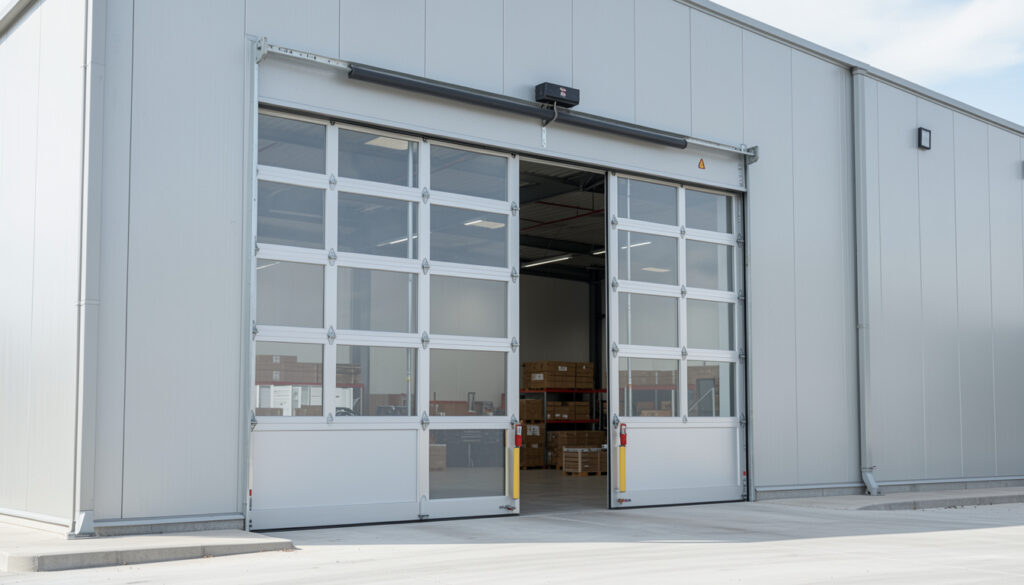
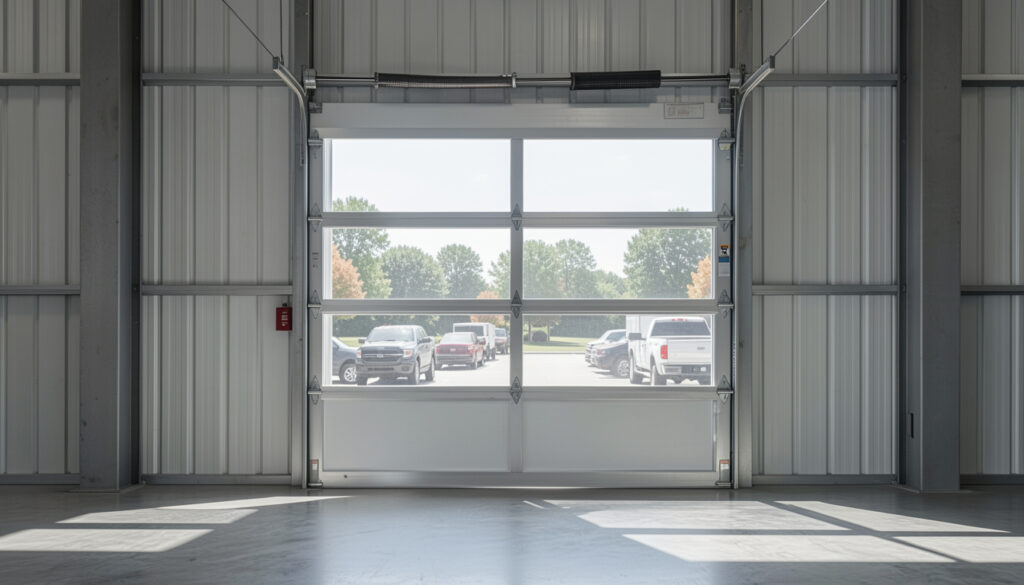
A full view sectional door is an overhead door made up of multiple horizontal sections containing large transparent panels.
When the door opens, the individual sections travel along tracks and move upward before resting above the doorway.
This operating method provides several advantages.
The door does not require the large horizontal clearance needed by a traditional swinging door, and the opening can remain completely unobstructed when the door is raised.
The full-view design replaces much of the conventional opaque door surface with transparent glazing.
This is especially valuable when the building owner wants to maintain visibility between the interior and exterior.
Why Choose a Full View Sectional Door?
The biggest advantage of a full-view sectional door is the combination of access and visibility.
A conventional solid overhead door can make an opening feel closed and isolated when the door is shut.
A full-view door creates a more open visual connection between the interior and exterior.
This can be beneficial for:
- Automotive dealerships
- Vehicle service centers
- Fire stations
- Equipment showrooms
- Commercial garages
- Warehouses
- Maintenance facilities
- Industrial service buildings
In customer-facing environments, visibility can also help customers understand what the facility does before they enter.
Full View Doors for Automotive Facilities
Automotive businesses are one of the clearest applications for full-view sectional doors.
A dealership or service center may want customers to see:
- Vehicles
- Service bays
- Technicians
- Equipment
- Showroom areas
A transparent sectional door allows the building to remain visually connected to the outside.
When the door is closed, natural light can still enter through the glazing.
When the door is open, vehicles and equipment can move freely through the opening.
This combination makes full-view sectional doors particularly useful for facilities where large vehicle openings are part of everyday operations.
Full View Doors for Service Centers
Vehicle and equipment service centers frequently use overhead doors to move vehicles into and out of service bays.
A full-view configuration provides additional visibility while maintaining the wide opening needed for vehicle access.
For service facilities, the door should be evaluated based on:
- Opening width
- Opening height
- Vehicle dimensions
- Traffic frequency
- Operating speed
- Headroom
- Sideroom
- Glazing requirements
- Weather exposure
The correct configuration depends on the actual building and operating environment.
Full View Doors for Fire Stations
Fire stations require large overhead openings for emergency vehicles.
The entrance also needs to provide visibility and natural light while allowing rapid access.
Full-view sectional doors can create a more open appearance and allow daylight into the apparatus bay.
However, fire-station applications require careful consideration of the specific door assembly, operating system, emergency requirements, and applicable codes.
The door should be specified according to the requirements of the facility rather than treated as a standard commercial garage door.
Natural Light and Building Design
One advantage of full-view sectional doors is the amount of daylight they can introduce into a building.
Traditional solid doors can create dark areas when closed.
Transparent panels allow daylight to pass through the opening, potentially reducing the need for artificial lighting during daylight hours.
This can be particularly useful in:
- Workshops
- Showrooms
- Service bays
- Warehouses
- Maintenance buildings
- Commercial garages
The amount of light transmitted depends on the glazing type, panel configuration, orientation, and surrounding building design.
Full View vs. Solid Sectional Doors
Both systems use sectional overhead-door operation, but the appearance and functional characteristics differ.
| Feature | Full View Sectional Door | Solid Sectional Door |
|---|---|---|
| Panel appearance | Primarily transparent | Primarily opaque |
| Visibility | High | Low |
| Natural light | High | Limited |
| Customer-facing appearance | Modern | More utilitarian |
| Vehicle access | Yes | Yes |
| Vertical operation | Yes | Yes |
| Typical applications | Showrooms, service centers | Warehouses, industrial buildings |
| Privacy | Lower | Higher |
Neither configuration is universally better.
The choice depends on whether the building prioritizes visibility and daylight or privacy and reduced glazing.
Door Panel Construction
The sections of a full-view door form the primary moving surface.
Each section must remain structurally stable while supporting its glazing and hardware.
The panels are connected using hinges, allowing the individual sections to follow the track system as the door opens and closes.
The panel construction must also accommodate:
- Glazing
- Hinges
- Rollers
- Weather seals
- Hardware
- Structural loading
Because the door repeatedly moves along the track, proper alignment between all sections is essential.
Glass and Glazing Considerations
The transparent portions of a full-view door are one of its defining characteristics.
Glazing selection should consider:
- Safety
- Impact resistance
- Visibility
- Light transmission
- Thermal performance
- Cleaning requirements
- Local building requirements
Different applications can require different glazing specifications.
For example, a service facility may prioritize impact resistance, while an office or showroom may place greater emphasis on appearance and thermal performance.
The glazing should therefore be selected according to the actual operating environment.
Thermal Performance
A full-view sectional door contains substantially more glazing than a solid insulated overhead door.
That can influence the thermal performance of the building envelope.
For conditioned facilities, consider:
- Glazing type
- Panel construction
- Perimeter seals
- Bottom seal
- Side seals
- Head seal
- Door opening frequency
A door that is opened frequently can have a much greater effect on energy use than one that remains closed most of the time.
In facilities where the door cycles frequently, operational practices can therefore be just as important as the door’s nominal insulation characteristics.
Weather Sealing
Exterior sectional doors must manage air and water around the perimeter.
Important sealing locations include:
- Bottom of the door
- Side jambs
- Head of the opening
- Between door sections
Worn seals can allow:
- Rain
- Dust
- Wind
- Outside air
- Temperature fluctuations
Weather seals should be inspected regularly, particularly on buildings exposed to severe weather.
A damaged bottom seal is especially noticeable because it can create a visible gap between the door and floor.
Sectional Door Track System
The track system controls how the door moves between the closed and open positions.
Depending on the building configuration, the track arrangement may be influenced by:
- Headroom
- Roof slope
- Ceiling height
- Available space
- Door height
- Door weight
- Building structure
Accurate field measurements are essential before ordering or replacing a sectional door.
A door may physically fit the opening but still be unsuitable if there is insufficient headroom or sideroom for the required track configuration.
Headroom and Sideroom
Two measurements are especially important when replacing a sectional overhead door:
Headroom is the available space above the door opening.
Sideroom is the available space on either side of the opening.
Both affect the track and operating-hardware configuration.
Before ordering a replacement door, document:
- Opening width
- Opening height
- Headroom
- Sideroom
- Backroom
- Roof structure
- Existing track configuration
These measurements can prevent costly surprises during installation.
Manual vs. Powered Operation
Sectional doors can be operated manually or through an electric operator depending on the application.
Manual operation may be practical for smaller doors with relatively low usage.
Powered operation is generally more convenient for larger openings and facilities with frequent vehicle traffic.
For commercial buildings, powered operation can be particularly useful when employees repeatedly open and close the door throughout the day.
The operator should be appropriately matched to the door’s size, weight, cycle frequency, and operating requirements.
Common Problems With Full View Sectional Doors
Broken or Damaged Glazing
Impact from vehicles, equipment, or other objects can damage transparent door panels.
Worn Rollers
Rollers travel through the track every time the door operates and can wear over time.
Damaged Hinges
Repeated movement places stress on hinges connecting the sectional panels.
Door Misalignment
A misaligned door may bind, operate unevenly, or fail to close properly.
Damaged Tracks
Impact or improper installation can bend the track and interfere with door movement.
Broken Springs
Torsion or extension springs can eventually fail after repeated operating cycles.
Worn Bottom Seal
A deteriorated bottom seal can create gaps that allow water, dust, and outside air into the building.
Operator Problems
Electric operators can experience mechanical, electrical, or control-system failures.
Excessive Noise
Grinding, rattling, or squealing can indicate worn rollers, hinges, tracks, or other moving components.
Signs Your Full View Door Needs Repair
Watch for changes in normal operation.
Potential warning signs include:
- Uneven movement
- Excessive noise
- Door sticking
- Slow operation
- Door failing to close completely
- Damaged glazing
- Broken hinges
- Loose hardware
- Bent tracks
- Worn seals
- Door sections separating
- Operator malfunction
A sectional door is a mechanically interconnected system.
A small component failure can place additional loads on other parts of the assembly.
For that reason, unusual operation should be investigated rather than ignored.
Signs Your Full View Door Needs Replacement
Complete replacement may make more sense when the door has extensive:
- Panel damage
- Corrosion
- Structural deformation
- Track damage
- Repeated mechanical failures
- Obsolete operating hardware
- Glazing deterioration
A replacement can also be justified when the existing door no longer meets the building’s operational requirements.
For example, a facility may have increased its vehicle traffic or changed its use since the original door was installed.
In that situation, replacing the door with a configuration better suited to current operations may be more practical than continuing to repair an undersized or outdated system.
Full View Doors for Showrooms
Showrooms benefit from visibility.
Whether the building displays vehicles, equipment, machinery, or other products, large transparent sections allow the contents of the building to remain visible from outside.
The door can also contribute to the building’s architectural appearance.
When closed, it provides a transparent facade.
When open, it provides unrestricted access.
This makes a full-view sectional door particularly effective where the building’s entrance needs to serve both an architectural and functional purpose.
Full View Doors for Warehouses
Warehouses generally prioritize function over appearance, but there are still situations where visibility matters.
A full-view door can help supervisors see activity around an opening and can introduce daylight into areas that would otherwise remain dark.
However, warehouses with high forklift traffic should carefully evaluate glazing specifications and door placement.
The door should not be installed where routine equipment movement creates an unreasonable risk of impact.
Full View Doors for Industrial Facilities
Industrial environments can be demanding.
Doors may be exposed to:
- Dust
- Moisture
- Temperature changes
- Equipment traffic
- Frequent cycling
- Accidental impacts
A full-view sectional door should therefore be selected according to the specific conditions of the facility.
High-cycle applications may require more robust hardware and operating systems than doors used only occasionally.
Security Considerations
Transparency provides visibility, but it also means that occupants and stored materials may be visible from outside.
Security requirements should therefore be considered before selecting a full-view door.
Questions to consider include:
- Does the facility need visual privacy?
- Can valuable equipment be visible from outside?
- Is the door inside a controlled area?
- Does the facility require access control?
- Is the door exposed to vandalism?
- What type of locking mechanism is required?
For highly secure environments, a solid insulated sectional door may be more appropriate.
Maintenance Requirements
Regular maintenance is important because sectional doors contain numerous moving components.
Inspect:
- Rollers
- Hinges
- Tracks
- Springs
- Cables
- Fasteners
- Seals
- Glazing
- Operator
- Safety devices
Lubrication should follow the manufacturer’s recommendations.
Tracks should remain properly aligned and free of debris.
The door should also be operated periodically to identify unusual noise or resistance.
Safety Considerations
Sectional overhead doors are heavy mechanical assemblies.
They should not be treated like ordinary manual doors.
Potential hazards include:
- Falling sections
- Spring failure
- Cable failure
- Pinch points
- Crushing hazards
- Unexpected door movement
Safety devices and operating hardware should be inspected regularly.
Repairs involving springs, cables, or other high-tension components should be performed by qualified personnel.
Replacing an Existing Full View Sectional Door
Before ordering a replacement, document the existing installation.
Measure:
- Door opening width
- Door opening height
- Headroom
- Sideroom
- Backroom
- Door section dimensions
- Track configuration
Also photograph:
- Exterior of the door
- Interior of the door
- Tracks
- Springs
- Rollers
- Hinges
- Operator
- Bottom seal
- Header
- Side jambs
These details can help determine the correct replacement configuration.
Matching the Door to the Building
A sectional door needs to work with the building around it.
Important considerations include:
- Structural framing
- Wall panels
- Opening dimensions
- Roof geometry
- Interior clearance
- Exterior clearance
- Electrical service
- Traffic patterns
This is particularly important when replacing a door in an existing Butler building.
The replacement should be evaluated as part of the entire building opening rather than as an isolated component.
Things to Know
- Full View Sectional Tereza Doors combine large transparent panels with sectional overhead operation.
- They are particularly useful where visibility and natural light are important.
- Automotive facilities, showrooms, service centers, and commercial garages are common applications.
- Glazing specifications should be selected based on safety, impact, thermal, and project requirements.
- Headroom and sideroom measurements are essential before ordering.
- Frequent-cycle doors may require appropriately rated hardware and operators.
- Weather seals should be inspected regularly.
- Tracks, rollers, hinges, springs, and cables require periodic inspection.
- Damaged glazing should be repaired or replaced promptly.
- The surrounding wall and structural opening must be considered when replacing an existing door.
- High-tension components should only be serviced by qualified personnel.
- Security requirements should be evaluated because full-view glazing increases visibility into the building.
Frequently Asked Questions
Q: What is a Full View Sectional Tereza Door?
It is a sectional overhead door that uses large transparent panels to provide visibility and natural light while maintaining the vertical operating design of a sectional door.
Q: Where are full-view sectional doors commonly used?
They are commonly used in automotive dealerships, service centers, showrooms, fire stations, commercial garages, warehouses, and industrial facilities.
Q: Do full-view sectional doors provide natural light?
Yes.
The transparent sections allow daylight to enter the building when the door is closed, reducing the enclosed appearance associated with solid overhead doors.
Q: Are full-view sectional doors suitable for automotive facilities?
Yes.
They are particularly useful for service bays and dealerships because they combine large vehicle access with visibility into the facility.
Q: Are full-view doors insulated?
The thermal performance depends on the specific panel and glazing configuration selected.
For conditioned spaces, the complete door assembly, glazing, seals, and opening frequency should be considered when evaluating energy performance.
Q: What measurements are needed to replace a sectional door?
At minimum, measure the opening width, opening height, headroom, and sideroom.
Backroom and existing track configuration should also be documented when applicable.
Q: Can a full-view sectional door be motorized?
Yes, depending on the door configuration and application.
Powered operation can be useful for larger doors and facilities with frequent opening cycles.
Q: How do I maintain a full-view sectional door?
Regularly inspect the rollers, hinges, tracks, springs, cables, glazing, seals, hardware, operator, and safety components.
Unusual noise, uneven movement, or difficulty opening should be investigated promptly.
Q: Can I replace an existing sectional door with a full-view configuration?
Potentially, provided the building opening, structure, headroom, sideroom, and operating requirements can accommodate the replacement.
Accurate measurements and photographs should be collected before ordering.
Q: Are full-view sectional doors secure?
They can provide secure access, but their transparent design provides greater visibility into the building than a solid door.
Security requirements should therefore be evaluated alongside the benefits of visibility and natural light.
The Bottom Line on Full View Sectional Tereza Doors
A Full View Sectional Tereza Door can provide a useful combination of large-scale access, visibility, and architectural appearance for commercial and industrial metal buildings.
For automotive dealerships, service centers, showrooms, fire stations, and similar facilities, the transparent sectional design allows the building to remain visually connected to its surroundings while maintaining the practical vertical operation of an overhead door.
The most important considerations are opening dimensions, headroom, sideroom, glazing requirements, operating frequency, weather exposure, security, and the surrounding building structure.
If you are replacing an existing sectional door, document the opening and existing hardware before ordering. Matching the replacement to the building’s actual conditions can help avoid installation problems and unnecessary modifications.
Need a replacement Full View Sectional Tereza Door? Request a Quote and provide your opening dimensions, existing door configuration, and photos of the current installation.