

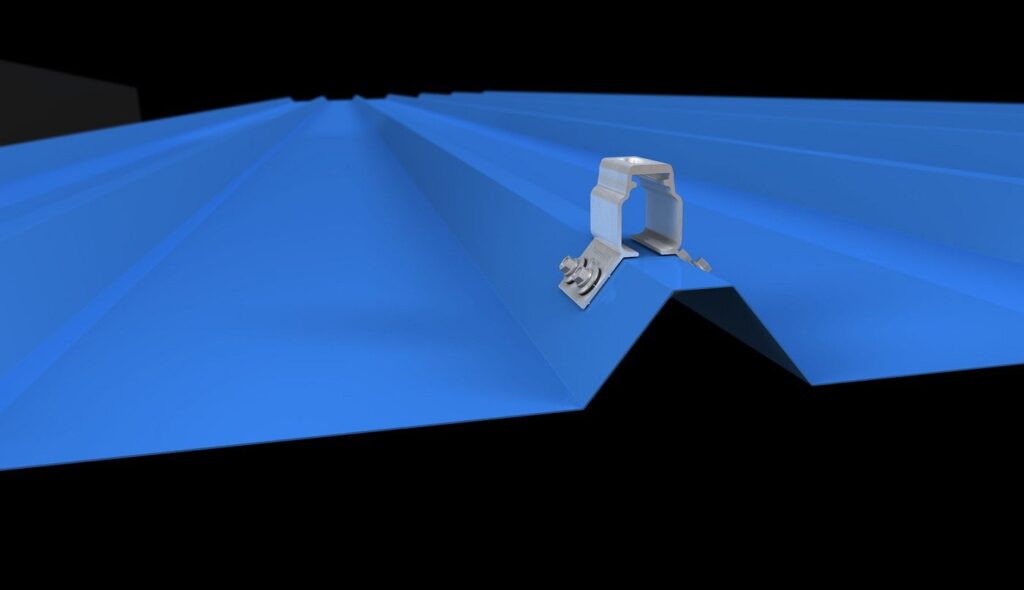
S-5 RibBracket I, II, IV, and V are structural aluminum roof brackets designed for specific exposed-fastened, trapezoidal-rib metal roof profiles. Each bracket is manufactured with different dimensions to accommodate different roof rib geometries.
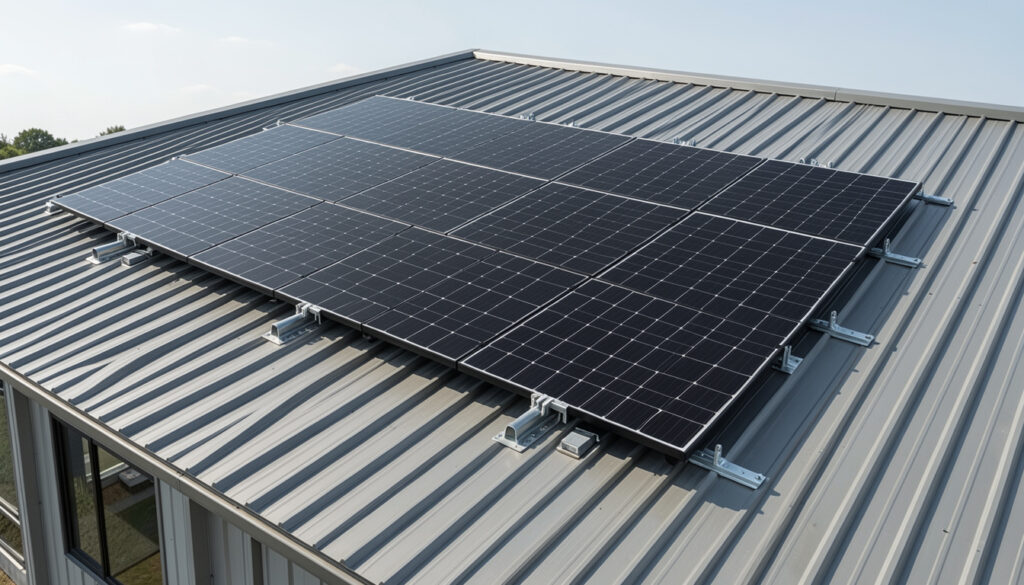
The RibBracket I-V family provides an attachment solution for applications such as solar PV systems, HVAC equipment, roof walkways, and other compatible rooftop accessories. The brackets mount directly to the crown of compatible roof panels and are designed to provide a secure attachment point without requiring conventional rails for direct-attach solar applications.
The key distinction between the four products is roof-profile compatibility. RibBracket I, II, IV, and V are not interchangeable simply because they look similar. The correct bracket must be selected according to the dimensions and geometry of the existing metal roof profile.
Key Takeaways
- RibBracket I, II, IV, and V are profile-specific metal roof brackets for exposed-fastened trapezoidal-rib roofing.
- Each bracket is designed for different roof rib dimensions and profiles.
- RibBracket I is designed for narrow profiles commonly found in Hawaiian roofing applications.
- RibBracket II is designed for several African and Australian roof profiles.
- RibBracket IV is designed for compatible African and North American profiles.
- RibBracket V is designed for Ternium TR and similarly dimensioned profiles.
- The brackets can be used with the S-5-PVKIT for rail-less solar PV mounting.
- S-5! states that the RibBracket I-V family is a sheeting-only attachment that can be positioned along the roof rib.
- Factory-applied EPDM seals help weatherproof the roof attachment.
- The correct bracket should always be selected by measuring and identifying the actual roof profile.
- S-5! advises against installing these brackets on lapped ribs in typical applications because of variations in rib geometry and sealant placement.
What Is the S-5 RibBracket I-V Family?
The RibBracket I-V family was developed to address the problem of attaching rooftop equipment to different trapezoidal metal roof profiles.
Exposed-fastened metal roofs are not manufactured with one universal rib dimension. The height, width, angle, and shape of the ribs can vary significantly between manufacturers and panel profiles.
Rather than using one generic bracket for every roof, S-5! offers different RibBracket models designed around specific profile geometries.
This allows the bracket to conform more closely to the roof rib and provide a more appropriate attachment configuration.
S-5! currently identifies RibBracket I, II, III, IV, and V as members of the product family. The specific models are differentiated primarily by the roof profiles they are designed to fit.
Why Roof Profile Compatibility Matters
A metal roof bracket does not simply need to sit on top of a roof panel.
Its geometry must properly engage the roof rib and transfer the applied loads through the roof panel and its connection to the supporting structure.
The dimensions of the roof rib therefore directly affect bracket compatibility.
S-5! provides specific dimensional information for each RibBracket model and recommends using its fitment resources when the correct bracket is uncertain. The company also offers a RibBracket Gauge Tool to help identify compatible roof profiles.
This is particularly important when working on an existing metal building where the original roof documentation may no longer be available.
Two roof panels can look nearly identical while having different rib dimensions.
For that reason, selecting a bracket based only on visual appearance is not recommended.
RibBracket I
RibBracket I is designed for narrow roof profiles, particularly popular Hawaiian profiles.
S-5! identifies examples including HPM Custom 4-Rib and HPM Custom 6-Rib, along with similarly dimensioned narrow-rib profiles. Its compatible top-rib dimension range is approximately 0.63 to 1 inch.
This makes RibBracket I appropriate for roof profiles that are smaller than those intended for some of the other models in the RibBracket family.
The actual roof should still be measured before selecting the bracket.
Typical RibBracket I Applications
RibBracket I can be used for compatible rooftop attachment applications, including direct-attach solar when paired with the appropriate S-5! PV mounting hardware.
The application must still be evaluated based on the roof panel, bracket configuration, loads, and installation requirements.
RibBracket II
RibBracket II is designed for specific profiles commonly found in African and Australian markets.
S-5! identifies Lysaght Trimdek 1015, Safintra Trimflute 1015, and similarly dimensioned profiles as examples of compatible roof configurations.
The different geometry of these roof profiles is why RibBracket II should not automatically be substituted with another RibBracket model.
When working with an existing roof, the panel manufacturer’s profile information should be compared with S-5!’s current product specifications.
RibBracket IV
RibBracket IV is designed for compatible African and North American trapezoidal roof profiles.
S-5! identifies Safintra IBR and KingSpan KS1000 among the profiles for which RibBracket IV is designed. The listed compatible top-rib dimension range is approximately 1¼ to 1⅜ inches.
This makes RibBracket IV particularly relevant to certain commercial and industrial exposed-fastened metal roof systems.
However, the profile must still be verified because similarly named roof panels can have different dimensions between manufacturers.
RibBracket V
RibBracket V is designed for Ternium TR and similarly dimensioned profiles.
S-5! lists a compatible top-rib dimension range of approximately 0.75 to 1 inch.
The bracket provides another profile-specific option within the RibBracket family for exposed-fastened trapezoidal roof systems.
As with the other models, compatibility should be confirmed using the actual roof profile dimensions before installation.
RibBracket I, II, IV, and V Compared
The easiest way to understand the four products is to compare their intended roof profiles.
| Product | Intended Roof Profiles | Approx. Top-Rib Dimension |
|---|---|---|
| RibBracket I | HPM Custom 4-Rib, HPM Custom 6-Rib and similar narrow profiles | 0.63–1 in. |
| RibBracket II | Lysaght Trimdek 1015, Safintra Trimflute 1015 and similar profiles | Profile specific |
| RibBracket IV | Safintra IBR, KingSpan KS1000 and similar profiles | 1¼–1⅜ in. |
| RibBracket V | Ternium TR and similar profiles | 0.75–1 in. |
These dimensions and profile examples come from S-5!’s current RibBracket I-V product information. RibBracket III is intentionally omitted from this comparison because it is covered separately in our product series.
RibBracket I-V for Solar Panel Installation
One of the primary applications for the RibBracket family is solar PV mounting.
The brackets can be paired with the S-5-PVKIT to create a rail-less, direct-attach solar mounting system. S-5! describes RibBracket I-V as a sheeting-only attachment that can be positioned along the roof rib, providing flexibility in solar module placement.
This differs from traditional solar installations that use long aluminum rails underneath the modules.
With a rail-less configuration, the attachment sequence can be simplified to:
Solar module → PVKIT → RibBracket → metal roof panel → building structure
The reduced number of components can simplify the installation and create a lower-profile solar array.
However, rail-less does not mean that structural engineering is unnecessary. Solar modules introduce wind uplift, gravity, and other loads that must be transferred through the roof attachment and into the building structure.
Why Rail-Less Solar Mounting Can Be Useful
Traditional rail-based solar systems require aluminum rails to run beneath the solar modules.
The rails then connect to roof attachments distributed across the roof.
A direct-attach system eliminates the conventional rail component and attaches the modules directly to the roof attachment hardware.
S-5! describes the RibBracket I-V and PVKIT combination as a rail-less solar PV mounting solution. The company also states that the RibBracket can be positioned anywhere along the roof rib, rather than being limited to locations directly above building substructure.
This can provide additional flexibility when laying out a solar array.
It can also reduce the number of components that need to be installed across the roof.
The actual mounting layout must still be designed around the solar module manufacturer’s requirements, roof capacity, wind loads, and applicable building codes.
Structural Load Considerations
Rooftop attachments are only as strong as the complete system supporting them.
For RibBracket applications, the load path generally involves the rooftop accessory, bracket, roof panel, fasteners, and supporting building structure.
S-5! conducts load testing on different roof profiles, materials, gauges, and substrates because roof construction varies significantly. The company publishes load-test results based on specific roof configurations rather than treating every metal roof as having the same capacity.
This distinction is important.
A published load value for a particular roof profile should not automatically be applied to a different roof panel.
Factors that can affect the final capacity include:
- Roof panel profile
- Panel thickness
- Roof material
- Fastener type
- Fastener spacing
- Supporting substrate
- Wind uplift
- Gravity loads
- Accessory weight
- Attachment spacing
- Existing roof condition
For solar installations, the complete array should be evaluated rather than looking only at the capacity of an individual bracket.
How RibBracket I-V Attaches to a Metal Roof
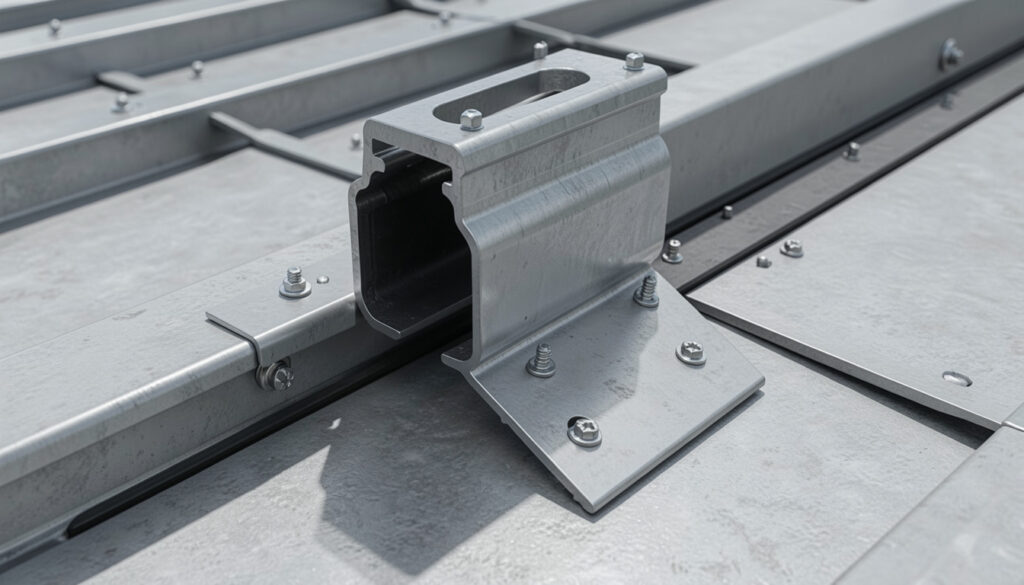
The RibBracket I-V family is designed to mount directly onto the crown of compatible trapezoidal roof panels while straddling the roof rib.
S-5! states that the brackets are attached using the specified stainless-capped self-piercing screws, with the attachment positioned along the roof rib.
The bracket’s design also uses an angled attachment geometry.
According to S-5!, the bracket design converts upward pull from wind uplift into shear, increasing the holding strength of the attachment.
The top slot provides lateral adjustability, which can help installers align attached components such as solar modules.
Weatherproofing the RibBracket Connection
Any time a component is attached to an exposed-fastened metal roof, maintaining the weather barrier is critical.
A poorly sealed roof attachment can create a path for water intrusion and potentially lead to corrosion or interior building damage.
S-5! uses factory-applied EPDM sealing components on its sheeting-only brackets. The company describes this configuration as a double seal, combining the EPDM seal on the bracket feet with EPDM washers beneath the fastener heads.
The seal is also designed to protect the sealing material from UV exposure and excessive compression.
S-5! states that RibBracket I-V has been tested for watertight performance using ASTM E2140 static water pressure testing.
This type of testing is important because rooftop attachments need to maintain weather resistance after installation.
Why Factory-Applied Sealing Matters
Field-applied sealants are commonly used in metal roofing, but their long-term performance can depend heavily on material selection, surface preparation, application technique, and exposure.
S-5! takes a different approach with its RibBracket family by incorporating the sealing components into the bracket.
The company states that its integrated sealant reservoirs help prevent over-compression and protect the seal from UV degradation.
S-5! also specifically advises against adding unnecessary field-applied sealant around its brackets because exposed sealant can deteriorate over time.
Installers should therefore follow the current manufacturer installation instructions rather than adding sealant as a substitute for the specified sealing system.
How to Select the Correct RibBracket
The first step is identifying the roof profile.
You should determine:
- Roof manufacturer
- Panel profile
- Rib width
- Rib height
- Rib geometry
- Panel thickness
- Roof material
- Fastener configuration
- Intended rooftop application
Once the profile has been identified, compare its dimensions against the manufacturer’s current RibBracket specifications.
S-5! provides a RibBracket Gauge Tool for identifying compatible trapezoidal roof profiles. The company notes that the legs of RibBracket I-V have some flexibility and can accommodate profiles that vary slightly from the dimensions shown on its gauge tool.
If the roof profile cannot be positively identified, contacting S-5! or an authorized distributor before ordering is preferable to selecting a bracket based on appearance alone.
RibBracket I-V for Butler Metal Buildings
RibBracket I, II, IV, and V may be useful for Butler buildings that use compatible exposed-fastened trapezoidal metal roof profiles.
However, Butler buildings have been manufactured with multiple roof systems over the years.
That means the fact that a building is a Butler building does not automatically determine which RibBracket should be used.
The actual roof panel profile must be identified.
If the building has an exposed-fastened trapezoidal roof matching one of the RibBracket profiles, the appropriate model may provide a suitable attachment solution.
If the building uses a standing seam system such as a compatible Butler MR-24 roof, a standing seam clamp rather than a RibBracket would generally be the relevant attachment category.
For an existing Butler building, it is therefore important to confirm the roof system before selecting a solar or rooftop attachment product.
Installation Considerations
Before installing RibBracket I, II, IV, or V, inspect the roof and verify that the existing system is suitable for the intended attachment.
Important considerations include:
- Confirm the exact roof profile.
- Measure the rib dimensions.
- Verify the bracket model.
- Check the roof panel condition.
- Inspect existing fasteners.
- Confirm panel gauge and material.
- Determine the intended accessory or equipment.
- Calculate applicable wind and gravity loads.
- Verify attachment spacing.
- Confirm the supporting structure can accommodate the additional loads.
- Follow the manufacturer’s installation instructions.
S-5! specifically states that the RibBracket I-V family should not generally be installed on lapped ribs because variations in the rib overlap and sealant placement can affect the attachment. Projects requiring attachment at a lapped rib should be reviewed with S-5!’s technical support team.
Things to Know
- RibBracket models are profile-specific. Do not assume RibBracket I, II, IV, and V are interchangeable.
- Measure before ordering. Roof rib dimensions determine which bracket is appropriate.
- RibBracket I is designed for narrow profiles such as HPM Custom 4-Rib and HPM Custom 6-Rib.
- RibBracket II is designed for profiles such as Lysaght Trimdek 1015 and Safintra Trimflute 1015.
- RibBracket IV is designed for profiles such as Safintra IBR and KingSpan KS1000.
- RibBracket V is designed for Ternium TR and similarly dimensioned profiles.
- The brackets can be used with PVKIT for rail-less solar mounting.
- Factory-applied EPDM seals help maintain the weather barrier at the roof attachment.
- Do not rely on additional field-applied sealant as a substitute for the manufacturer’s sealing system.
- Lapped ribs require special consideration. S-5! generally does not recommend installing RibBracket I-V on lapped ribs.
- Roof condition matters. Existing corrosion, damaged panels, or deteriorated fasteners can affect attachment performance.
- The entire load path matters. The bracket, fasteners, roof panel, and supporting structure must be considered together.
Frequently Asked Questions
Q: What is S-5 RibBracket I-V?
S-5 RibBracket I-V is a family of structural aluminum brackets designed for attaching rooftop equipment and solar systems to compatible exposed-fastened trapezoidal metal roofs.
The family includes multiple bracket configurations so different roof profiles can be accommodated.
Q: What is the difference between RibBracket I, II, IV, and V?
The primary difference is the roof profile each bracket is designed to fit.
RibBracket I is intended for narrow Hawaiian profiles, RibBracket II for specific African and Australian profiles, RibBracket IV for certain African and North American profiles, and RibBracket V for Ternium TR and similarly dimensioned profiles.
Q: Can RibBracket I-V be used for solar panels?
Yes. RibBracket I-V can be paired with the S-5-PVKIT for rail-less, direct-attach solar PV mounting.
The correct RibBracket model must be selected according to the roof profile.
Q: Can RibBracket I-V be used with solar rails?
S-5! specifically states that RibBracket I-V should not be used with rails.
For rail-based solar applications, a different S-5! attachment product should be selected according to the roof and mounting configuration.
Q: How do I know which RibBracket fits my roof?
Identify the roof profile and compare its rib dimensions with S-5!’s current RibBracket specifications.
S-5! also offers a RibBracket Gauge Tool to help determine the correct fit.
Q: Can RibBracket I-V be installed on a Butler metal building?
Potentially, if the Butler building has an exposed-fastened trapezoidal roof profile compatible with the specific RibBracket model.
The building manufacturer alone does not determine compatibility. The actual roof profile must be identified.
Q: Are RibBracket I-V brackets waterproof?
S-5! uses factory-applied EPDM sealing technology and states that RibBracket I-V has passed ASTM E2140 static water pressure testing.
The attachment must still be installed according to the manufacturer’s instructions to achieve the tested performance.
Q: Can RibBracket I-V be installed on a standing seam roof?
RibBracket I-V is designed for exposed-fastened trapezoidal-rib roofs rather than standard standing seam roofs.
Standing seam applications generally require a compatible clamp designed for the specific seam profile.
Q: Can RibBracket I-V be installed on a lapped rib?
S-5! generally does not recommend installing RibBracket I-V on lapped ribs because of variations in rib overlap and sealant placement.
If a project requires attachment at a lapped rib, S-5! recommends contacting its support team for guidance.
Q: Can RibBracket I-V be used for HVAC equipment?
Yes, RibBracket products are designed for rooftop applications including HVAC equipment when the roof profile and loading requirements are appropriate.
The equipment weight, wind loads, roof capacity, and supporting structure must be evaluated before installation.
The Bottom Line on S-5 RibBracket I, II, IV, and V
S-5 RibBracket I, II, IV, and V provide profile-specific attachment solutions for compatible exposed-fastened trapezoidal metal roofs. Instead of treating every metal roof as having the same rib geometry, the RibBracket family provides different configurations designed around different roof profiles.
The brackets can support applications such as solar PV, HVAC equipment, and roof walkways, while the S-5-PVKIT can be used with compatible RibBracket models for rail-less solar installations.
For existing Butler metal buildings, the most important consideration is identifying the actual roof profile. The fact that a building is manufactured by Butler does not by itself determine which RibBracket is appropriate.
Before ordering, verify the roof profile, rib dimensions, panel construction, intended application, and applicable loads. Selecting the correct bracket based on the actual roof geometry is essential for achieving the intended attachment performance.
Need help finding the right RibBracket for your Butler metal building? Request a Quote and provide your roof profile, panel dimensions, and intended application.