

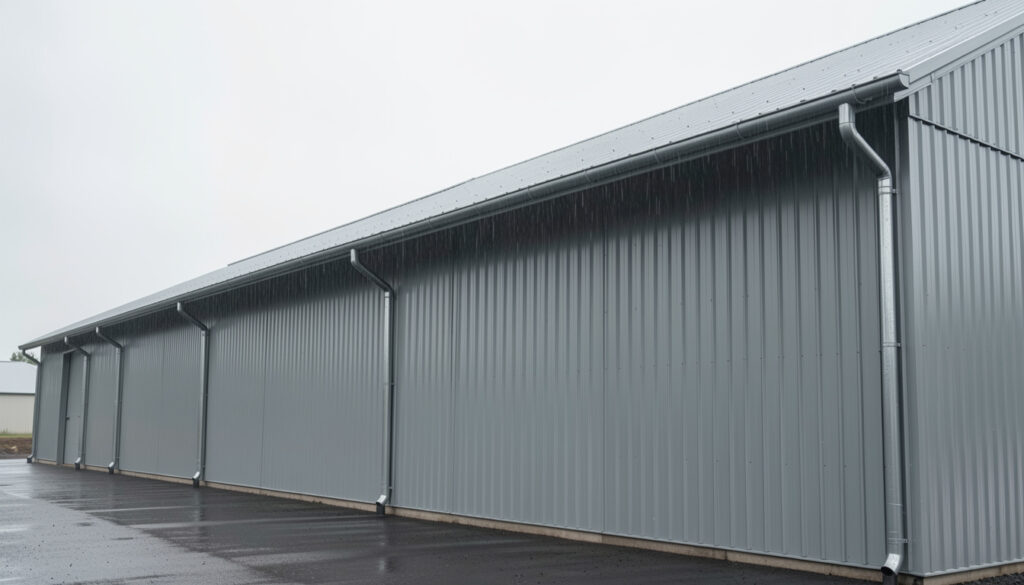
Gutters and downspouts are essential components of a properly designed metal building drainage system. They collect rainwater from the roof and direct it away from the building’s walls, entrances, foundation, and surrounding areas.
For Butler metal buildings, the gutter system needs to work with the specific roof profile, eave configuration, building dimensions, and expected water flow. A properly functioning system can help reduce uncontrolled runoff and protect other building components from prolonged exposure to water.
Gutters and downspouts are particularly important for commercial, industrial, agricultural, and warehouse buildings where large roof areas can generate substantial amounts of runoff during heavy rainfall.
Key Takeaways
- Gutters collect rainwater flowing from the metal roof and direct it toward downspouts.
- Downspouts carry collected water away from the roof and building perimeter.
- Proper drainage helps protect walls, doors, foundations, walkways, landscaping, and surrounding areas.
- Gutter capacity should be appropriate for the roof area and expected rainfall.
- Clogged gutters can cause water to overflow and damage adjacent building components.
- Damaged or improperly installed gutters can contribute to water intrusion around the eave.
- Downspout placement affects how effectively water is moved away from the building.
- Gutters should be inspected periodically for corrosion, debris, loose connections, and drainage problems.
- Replacement gutters should be compatible with the existing Butler roof and eave configuration.
- Gutters and downspouts are part of the overall building-envelope and roof drainage system.
What Do Gutters and Downspouts Do?
A metal building roof is designed to shed water.
As rain falls onto the roof surface, gravity moves the water toward the lower roof edge. Without a controlled drainage system, that water can simply fall from the eave onto the ground below.
Gutters intercept the water at the roof edge.
The water then flows through the gutter toward a downspout, which directs it vertically downward and away from the building.
The basic drainage path is:
Roof → Gutter → Downspout → Ground-level discharge
This simple system helps control where water leaves the building.
Without it, concentrated roof runoff can cause erosion, splashback, standing water, and excessive moisture around the building perimeter.
Why Gutters Matter on Metal Buildings
Metal building roofs can cover very large areas.
A small residential roof may have a relatively modest drainage requirement, while a warehouse, manufacturing facility, agricultural building, or commercial structure can have thousands of square feet of roof area.
During heavy rainfall, that surface can collect a substantial volume of water.
If the water is not properly controlled, it can create problems around the building.
Potential consequences include:
- Soil erosion
- Foundation moisture
- Water pooling
- Mud around entrances
- Splashback onto wall panels
- Damage to landscaping
- Erosion around walkways
- Water accumulation near doors
- Premature deterioration of adjacent components
A properly sized and maintained gutter system provides a controlled path for the water.
How Gutters Work With Butler Metal Roofs
Gutters are installed along the lower edge of the roof, where they collect runoff before it reaches the ground.
The gutter must be positioned correctly relative to the roof edge.
The relationship between the roof panel, eave trim, gutter, and downspout affects how efficiently water enters and moves through the drainage system.
Butler has produced multiple metal roof systems, including Butlerib II, MR-24, VSR II, and other configurations.
Because these systems can have different profiles and eave details, gutter components should be selected based on the specific roof system.
Butler Metal Roof Panels can help identify the major Butler roof systems when planning replacement or repair work.
Gutter Capacity Matters
Not every gutter system is capable of handling the same amount of water.
Gutter capacity depends on several factors, including:
- Roof area
- Roof pitch
- Rainfall intensity
- Gutter dimensions
- Gutter slope
- Downspout size
- Number of downspouts
- Downspout placement
- Roof drainage configuration
A building located in an area that experiences intense rainfall may require more drainage capacity than a similar building in a region with lower rainfall intensity.
The goal is to ensure that water can move through the system faster than it is being delivered to the gutter during the design rainfall event.
Why Downspouts Are Just as Important as Gutters
A gutter can collect water effectively but still fail to drain the roof properly if the downspouts are undersized, blocked, or incorrectly positioned.
Downspouts provide the vertical pathway that carries water from the gutter to the discharge point.
Problems with downspouts can include:
- Clogging
- Restricted flow
- Loose connections
- Corrosion
- Damage from impact
- Improper discharge location
- Insufficient capacity
A drainage system therefore needs to be considered as a complete assembly rather than evaluating the gutter alone.
Where Should Downspouts Discharge Water?
The downspout should direct water to an appropriate location away from the building.
Depending on the site, water may be discharged onto:
- A graded drainage area
- A splash block
- A drainage channel
- A stormwater system
- A collection system
- Underground drainage
- Another engineered discharge point
The specific method depends on the building site and local requirements.
Simply allowing concentrated water to discharge directly beside the foundation can create unnecessary moisture and erosion problems.
Gutters Protect Metal Wall Panels
Roof runoff can affect more than the ground below.
When water falls directly from the roof edge, it can repeatedly strike the wall panel below or splash upward from the ground.
Over time, uncontrolled runoff can contribute to:
- Dirt accumulation
- Staining
- Coating deterioration
- Corrosion at vulnerable areas
- Moisture around wall transitions
A properly functioning gutter system moves water away from the wall surface and helps reduce this exposure.
This is particularly important around building entrances, loading areas, and other locations where people and equipment regularly move around the structure.
Gutters and Building Foundations
Water management around the foundation is another important consideration.
Repeated discharge immediately beside the building can saturate the surrounding soil.
Depending on the site conditions, this can contribute to:
- Soil erosion
- Foundation moisture
- Settlement-related concerns
- Water pooling
- Mud and unstable walking surfaces
Gutters and downspouts do not replace proper site grading or foundation drainage, but they can significantly improve the control of roof runoff.
The objective is to move water away from vulnerable areas rather than allowing it to accumulate directly beside the building.
Common Gutter Problems on Metal Buildings
Gutter systems can develop problems over time.
Some of the most common include:
Clogged Gutters
Leaves, dirt, branches, roofing debris, and other materials can accumulate inside the gutter.
A blockage restricts water flow and can cause the gutter to overflow.
Sagging Gutters
A gutter that has lost its proper slope may develop areas where water remains standing.
Standing water adds unnecessary weight and can accelerate deterioration.
Corrosion
Gutters are exposed to water and environmental conditions throughout their service life.
Corrosion should be addressed before it compromises the gutter’s ability to contain and direct runoff.
Loose Connections
Gutter sections, brackets, end caps, and downspouts can loosen over time.
Loose connections can create leaks and reduce system stability.
Damaged Downspouts
Downspouts can be damaged by equipment, vehicles, storms, or general wear.
A crushed or obstructed downspout can significantly restrict drainage.
Signs Your Butler Building Gutter System Needs Attention
Regular inspection can identify problems before they become more significant.
Look for:
- Water overflowing during rainfall
- Standing water inside the gutter
- Visible corrosion
- Sagging gutter sections
- Loose brackets
- Separated joints
- Damaged end caps
- Blocked downspouts
- Water stains on walls
- Erosion beneath downspouts
- Water pooling near the building
- Excessive debris accumulation
Water stains or erosion around the building can sometimes indicate a drainage problem even when the gutter itself appears intact.
Gutter Maintenance for Metal Buildings
Gutter maintenance does not have to be complicated, but it should be performed consistently.
A basic inspection should include:
- Remove leaves, dirt, and accumulated debris.
- Inspect the gutter for corrosion or physical damage.
- Check that the gutter maintains the intended slope.
- Inspect brackets and attachment points.
- Check seams and joints for leakage.
- Inspect downspouts for blockages.
- Confirm that downspouts remain securely connected.
- Verify that water is being discharged away from vulnerable areas.
- Inspect surrounding walls and ground for signs of uncontrolled runoff.
The appropriate inspection frequency depends on the building’s environment.
Buildings surrounded by trees may require more frequent cleaning than buildings in open industrial areas.
Gutters During Butler Roof Replacement
Roof replacement is an ideal opportunity to inspect the gutter system.
When roof panels, eave components, or flashing are removed, installers may be able to identify problems that are difficult to see from ground level.
Potential issues include:
- Deteriorated gutter sections
- Corroded attachments
- Damaged eave trim
- Improper gutter alignment
- Failed sealants
- Damaged downspouts
- Poor drainage connections
Replacing a roof while leaving a severely deteriorated drainage system in place can result in avoidable maintenance problems later.
A roof replacement project should therefore consider the entire roof-edge assembly.
Gutters, Eave Trim, and Sealants
Gutters are not installed independently of the roof edge.
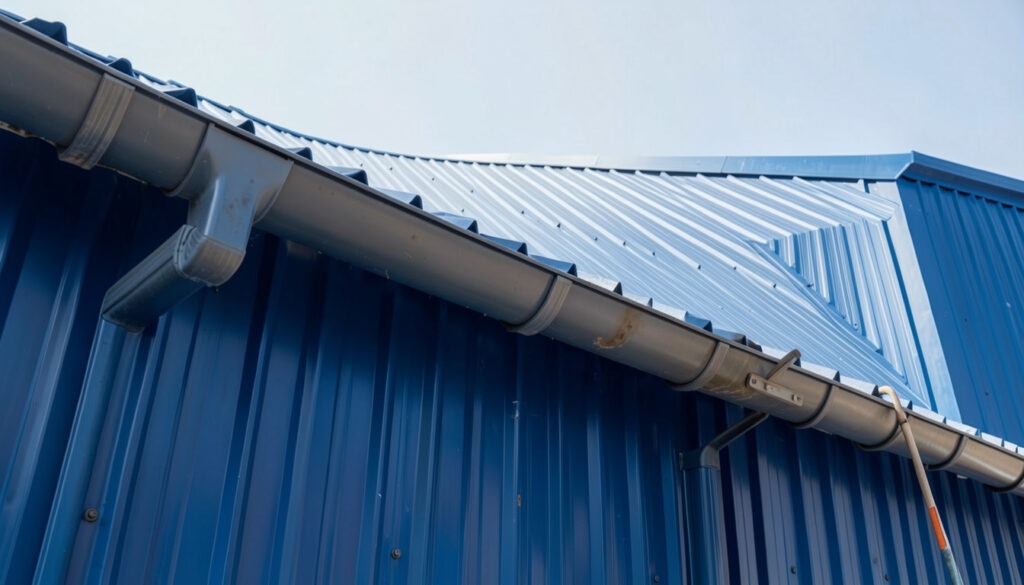
The gutter system interacts with other components such as:
- Roof panels
- Eave trim
- Fascia
- Flashing
- Sealants
- Fasteners
- Downspouts
Each component contributes to the overall performance of the roof edge.
Sealants may be used at specific joints to help prevent water from entering between connected components.
Fasteners secure the components mechanically.
Eave trim provides the appropriate transition between the roof and edge conditions.
The gutter then collects and directs the resulting runoff.
This is why a leak or drainage problem at the eave should be evaluated as a complete assembly rather than focusing on a single component.
Gutter and Downspout Replacement for Existing Butler Buildings
Older Butler buildings may eventually require replacement drainage components even when the main structural system remains serviceable.
Gutters can deteriorate from:
- Long-term moisture exposure
- Corrosion
- Physical impact
- Repeated thermal movement
- Improper maintenance
- Debris accumulation
Downspouts can similarly become damaged or disconnected.
When replacing components, the new gutter and downspout should be compatible with the building’s existing eave configuration and drainage requirements.
For older buildings, accurate measurements are particularly useful.
How to Identify the Right Replacement Gutter Components
Before ordering replacement components, gather information about the existing system.
Useful details include:
- Butler building model or system
- Roof type
- Roof panel profile
- Building width and length
- Gutter dimensions
- Downspout dimensions
- Existing eave configuration
- Gutter attachment method
- Number and location of downspouts
- Photographs of the existing installation
If the original construction documentation is available, it can provide additional information about the original roof and drainage configuration.
For replacement projects, measurements of the existing gutter and downspout system can help ensure compatibility.
Gutters for Large Commercial and Industrial Buildings
Large buildings often have complex roof drainage requirements.
A warehouse, manufacturing plant, aircraft hangar, or distribution center can have a substantial roof area that generates significant runoff during storms.
These buildings may require careful consideration of:
- Gutter capacity
- Downspout spacing
- Roof drainage patterns
- Overflow protection
- Discharge locations
- Site grading
- Stormwater management
The drainage system should be designed around the building and local rainfall conditions rather than simply installing the largest available gutter.
Things to Know
- Gutters control roof runoff; they do not replace proper site drainage.
- Downspouts must have sufficient capacity to handle the water delivered by the gutter.
- Roof area and rainfall intensity influence drainage requirements.
- Clogged gutters can overflow and cause water to reach walls and foundations.
- Standing water inside a gutter is a warning sign that the system may have a slope or blockage problem.
- Inspect gutter connections and brackets for looseness and corrosion.
- Discharge water away from the foundation whenever site conditions and drainage design require it.
- Gutter compatibility matters when replacing components on an existing Butler building.
- Roof replacement is a good time to inspect the eave drainage system.
- Gutters, downspouts, eave trim, fasteners, and sealants should be evaluated as a complete roof-edge assembly.
Frequently Asked Questions
Q: What are gutters used for on a metal building?
Gutters collect rainwater from the roof and direct it toward downspouts so that runoff can be controlled and discharged away from the building.
This helps reduce uncontrolled water around walls, entrances, foundations, and surrounding areas.
Q: Do metal buildings need gutters?
Not every metal building requires gutters, but they can be highly beneficial where controlled roof drainage is important.
The need depends on the roof design, building use, site conditions, rainfall, and drainage requirements.
Q: What do downspouts do?
Downspouts carry water collected by the gutter vertically downward and direct it toward an appropriate discharge location.
They are an essential part of the roof drainage system.
Q: How often should Butler building gutters be cleaned?
The appropriate cleaning frequency depends on the building’s environment and the amount of debris it receives.
Buildings surrounded by trees may require more frequent cleaning, while open industrial sites may require less frequent maintenance.
Q: Why are my metal building gutters overflowing?
Overflow can result from clogged gutters, insufficient gutter capacity, blocked downspouts, poor gutter slope, or excessive rainfall.
The entire drainage system should be inspected to determine the cause.
Q: Can clogged gutters cause metal building leaks?
Yes. Clogged gutters can cause water to overflow into areas that were not designed to handle uncontrolled runoff.
Depending on the building configuration, this can contribute to moisture around the eave, walls, doors, and other vulnerable areas.
Q: Should downspouts discharge next to the foundation?
Generally, concentrated roof runoff should be directed away from vulnerable foundation areas when site conditions require it.
The appropriate discharge method depends on grading, drainage design, local requirements, and site conditions.
Q: Can gutters be replaced without replacing the metal roof?
In many situations, yes.
If the existing roof panels and supporting components remain serviceable, the gutter system may be repaired or replaced separately. Compatibility with the existing eave configuration should be verified first.
Q: How do I know which gutter fits my Butler building?
Identify the existing roof system, eave configuration, gutter dimensions, downspout dimensions, and attachment method.
Measurements and photographs can help determine the appropriate replacement components.
Q: Should gutters be replaced during a Butler roof replacement?
They should at least be inspected during the roof replacement process.
If the existing gutters are deteriorated, damaged, or incompatible with the new roof-edge configuration, replacement may be appropriate.
The Bottom Line on Butler Building Gutters and Downspouts
Gutters and downspouts are an important part of a metal building’s drainage system. They provide a controlled path for roof runoff, helping protect walls, entrances, foundations, walkways, landscaping, and surrounding areas from uncontrolled water.
For Butler buildings, the drainage system needs to work with the specific roof and eave configuration. Proper gutter capacity, downspout placement, attachment, maintenance, and discharge location all contribute to effective performance.
When maintaining or replacing an existing Butler building roof, don’t overlook the roof-edge drainage system. A serviceable roof can still experience water-management problems if the gutters and downspouts are clogged, damaged, undersized, or improperly configured.
Need replacement gutters or downspouts for your Butler metal building? Request a Quote and provide your building, roof system, and existing drainage information so the appropriate components can be identified.