

For commercial and industrial buildings that need strong thermal performance without the pronounced ribs of a traditional fluted metal wall panel, the Butler Thermawall Fineline IMP provides a middle ground between architectural appearance and insulated wall performance.
Thermawall Fineline is an insulated metal panel system consisting of exterior and interior steel faces with a factory-installed foam insulation core. Its defining feature is a series of shallow, precision-formed grooves across the exterior face. These subtle lines create visual texture and shadowing while maintaining a relatively clean, refined appearance.
The system is designed to work with Butler structural framing and is suited to commercial, industrial, and architectural applications where both appearance and energy performance are important.
Key Takeaways
- Thermawall Fineline IMP combines an insulated wall assembly with a subtle architectural exterior profile.
- The exterior uses shallow grooves rather than the deep ribs found on fluted panels.
- The panels use a factory-installed poured-in-place foam insulation core.
- Available panel thicknesses are 2, 2½, 3, and 4 inches.
- The Thermawall system provides published R-values ranging from approximately R-14 to R-32, depending on panel thickness.
- Fineline panels are 42 inches wide.
- Concealed fasteners create a cleaner exterior appearance.
- Tongue-and-groove joints help create a continuous weather-resistant wall assembly.
- A thermal-break joint design improves continuity across panel connections.
- Factory-applied joint sealant contributes to the wall’s weather barrier.
- Butler-Cote finishes provide architectural color and long-term coating performance.
- The interior face is a virtually flat finished metal surface.
- Thermawall assemblies can achieve 1- to 2-hour fire-resistance ratings depending on configuration.
- The system is identified as FM Global approved.
- Fineline panels can be useful for both new construction and compatible replacement projects.
What Is a Thermawall Fineline IMP?
A Thermawall Fineline IMP is a factory-insulated sandwich panel used as an exterior wall system.
The basic construction consists of:
Exterior steel face → foam insulation core → interior steel face
Unlike conventional metal wall systems where insulation and exterior cladding are installed as separate components, an insulated metal panel combines these functions into one engineered panel.
The Fineline version adds a subtle architectural profile to the exterior steel face.
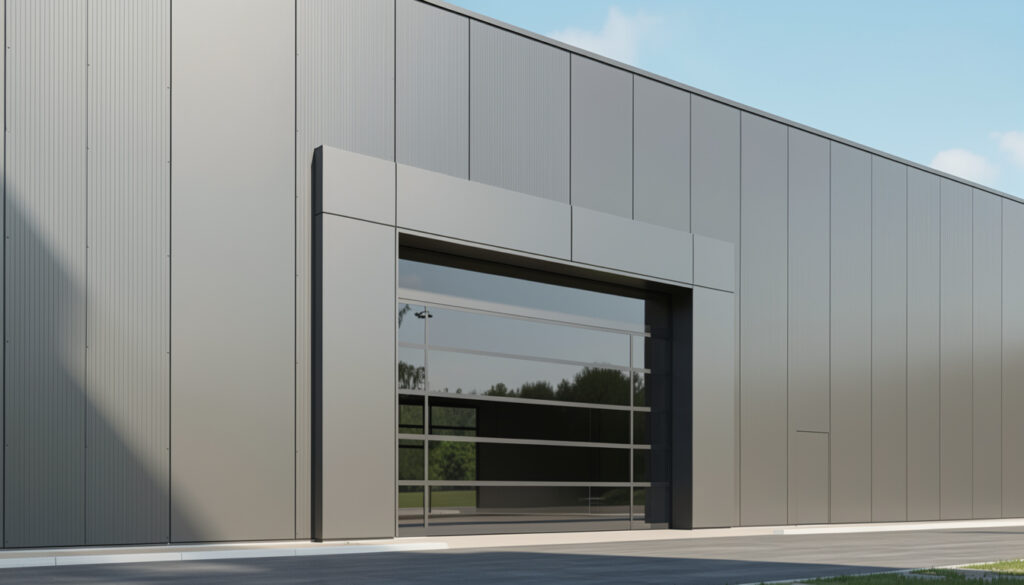
Butler describes the profile as lightly grooved, creating a plank-like appearance with shallow shadow lines across the building facade.
This makes it particularly useful when a project needs more visual texture than a flat panel but does not require the deeper corrugations of a fluted panel.
The Fineline Profile
The defining characteristic of the system is its shallow-groove exterior profile.
The grooves create soft vertical shadow lines that visually break up large wall elevations without creating the heavy industrial appearance associated with deeper ribbed panels.
This can be useful for:
- Commercial buildings
- Office facilities
- Retail buildings
- Manufacturing facilities
- Industrial campuses
- Architectural metal buildings
- High-profile commercial developments
The profile also helps disguise optical distortion and makes the wall appear more visually consistent across large elevations.
Fineline vs. Fluted vs. Flat Thermawall Panels
The Thermawall family gives designers several different exterior appearances.
Thermawall Fluted uses deeper corrugations for a more pronounced industrial appearance.
Thermawall Fineline uses shallow grooves for subtle texture.
Thermawall Flat provides a smoother, more monolithic exterior.
| Feature | Thermawall Fluted | Thermawall Fineline | Thermawall Flat |
|---|---|---|---|
| Exterior profile | Deep ribs | Shallow grooves | Smooth/flat |
| Visual character | Industrial | Architectural/subtle | Minimalist |
| Thermal insulation | Integrated | Integrated | Integrated |
| Concealed fasteners | Yes | Yes | Yes |
| Panel width | 42 in. | 42 in. | Varies by configuration |
| Interior finish | Metal | Metal | Metal |
| Best suited for | Industrial/commercial | Architectural/commercial | High-end architectural |
The choice is primarily a combination of appearance, performance requirements, and compatibility with the building design.
Integrated Thermal Performance
One of the primary reasons to choose an IMP is the integration of insulation into the wall panel.
Thermawall uses a factory-installed poured-in-place foam core. The available panel thicknesses are 2, 2½, 3, and 4 inches, with published R-values ranging from approximately R-14 to R-32.
| Panel Thickness | Approximate Published R-Value |
|---|---|
| 2 in. | R-14 |
| 2½ in. | R-20 |
| 3 in. | R-25 |
| 4 in. | R-32 |
The exact thermal performance of a completed building depends on more than the panel’s nominal R-value. Framing, joints, penetrations, openings, air leakage, and installation quality all affect whole-wall performance.
For projects with specific energy-code requirements, the complete wall assembly should be evaluated.
Thermal Break Joint Design
Panel joints can become weak points in an insulated wall system if they are not properly designed.
Thermawall incorporates a thermal-break joint design intended to improve thermal continuity between adjacent panels.
This is important because a wall does not perform based solely on the insulation in the center of each panel.
The connections between panels also affect:
- Heat transfer
- Air leakage
- Moisture resistance
- Weather protection
- Overall envelope performance
The joint design therefore plays an important role in the system’s overall performance.
Tongue-and-Groove Panel Joints
Thermawall Fineline panels use a concealed fastening system combined with a tongue-and-groove joint configuration.
The panels nest together to create a continuous wall surface while keeping the fastening components out of sight.
This approach provides both functional and aesthetic benefits.
From an architectural perspective, the concealed fastening helps maintain the clean Fineline appearance.
From an enclosure perspective, the interlocking joint helps create a continuous weather-resistant wall assembly.
Factory-Applied Joint Sealant
Thermawall’s joint system incorporates factory-applied sealant.
The sealant works with the panel joint to contribute to the overall weather barrier.
Factory application can also provide greater consistency than relying entirely on field-applied sealant.
However, installation still needs to follow the manufacturer’s requirements. Incorrect panel alignment, damaged joints, or improper field detailing can compromise the intended performance.
42-Inch Panel Width
The Thermawall Fineline panel is 42 inches wide.
The relatively wide panel format can help reduce the number of vertical joints across a building facade.
This is particularly useful for architectural projects where the designer wants a relatively continuous appearance.
The panel width also needs to be considered when laying out:
- Doors
- Windows
- Building corners
- Wall transitions
- Panel terminations
- Expansion conditions
Careful panel layout before installation can minimize unnecessary field modifications.
Concealed Fasteners
Visible fasteners can interrupt the appearance of an architectural metal wall.
Fineline uses concealed fastening so that screws and clips are hidden within the panel system.
This produces a cleaner exterior facade and allows the shallow-groove profile to remain the dominant visual feature.
Concealed fastening can also reduce the number of exposed components directly subjected to weather.
Butler-Cote Finish
Thermawall Fineline panels are available with the Butler-Cote finish system.
Butler describes Butler-Cote as a high-performance fluoropolymer coating system using Kynar 500 or Hylar 5000 coating technology. The finish is designed for resistance to fading, chalking, and long-term environmental exposure.
The available color options allow the panel to be coordinated with other Butler wall, roof, and trim components.
Cool Color options can also support projects with specific energy-performance goals.
Interior Metal Face
Thermawall is designed to provide a finished surface on the interior side as well.
The interior metal face is described as a virtually flat polyester-white finish. Butler also identifies the interior face as USDA approved.
This means the wall system can potentially reduce the need for an additional interior wall finish in applications where the finished metal surface is acceptable.
For some facilities, that can simplify the interior wall assembly.
Architectural Applications
Fineline is particularly useful when the building needs more visual refinement than a conventional industrial wall panel.
Its shallow grooves provide texture without dominating the facade.
Potential applications include:
- Corporate facilities
- Retail centers
- Commercial offices
- Manufacturing buildings
- Distribution centers
- Institutional facilities
- Architectural additions
- Mixed-use commercial structures
The panel allows the building to retain the practical characteristics of a metal building while presenting a more refined exterior.
Commercial Buildings
Commercial buildings frequently need to balance cost, performance, and appearance.
A traditional exposed-fastener wall panel may provide adequate weather protection but may not deliver the architectural appearance required by the project.
Fineline provides a concealed-fastener wall with an integrated insulation core and a subtle exterior profile.
This combination can be useful when the building needs to look more architectural without moving entirely away from metal building construction.
Industrial Buildings
Industrial facilities can also benefit from Fineline.
The panel provides an insulated wall system capable of supporting the thermal requirements of commercial and industrial environments.
The shallow-groove exterior can also provide a cleaner appearance for facilities that need to present a more polished image to customers, employees, or visitors.
For heavy-duty industrial applications, the selected panel thickness, framing, finish, and wall assembly should be evaluated against the specific environmental conditions.
Cold Storage and Temperature-Controlled Facilities
Insulated metal panels are frequently considered for facilities where maintaining stable interior temperatures is important.
The integrated foam core and continuous panel construction can provide a more controlled wall assembly than a wall made from separately installed cladding and insulation components.
However, cold-storage applications require careful attention to:
- Panel joints
- Vapor control
- Air sealing
- Door openings
- Refrigeration penetrations
- Floor-to-wall transitions
- Ceiling connections
The panel’s nominal R-value alone does not determine the performance of the complete temperature-controlled enclosure.
Data Centers and High-Performance Facilities
Facilities with significant cooling requirements can place substantial demands on their building envelope.
An insulated panel system can contribute to controlling heat transfer through the exterior wall.
Thermawall products are marketed for commercial and industrial applications, including high-performance facilities.
For data centers and other mission-critical facilities, however, the wall assembly should be evaluated as part of the complete mechanical and building-envelope design.
Installation Advantages
Thermawall is designed to simplify installation compared with multi-layer field-assembled wall systems.
According to the product information, installation requires a clip and two fasteners at each structural connection, with installation performed from the exterior side of the building envelope.
This means crews do not need to work from inside the building to fasten each panel.
The approach can reduce installation complexity and help accelerate enclosure of the building.
Actual installation time depends on building size, panel lengths, openings, framing layout, weather, and crew experience.
Exterior-Only Installation
One practical advantage of the Thermawall system is that installation is performed from outside the building envelope.
This can reduce interference with interior construction activities.
It can also allow interior trades to begin work sooner because crews do not need to repeatedly access the interior side of the wall to install exterior panels.
For large commercial projects, this separation of exterior and interior work can improve overall jobsite coordination.
Panel Lengths and Replacement Projects
The current Butler Metal Building Parts product information states that Thermawall panels can be cut to lengths of up to 40 feet and are available for both new construction and replacement projects.
Longer panels can reduce the number of horizontal joints on certain wall elevations.
For replacement projects, however, the existing building dimensions should be carefully documented.
Before ordering replacement Fineline panels, verify:
- Panel thickness
- Panel width
- Panel length
- Groove/profile configuration
- Joint configuration
- Existing framing
- Fastener locations
- Openings
- Corner details
- Trim
- Existing finish
Replacing Damaged Fineline Panels
Damage to one portion of an insulated metal wall does not necessarily mean the entire wall must be replaced.
Depending on the damage and existing configuration, individual panels or sections may be replaced.
Common causes of damage include:
- Vehicle impact
- Equipment contact
- Storm damage
- Improper maintenance
- Corrosion
- Water intrusion
- Construction activity
Before replacing a panel, the surrounding wall assembly should be inspected.
A damaged exterior panel may also indicate damage to the insulation core, panel joint, framing, or sealant.
Fineline IMP and Weather Protection
An exterior wall needs to control more than heat transfer.
It also needs to resist:
- Wind-driven rain
- Air infiltration
- Moisture
- Temperature changes
- UV exposure
- Physical impact
The Thermawall system combines the exterior steel face, insulated core, interlocking joint, thermal-break design, and factory-applied joint sealant to create an integrated wall enclosure.
Proper installation remains critical.
Even a high-performance panel can develop problems if joints, penetrations, openings, or transitions are incorrectly installed.
Fire-Resistance Ratings
Fire performance can be an important requirement for commercial and industrial buildings.
The Thermawall system can achieve one- or two-hour fire-resistance ratings depending on the specific configuration and tested assembly.
The rating should never be assumed simply because a project uses a Thermawall panel.
The exact assembly must be verified against the applicable listing and project requirements.
FM Global Approval
The Thermawall system is identified as FM Global approved in the current product information.
For certain commercial and industrial facilities, FM approval can be an important consideration when evaluating property protection and risk-management requirements.
The specific approval should be confirmed for the exact panel configuration and intended application.
Maintenance of Thermawall Fineline Panels
Fineline panels generally require routine inspection rather than intensive maintenance.
Building owners should periodically inspect:
- Exterior panel surfaces
- Panel joints
- Sealants
- Corners
- Door and window openings
- Trim
- Fasteners and connections
- Areas vulnerable to impact
Dirt and debris should be removed using cleaning methods compatible with the panel’s coating.
Harsh chemicals and abrasive cleaning methods should be avoided unless specifically approved for the selected finish.
Fineline IMP vs. Traditional Metal Wall Panels
The biggest difference between Fineline and a conventional single-skin metal wall system is that Fineline integrates insulation into the panel itself.
| Factor | Thermawall Fineline IMP | Conventional Metal Wall Panel |
|---|---|---|
| Insulation | Integrated | Usually separate |
| Exterior profile | Shallow grooves | Varies |
| Fasteners | Concealed | Often exposed |
| Interior face | Finished metal | Separate assembly may be required |
| Thermal continuity | Integrated panel system | Depends on insulation assembly |
| Installation | Panelized | Multiple components |
| Architectural appearance | Refined | Varies |
| Weather barrier | Integrated joint system | Depends on complete wall assembly |
The right choice depends on project requirements, budget, thermal goals, and desired appearance.
Fineline IMP vs. Flat IMP
Fineline and Flat Thermawall panels share many of the same system characteristics, including integrated insulation, concealed fastening, and engineered panel joints.
The major difference is the exterior appearance.
Fineline uses shallow grooves to create subtle shadow lines.
Flat provides a smoother, more continuous exterior appearance.
For large architectural elevations, the choice can significantly affect how the building looks in changing sunlight.
Fineline IMP vs. Fluted IMP
The Fluted and Fineline systems both use vertical exterior profiles, but the visual effect is different.
Fluted panels use deeper corrugations that create stronger shadows and a more pronounced industrial appearance.
Fineline uses shallower grooves that provide more restrained visual texture.
A project that wants an industrial aesthetic may favor Fluted.
A project that wants a refined architectural appearance may favor Fineline.
Common Problems With Thermawall Fineline IMP
Damaged Exterior Face
Vehicle impact, equipment contact, and construction activity can dent or damage the exterior steel face.
Damaged Panel Joints
Impact or improper installation can affect the tongue-and-groove connection between panels.
Sealant Failure
Deteriorated or improperly installed sealant can compromise the weather barrier.
Water Intrusion
Improper detailing around openings, penetrations, or joints can allow moisture into the wall assembly.
Finish Damage
Scratches, abrasion, or chemical exposure can damage the Butler-Cote finish.
Incorrect Replacement Panel
A replacement panel with the wrong thickness, width, profile, or joint configuration may not properly integrate with the existing system.
Thermal Performance Problems
Poor installation around joints, penetrations, or transitions can reduce the effective performance of the wall assembly.
Damaged Interior Face
The interior steel face can also be damaged by forklifts, equipment, or maintenance activities.
Corrosion
Damage to the protective coating combined with persistent moisture exposure can contribute to corrosion.
Signs Your Fineline IMP Needs Inspection
Inspect the wall system if you notice:
- Dents
- Damaged grooves
- Scratched coating
- Open panel joints
- Loose components
- Failed sealant
- Water staining
- Interior moisture
- Corrosion
- Damaged trim
- Gaps around openings
- Unusual changes in interior temperature
Some cosmetic damage may not affect the wall’s performance.
Damage involving panel joints, penetrations, or the insulated core should receive more immediate attention.
Things to Know
- Thermawall Fineline is an insulated metal panel system designed for commercial, industrial, and architectural applications.
- The exterior uses shallow grooves to create subtle vertical shadow lines.
- Fineline panels are 42 inches wide.
- Available Thermawall thicknesses include 2, 2½, 3, and 4 inches.
- Published R-values range from approximately R-14 to R-32 depending on panel thickness.
- The insulation core is factory installed.
- The system uses concealed fastening and tongue-and-groove panel joints.
- Factory-applied joint sealant contributes to the weather barrier.
- A thermal-break joint design helps improve thermal continuity.
- The interior face is a virtually flat finished metal surface.
- Thermawall assemblies can achieve 1- or 2-hour fire-resistance ratings depending on configuration.
- The system is identified as FM Global approved.
- Butler-Cote finishes provide multiple architectural finish options.
- Replacement panels should be matched carefully to the existing building system.
Frequently Asked Questions
Q: What is a Thermawall Fineline IMP?
A Thermawall Fineline IMP is a factory-insulated metal wall panel with a shallow-groove exterior profile and concealed fastening system.
It combines exterior cladding, insulation, and an interior metal face into one wall component.
Q: What does Fineline mean?
Fineline refers to the panel’s shallow exterior grooves.
These grooves create subtle vertical shadow lines rather than the deeper corrugations associated with a fluted panel.
Q: How thick are Thermawall Fineline panels?
Thermawall panels are available in 2-, 2½-, 3-, and 4-inch thicknesses.
Q: What R-value does Thermawall Fineline provide?
The Thermawall system provides published R-values ranging from approximately R-14 to R-32 depending on panel thickness.
The actual whole-wall R-value depends on the complete assembly.
Q: Are the fasteners visible on Fineline panels?
The system uses concealed fastening.
This helps maintain the clean architectural appearance of the Fineline profile.
Q: How wide are Fineline panels?
Fineline panels are 42 inches wide.
Q: Can Fineline panels be used for commercial buildings?
Yes.
The system is designed for commercial, industrial, and architectural metal building applications.
Q: Can Thermawall Fineline be used for replacement panels?
Yes, provided the replacement panel is compatible with the existing wall system.
Existing panel dimensions, profile, thickness, joint configuration, framing, and trim should be verified before ordering.
Q: How does Fineline compare with Thermawall Fluted?
Fineline has shallow grooves, while Fluted uses deeper exterior corrugations.
Fineline generally creates a more subtle architectural appearance, while Fluted produces stronger shadow lines and a more pronounced industrial profile.
Q: How does Fineline compare with Thermawall Flat?
Fineline has shallow vertical grooves, while Flat has a smoother exterior profile.
Both are part of the Thermawall insulated panel family.
Q: Does Thermawall Fineline have a finished interior surface?
Yes.
The interior face is a virtually flat polyester-white metal surface.
Q: Can Thermawall Fineline achieve a fire rating?
Depending on the specific assembly, Thermawall systems can achieve one- or two-hour fire-resistance ratings.
The applicable tested configuration should be verified for the project.
Q: Is Thermawall Fineline FM Global approved?
The current product information identifies the Thermawall system as FM Global approved.
The Bottom Line on Thermawall Fineline IMP
Thermawall Fineline IMP provides a practical balance between architectural appearance, thermal performance, and installation efficiency.
Its subtle grooved exterior, concealed fasteners, integrated foam insulation, thermal-break joints, factory-applied sealant, and finished interior face make it an attractive option for commercial and industrial buildings that need more architectural refinement than a conventional ribbed metal wall.
With available thicknesses from 2 to 4 inches and published R-values from approximately R-14 to R-32, the system can be configured around different thermal performance requirements.
For replacement projects, the most important consideration is matching the existing building system. Panel thickness, width, profile, joint configuration, framing, openings, and trim should all be verified before ordering.
If you are replacing damaged Fineline panels or planning a new insulated metal wall system, Request a Quote and provide your building measurements and photographs. This information can help determine the appropriate Thermawall Fineline configuration for your project.