

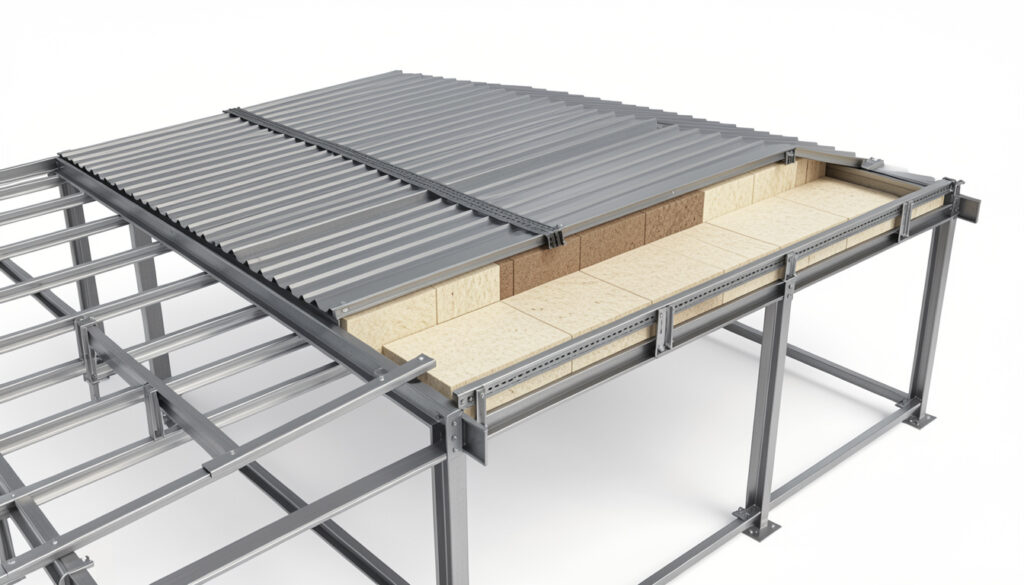
Butler OptiLiner is a banded liner insulation system designed to improve the thermal performance of metal building roof and wall assemblies. The system uses a fabric support and bi-directional banding arrangement that allows insulation cavities to be filled more completely while minimizing compression.
For Butler metal buildings, OptiLiner can be used in both new construction and retrofit applications. It is particularly relevant when a project requires improved insulation coverage, better thermal performance, and a more consistent installation across large roof or wall areas.
Butler Metal Building Parts identifies OptiLiner as a system designed for light-density fiberglass insulation and states that its installation method can accommodate two layers of insulation with minimal compression.
Key Takeaways
- OptiLiner is a banded liner system designed for metal building roof and wall applications.
- The system uses bi-directional banding and fabric support to hold insulation in place.
- It allows roof cavities to be filled with two layers of insulation with minimal compression.
- Reduced compression can help maintain the intended thickness and thermal performance of the insulation.
- OptiLiner can be used for both new construction and retrofit projects.
- The system is designed to work with light-density fiberglass insulation.
- Proper installation is important to maintain continuous insulation coverage.
- OptiLiner can be integrated with Butler roof systems such as MR-24 and VSR II.
- The system can be useful when upgrading the insulation performance of an existing metal building.
- Insulation, vapor control, air sealing, and the exterior roof or wall panel should be evaluated as one complete assembly.
What Is Butler OptiLiner?
OptiLiner is a banded insulation support system for metal building construction.
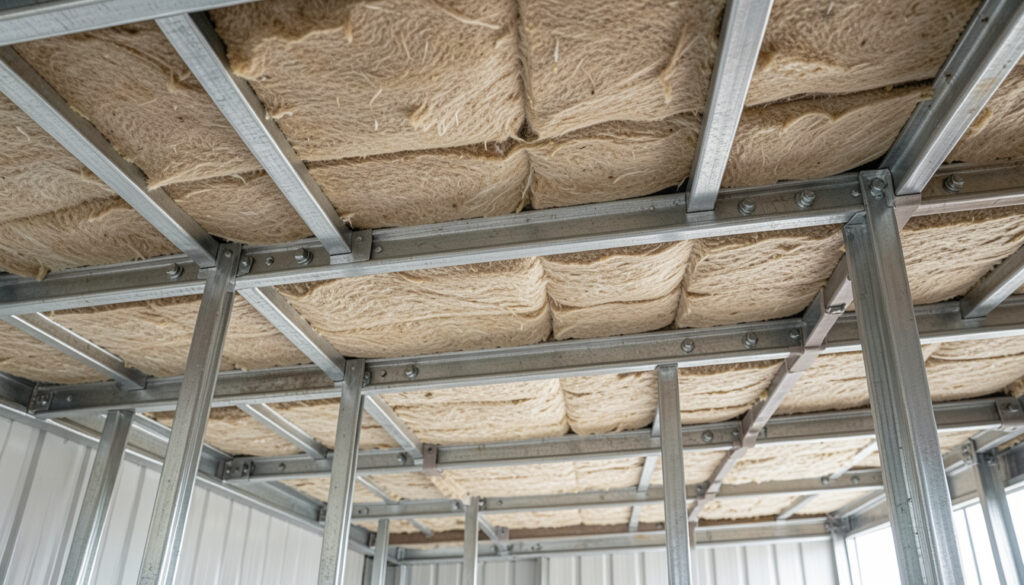
Instead of allowing insulation to simply hang within the roof or wall cavity, the system uses strategically positioned bands and fabric support to hold the insulation in place.
The goal is to create a more consistent insulation layer with fewer areas of compression or gaps.
Butler describes the OptiLiner Banded Liner System as being designed for maximum thermal performance of light-density fiberglass insulation in metal building roof and wall applications.
How the OptiLiner System Works
The system uses bi-directional banding to support insulation within the building cavity.
The bands create a framework that holds the insulation in position.
This is particularly useful in roof assemblies where insulation needs to span between structural members without becoming excessively compressed.
The system can support two layers of insulation, allowing the cavity to be filled more completely while maintaining the intended insulation thickness.
The result is a more consistent insulation installation than a system where insulation is allowed to sag or become compressed between framing members.
Why Insulation Compression Matters
Fiberglass insulation is designed to perform at a particular thickness.
When insulation is compressed, its effective thermal performance can be affected.
For example, if insulation designed to occupy a deep cavity is compressed around structural components or attachment points, the resulting assembly may contain areas with less insulation thickness than intended.
This can create variations in thermal performance across the building envelope.
OptiLiner is designed to minimize this type of compression by providing structured support for the insulation.
Two-Layer Insulation
One of the notable characteristics of the OptiLiner system is its ability to support two layers of insulation.
Butler’s product information specifically describes the system as allowing roof cavities to be completely filled with two layers of insulation with minimal compression.
This can be useful when a project requires higher insulation levels without significantly changing the basic building structure.
The actual insulation thickness and R-value should be determined according to the building’s design and applicable energy requirements.
OptiLiner and R-Value
The thermal performance of an insulation assembly is commonly discussed in terms of R-value.
Higher R-values generally indicate greater resistance to heat flow.
However, the nominal R-value of the insulation material does not necessarily represent the effective R-value of the entire installed assembly.
Compression, gaps, thermal bridges, framing, fasteners, and air movement can all affect actual performance.
OptiLiner is intended to help maintain more consistent insulation coverage and reduce compression within the assembly.
Reducing Thermal Gaps
Thermal gaps occur when portions of the building envelope contain significantly less insulation than surrounding areas.
These gaps can occur around:
- Structural framing
- Purlins
- Girts
- Fasteners
- Openings
- Mechanical penetrations
- Poorly installed insulation
By supporting the insulation more consistently, a banded system can help reduce areas where insulation becomes displaced.
This is especially important across large metal building roofs where small installation inconsistencies can be repeated across a large area.
OptiLiner for Metal Building Roofs
Roof applications are one of the primary uses for OptiLiner.
Metal roofs can experience substantial temperature changes throughout the day and across different seasons.
A properly insulated roof assembly can help reduce heat transfer between the interior and exterior.
OptiLiner provides a structured method for supporting insulation within the roof cavity.
This can help maintain insulation thickness across the roof rather than allowing sections to sag or become compressed.
OptiLiner for Metal Building Walls
OptiLiner can also be used in metal building wall applications.
Wall insulation can experience many of the same issues as roof insulation, including:
- Compression
- Sagging
- Gaps
- Displacement
- Poor coverage
A properly supported insulation system can provide more consistent coverage between wall framing members.
This can be particularly useful for large warehouses and industrial buildings with extensive wall areas.
OptiLiner and MR-24 Roof Systems
OptiLiner can be integrated with Butler’s MR-24 Standing Seam Roof System.
Butler Metal Building Parts specifically identifies OptiLiner as compatible with MR-24 and VSR II roof systems within its roof insulation offering.
The combination allows the roof system and insulation assembly to be considered together rather than as completely separate components.
This is important when designing a high-performance metal building envelope.
OptiLiner and VSR II Roof Systems
OptiLiner can also be used with the VSR II Roof System.
The insulation system is designed to work within the roof cavity while the exterior standing-seam roof provides the primary weather-resistant surface.
The complete assembly should be designed around the structural, thermal, and moisture-control requirements of the building.
OptiLiner for New Construction
New construction provides an ideal opportunity to incorporate OptiLiner from the beginning.
The structural framing, insulation, vapor control, roof panels, and interior liner can all be coordinated during the design phase.
This allows the installation team to establish the banding pattern before the roof or wall assembly is completed.
Proper planning can reduce field adjustments and help maintain consistent insulation coverage.
OptiLiner for Retrofit Projects
OptiLiner can also be considered for existing metal building upgrades.
A retrofit project may involve:
- Increasing insulation levels
- Improving thermal performance
- Addressing condensation
- Replacing damaged insulation
- Upgrading a roof assembly
- Improving building-envelope efficiency
Before installing new insulation, the existing roof or wall assembly should be inspected.
Existing moisture problems should be corrected before new insulation is installed.
OptiLiner and Condensation Control
Condensation occurs when moisture-laden air encounters a surface that is sufficiently cold for water vapor to condense.
Improving insulation coverage can help keep interior surfaces warmer and reduce temperature differences within the building assembly.
However, insulation alone does not eliminate condensation risk.
Condensation control also depends on:
- Interior humidity
- Air leakage
- Vapor-control layers
- Exterior temperature
- Roof configuration
- Building use
OptiLiner should therefore be considered as part of a complete moisture-control strategy.
OptiLiner and Vapor Retarders
A vapor retarder controls water-vapor movement through the building assembly.
OptiLiner provides insulation support.
These are different functions, but they work together.
If the vapor-control layer is damaged or improperly sealed, adding more insulation may not solve a moisture problem.
For more information, see our article on Vapor Retarders for Butler Metal Buildings.
OptiLiner and Air Leakage
Air movement can transport moisture through a building assembly.
Even a well-insulated roof can experience moisture problems if warm, humid air is able to move through gaps.
This is why the complete assembly should address both insulation and air control.
Seams, penetrations, transitions, and openings should be properly detailed.
Why Continuous Insulation Coverage Matters
A metal building roof can cover tens of thousands of square feet.
If insulation coverage is inconsistent across that area, the effect can be significant.
Small gaps may seem insignificant individually.
But when repeated throughout a large building, those gaps can contribute to:
- Increased heat transfer
- Uneven interior temperatures
- Higher HVAC loads
- Condensation risk
- Reduced overall thermal performance
Maintaining consistent coverage is therefore an important part of insulation installation.
OptiLiner and Thermal Bridging
Steel is an excellent conductor of heat compared with insulation materials.
Structural steel members can therefore create thermal bridges through an insulated assembly.
OptiLiner does not eliminate all thermal bridging.
However, maintaining more consistent insulation coverage around the building’s structural system can help reduce unnecessary gaps in the insulation layer.
The complete roof or wall design should still account for the thermal performance of the structural system.
Installation Considerations
OptiLiner installation should follow the applicable manufacturer’s instructions.
The banding needs to be positioned correctly to support the insulation and maintain the intended assembly configuration.
Installation should account for:
- Structural framing
- Insulation thickness
- Band spacing
- Vapor-control materials
- Roof penetrations
- Wall openings
- Interior liners
Improper banding can result in insulation movement or inconsistent coverage.
Factory and Field Coordination
Metal building insulation systems often require coordination between several trades.
The insulation installer may need to work around:
- Electrical systems
- HVAC ducts
- Plumbing
- Roof penetrations
- Structural components
- Lighting
- Interior liner systems
Early coordination can reduce the number of field modifications and help maintain the continuity of the insulation system.
OptiLiner and OSHA Roof Safety
Butler Metal Building Parts states that when installed in strict compliance with the Bi-Directional Banding Roof Installation Instructions, the OptiLiner system meets the requirements of OSHA Standard 29 CFR 1926.754(e)(3)(i) regarding covers for roof and floor openings.
This is an important installation-specific claim.
It should not be interpreted as meaning that every installation automatically satisfies OSHA requirements.
The system must be installed according to the applicable instructions and jobsite safety requirements.
Inspecting Existing Insulation
Before upgrading an existing metal building with OptiLiner, inspect the current insulation.
Look for:
- Compression
- Sagging
- Tears
- Wet areas
- Mold-supporting conditions
- Discoloration
- Missing insulation
- Pest damage
- Corrosion around framing
If moisture is present, the source should be identified before installing new insulation.
Replacing Wet Insulation
Wet insulation should not simply be covered with a new insulation layer.
The source of the moisture should first be identified.
Possible causes include:
- Roof leaks
- Wall leaks
- Condensation
- Failed flashing
- Open penetrations
- Damaged vapor-control materials
- Air leakage
Correcting the underlying issue is necessary for a successful retrofit.
Common Problems With OptiLiner Installations
Incorrect Band Spacing
Improper band placement can reduce the support provided to the insulation.
Insulation Compression
Excessive compression can reduce the installed thickness and affect thermal performance.
Insulation Gaps
Missing or displaced insulation can create thermal weak points.
Damaged Vapor Retarder
Tears or open seams can compromise moisture control.
Improper Overlaps
Incorrect material overlaps can create discontinuities in the insulation or vapor-control layer.
Poor Penetration Detailing
Electrical, mechanical, and structural penetrations can interrupt the insulation system.
Sagging Insulation
Insufficient support can cause insulation to move away from its intended position.
Wet Insulation
Moisture can reduce insulation performance and contribute to corrosion.
Incorrect Installation
The system needs to be installed according to the applicable manufacturer’s instructions.
Unaddressed Roof Leaks
Installing new insulation without repairing an existing roof leak can leave the underlying moisture problem unresolved.
Things to Know
- OptiLiner is a banded liner system for metal building roof and wall insulation.
- The system is designed for light-density fiberglass insulation.
- Butler describes OptiLiner as allowing two layers of insulation to fill roof cavities with minimal compression.
- Bi-directional banding provides structured support for the insulation.
- OptiLiner can be used in both new construction and retrofit applications.
- The system can be integrated with MR-24 and VSR II roof systems.
- Proper installation is essential for maintaining insulation coverage and system performance.
- Vapor retarders and air-control layers still need to be properly detailed.
- Wet or damaged existing insulation should be investigated before installing a new insulation system.
- The complete roof or wall assembly should be evaluated rather than focusing only on the insulation.
Frequently Asked Questions
Q: What is Butler OptiLiner?
OptiLiner is a banded liner insulation support system designed for metal building roof and wall applications.
It uses bi-directional banding and fabric support to hold light-density fiberglass insulation in place.
Q: What type of insulation does OptiLiner use?
Butler describes OptiLiner as a system for light-density fiberglass insulation.
The specific insulation product and thickness should be selected according to the building design.
Q: Can OptiLiner support two layers of insulation?
Yes. Butler states that the system allows roof cavities to be completely filled with two layers of insulation with minimal compression.
Q: Can OptiLiner be used in existing Butler buildings?
Yes.
Butler Metal Building Parts identifies OptiLiner for both new construction and retrofit applications.
The existing assembly should be inspected before beginning a retrofit.
Q: Can OptiLiner be used for walls?
Yes.
The system is described for both metal building roof and wall applications.
Q: Does OptiLiner replace a vapor retarder?
No.
OptiLiner supports insulation, while a vapor retarder controls water-vapor movement.
Both may be required depending on the building-envelope design.
Q: Can OptiLiner help reduce condensation?
It can contribute to condensation control by helping maintain consistent insulation coverage, but it does not independently eliminate condensation.
Humidity, air leakage, vapor control, temperature, and the complete assembly also matter.
Q: Does insulation compression affect performance?
Yes.
Compression can change the effective thickness of insulation and may affect its thermal performance.
OptiLiner is designed to support insulation while minimizing unnecessary compression.
Q: Can OptiLiner be used with an MR-24 roof?
Yes.
Butler Metal Building Parts identifies OptiLiner as compatible with the MR-24 roof system.
Q: Can OptiLiner be used with VSR II?
Yes.
The system is also identified as compatible with the VSR II roof system.
Q: Should existing wet insulation be covered with OptiLiner?
No—not without investigating the cause of the moisture.
The source of the moisture should be corrected and the existing insulation evaluated before proceeding with a retrofit.
The Bottom Line on Butler OptiLiner
Butler OptiLiner provides a structured method for supporting fiberglass insulation in metal building roof and wall assemblies while minimizing unnecessary compression.
Its bi-directional banding, fabric support, ability to accommodate two insulation layers, and compatibility with Butler roof systems make it useful for both new construction and retrofit applications.
For an existing Butler building, however, installing a new insulation system should begin with an assessment of the existing roof or wall assembly. Leaks, condensation, damaged vapor retarders, wet insulation, and air leakage should be addressed before the new system is installed.
If you’re planning a Butler insulation upgrade or need the appropriate components for an OptiLiner installation, Request a Quote and provide your building information, measurements, and project requirements.