

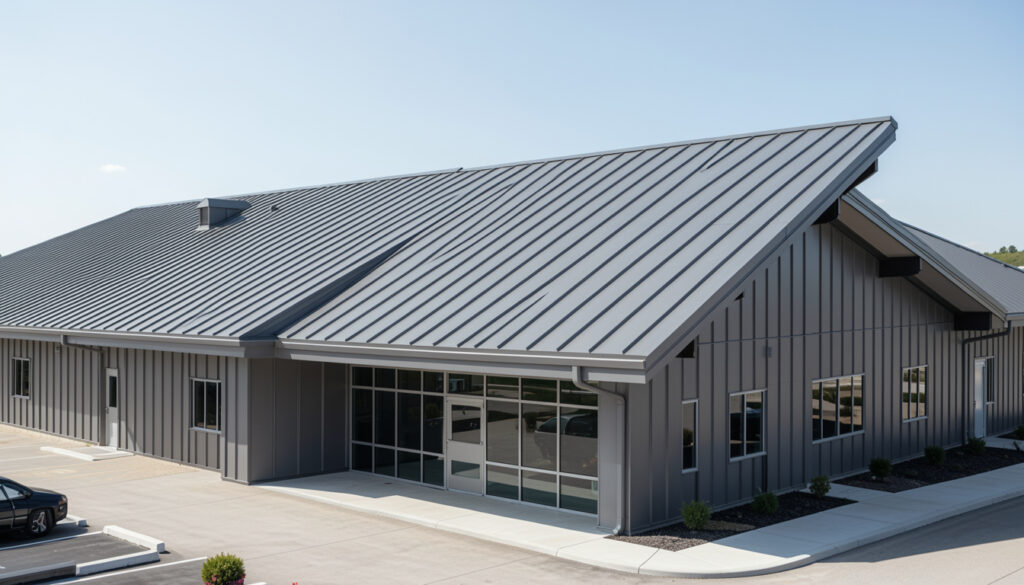
The VSR-II metal roof is Butler’s architectural standing-seam roofing system for buildings where the roof is an important part of the overall appearance as well as the building envelope. Its clean standing-seam profile, concealed fastening system, and ability to accommodate complex roof geometry make it particularly suited to commercial, institutional, civic, and other architecturally visible buildings.
Unlike a conventional exposed-fastener metal roof, the VSR-II keeps its primary fastening points concealed beneath the standing seams. The current system uses 16-inch-wide panels, a 2-inch-high standing seam, and concealed fixed or movable clips. The clip system is designed to accommodate the expansion and contraction that naturally occurs as metal responds to temperature changes.
For owners maintaining an existing Butler building, these characteristics are important when identifying replacement panels, clips, flashing, sealants, or other roof components. The correct repair depends not only on the visible panel but also on how the entire roofing assembly was designed to work.
Why VSR-II Is Different From a Typical Metal Roof
The appearance of a standing-seam roof can look relatively simple from the ground. Underneath that clean appearance, however, is a carefully coordinated system of panels, clips, seams, sealants, insulation, flashing, and structural components.
The VSR-II system is designed so that the primary fastening mechanism is concealed. This eliminates the rows of exposed fasteners commonly associated with some other metal roofing systems and creates a cleaner architectural appearance.
The system’s current specifications identify:
- 16-inch panel width
- 2-inch-high standing seam
- 24- and 22-gauge panel options
- Concealed floating clips
- Factory-applied sealant
- Butler-Cote finish options and Galvalume
- Fiberglass blanket insulation options
- Up to 6 inches of insulation
- UL Class 90 uplift rating
- FM Class 1 approval
- Class 4 impact resistance
- Miami-Dade certification
These specifications describe the current VSR-II system. Existing buildings may have been constructed under earlier specifications, so replacement work should always be based on the actual roof installed on the building.
The Standing-Seam Design
The defining feature of VSR-II is its raised standing seam.
The adjacent panels are joined through the standing-seam configuration, creating continuous raised lines along the roof. The current system uses a 2-inch-high seam and a 16-inch panel width.
This geometry serves both an aesthetic and functional purpose.
From an architectural perspective, the narrow, consistent seams create a deliberate visual rhythm across the roof.
From a roofing perspective, the seam forms part of the mechanism used to connect adjacent panels and create a weather-resistant roof surface.
Concealed Clips and Thermal Movement
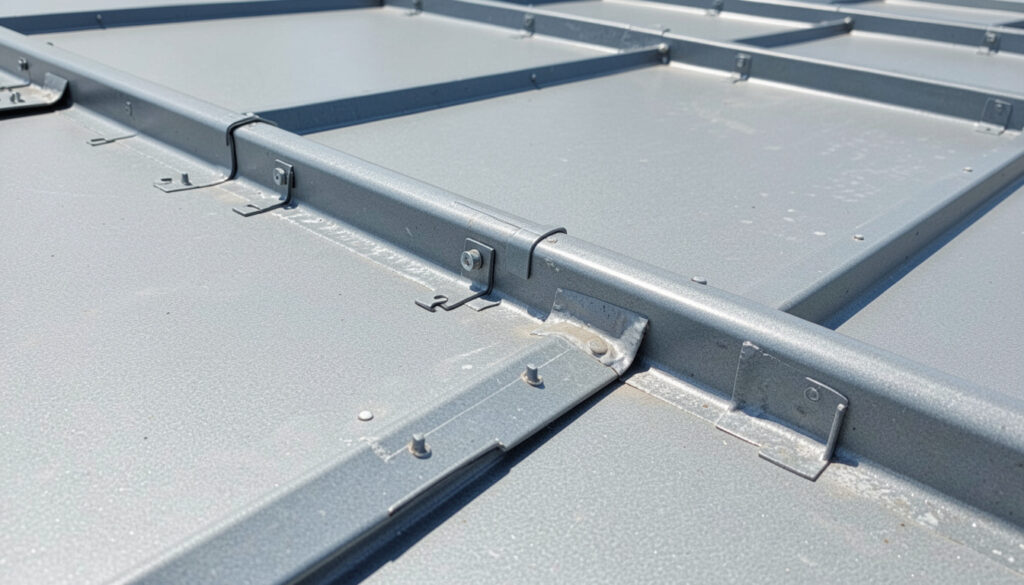
One of the most important components of a VSR-II roof is something that cannot normally be seen from the exterior: the concealed clip.
Metal naturally expands when heated and contracts when cooled. On a large roof, repeated temperature changes can produce substantial movement over time.
The VSR-II concealed clip system is designed to accommodate this movement. The current specifications identify floating clips and specifically note that the concealed clip system accommodates expansion and contraction.
This is important when performing repairs.
A replacement component should not simply be selected because it physically fits. It needs to work with the movement characteristics of the existing roof system.
Where VSR-II Works Particularly Well
VSR-II is intended for applications where the roof remains visually prominent.
Butler describes the system as an architectural roof engineered for projects where visibility matters, with clean lines and a modern profile.
Examples of buildings where the system may be appropriate include:
- Commercial facilities
- Healthcare buildings
- Schools
- Churches
- Civic buildings
- Transportation facilities
- Office buildings
- Institutional facilities
Butler project examples include healthcare, aviation, municipal, and religious facilities using VSR-II as an architectural roof system.
Complex Roof Geometry
Architectural buildings often require more than a simple gable roof.
A project may include multiple slopes, transitions, high roof pitches, intersecting roof sections, or other architectural elements.
VSR-II is designed to accommodate complex roof geometries. Butler specifically identifies this as one of the applications for the system.
However, complex geometry also means that flashing, transitions, and penetrations need to be carefully detailed.
A roof leak at a complicated transition can be considerably more difficult to trace than a leak occurring on an uninterrupted panel field.
What the Roof Assembly Includes
The visible metal panels are only one part of the VSR-II roof.
Depending on the building configuration, the complete assembly can involve:
- Roof panels
- Standing seams
- Concealed clips
- Structural framing
- Insulation
- Vapor-control components
- Flashing
- Factory-applied sealants
- Roof penetrations
- Drainage components
- Interior liner systems
Butler identifies VSR-II as a system that integrates with Butler walls, structures, and insulation.
This integrated approach is important when troubleshooting an existing roof.
Identifying an Existing VSR-II Roof
If you are trying to determine whether an existing Butler building has a VSR-II roof, several characteristics can help.
Look at:
- Panel width
- Standing-seam profile
- Seam height
- Fastening arrangement
- Panel surface
- Roof geometry
- Eave details
- Existing documentation
The current VSR-II system has a 16-inch panel width and 2-inch standing seam, with concealed fastening.
However, measurements alone should not be treated as absolute proof that a roof is VSR-II. Older buildings can have different configurations, modifications, or replacement components.
Photographs of the seam, eave, roof edge, and any visible attachment details can provide useful information when identifying a system.
VSR-II Roof Leaks
A leaking VSR-II roof does not necessarily mean the standing-seam panels have failed.
Water can enter through several areas, including:
- Roof penetrations
- Flashing
- End conditions
- Transitions
- Damaged seams
- Failed sealants
- Damaged panels
- Drainage problems
Water can also travel along the roof assembly before appearing inside the building.
For this reason, the location of an interior water stain should not automatically be treated as the location of the exterior leak.
Roof Penetrations Deserve Special Attention
Commercial buildings frequently have equipment that passes through the roof.
Examples include:
- HVAC equipment
- Exhaust systems
- Pipes
- Vents
- Electrical components
- Skylights
- Mechanical equipment
Each penetration interrupts the otherwise continuous roof surface.
That makes the flashing and sealant around the penetration particularly important.
When a leak appears near a roof penetration, inspect the entire transition rather than focusing only on the nearby panel.
Flashing and Transitions
Flashing helps move water away from areas where the roof changes direction or intersects another building component.
Potential problem areas include:
- Roof-to-wall transitions
- Roof edges
- Valleys
- Penetrations
- Equipment curbs
- Changes in roof geometry
Flashing can deteriorate through corrosion, physical damage, movement, or failed sealants.
A replacement roof panel will not necessarily solve a leak caused by deteriorated flashing.
Sealants and Weather Resistance
Sealants are another important part of the roof assembly.
The current VSR-II specifications identify factory-applied sealant as part of the system.
Sealants can deteriorate over time because of:
- UV exposure
- Temperature changes
- Aging
- Movement
- Physical damage
- Loss of adhesion
When sealant failure is suspected, the surrounding joint or transition should be inspected rather than simply applying new material over the existing sealant.
Panel Damage
VSR-II panels can be damaged by:
- Severe weather
- Falling objects
- Improper foot traffic
- Maintenance equipment
- Mechanical impact
- Building modifications
The severity of the damage determines the appropriate response.
A minor surface defect may require a different treatment than a punctured or severely deformed panel.
The condition of the seam should also be considered.
Protecting the Standing Seams
The raised seams are an important functional component of the roof.
Improper maintenance activity or foot traffic can potentially deform roof components.
Workers who need roof access should follow appropriate procedures and avoid unnecessary impact or loading on seams and panels.
This is particularly important when mechanical equipment is being installed or serviced.
Corrosion on VSR-II Roofs
Metal roofing is exposed to moisture and environmental conditions throughout its service life.
Corrosion can develop when the protective finish is damaged or when moisture remains against the metal for extended periods.
Inspect areas such as:
- Roof edges
- Seams
- Flashing
- Penetrations
- Areas where debris accumulates
- Drainage areas
- Locations with previous repairs
The cause of the corrosion should be understood before selecting a repair method.
VSR-II Finishes
The current VSR-II system is available with Butler-Cote finish options and Galvalume.
The finish contributes to the roof’s appearance while helping protect the underlying metal.
When the finish becomes scratched or damaged, the affected area should be evaluated to determine whether the underlying metal has also been compromised.
Insulation and the Roof Assembly
Insulation is an important part of the building envelope.
The current VSR-II specifications identify fiberglass blanket insulation as an available insulation option, with a maximum listed insulation thickness of 6 inches.
Insulation can help reduce heat transfer and contribute to interior comfort.
It also works alongside vapor and air-control components to help manage moisture within the building envelope.
Wet Insulation Is a Warning Sign
If insulation becomes wet, the moisture source should be identified.
Potential causes include:
- Roof leaks
- Failed flashing
- Condensation
- Air leakage
- Damaged vapor-control components
- Penetration problems
Replacing the insulation without addressing the underlying moisture source can result in the same problem recurring.
Condensation Concerns
Condensation occurs when moisture in the air encounters a surface cold enough for water vapor to condense.
The risk can increase depending on:
- Interior humidity
- Exterior temperatures
- Building use
- Insulation
- Air movement
- Vapor control
- Roof assembly configuration
A roof inspection should distinguish between water entering from outside and moisture generated within the building.
Drainage Matters
Even a properly installed roof needs effective drainage.
Inspect:
- Gutters
- Downspouts
- Roof slopes
- Drainage outlets
- Roof edges
Leaves, dirt, branches, and other debris can restrict drainage.
Persistent water accumulation can increase the likelihood of corrosion and deterioration.
Roof-Edge Problems
Water appearing around a wall or soffit does not necessarily mean the wall itself is leaking.
A roof-edge drainage problem can direct water toward:
- Fascia
- Soffits
- Exterior walls
- Flashing
- Insulation
When moisture appears near the perimeter of a building, inspect the roof edge and drainage system along with the wall.
VSR-II and Wind Performance
The roof attachment system plays an important role in transferring wind forces into the supporting structure.
The current VSR-II product specifications identify UL Class 90 uplift testing, along with FM Class 1 approval and other testing and certification.
Actual project requirements depend on the building’s design, location, geometry, applicable codes, and engineering requirements.
A roof that has experienced severe wind should therefore be inspected for more than obvious panel damage.
Maintaining an Existing VSR-II Roof
Routine inspections can help identify developing problems before they become expensive repairs.
A basic inspection should look for:
- Damaged panels
- Damaged seams
- Corrosion
- Failed sealants
- Damaged flashing
- Roof penetrations
- Drainage problems
- Debris
- Interior water stains
- Wet insulation
Inspections are especially valuable after major storms.
Repair or Replace?
Not every VSR-II roof problem requires complete replacement.
A localized issue may involve:
- One damaged panel
- Failed sealant
- Damaged flashing
- A problematic penetration
- A drainage obstruction
- A damaged attachment component
If the surrounding roof remains in good condition, a targeted repair may be appropriate.
However, repeated leaks or widespread deterioration may indicate that the roof requires a broader assessment.
Replacing VSR-II Roof Panels
When replacing a panel, compatibility is critical.
Consider:
- Panel width
- Seam profile
- Seam height
- Material
- Gauge
- Finish
- Clip arrangement
- Sealant
- Roof geometry
The current VSR-II specifications identify 22- and 24-gauge panel options.
Existing buildings may have different original specifications, so the installed roof should be verified before replacement parts are ordered.
Replacing Concealed Clips
Clips are not simply generic pieces of hardware.
They form part of the roof’s attachment and thermal-movement system.
If a clip is damaged, the replacement should be matched to the specific roof configuration.
Improperly restricting the movement of the panel can create stress that was not present in the original design.
Roof Modifications
Existing buildings frequently receive new equipment during their service life.
Common modifications include:
- HVAC equipment
- Exhaust systems
- Solar installations
- Electrical equipment
- Skylights
- New mechanical penetrations
These modifications need to be integrated with the existing VSR-II assembly.
A poorly detailed penetration can create a leak even when the original roof panels remain in excellent condition.
Adding Solar to a VSR-II Roof
Solar installations require evaluation of both the roof and the building structure.
Before adding an array, consider:
- Roof condition
- Remaining service life
- Structural capacity
- Attachment method
- Waterproofing
- Equipment layout
- Maintenance access
The roof should not be treated as an unlimited mounting surface simply because it is structurally capable of supporting the building’s original design loads.
When a Full Roof Replacement Makes Sense
A full replacement may become appropriate when deterioration is widespread.
Factors may include:
- Extensive corrosion
- Repeated leaks
- Widespread panel damage
- Deteriorated flashing
- Significant previous modifications
- Poor remaining service life
- Extensive attachment problems
The decision should be based on the condition of the complete roof assembly.
Information Needed for Replacement Parts
If you are trying to source replacement VSR-II components, provide as much information as possible.
Useful information includes:
- Building information
- Roof system identification
- Panel measurements
- Photographs
- Seam measurements
- Component location
- Existing hardware
- Description of the damage
A clear photograph of the standing seam and roof edge can be particularly helpful.
Common Problems With VSR-II Metal Roofs
Roof Leaks
Leaks can originate from damaged seams, penetrations, flashing, sealants, panels, or drainage problems.
Damaged Standing Seams
Impact or improper roof access can deform seams and affect the roof assembly.
Corrosion
Moisture exposure and damaged finishes can cause deterioration of the underlying metal.
Failed Sealants
Aging or damaged sealants can allow water to enter transitions and joints.
Damaged Flashing
Flashing around penetrations, roof edges, and transitions can deteriorate over time.
Damaged Clips
A damaged or incorrect clip can affect panel attachment and thermal movement.
Panel Damage
Severe weather, debris, maintenance activity, and modifications can damage panels.
Wet Insulation
Wet insulation can indicate a roof leak or condensation problem that needs to be investigated.
Drainage Problems
Blocked gutters or drainage pathways can leave water where it should not remain.
Improper Modifications
Poorly integrated equipment or penetrations can create new leak paths.
Things to Know
- VSR-II is Butler’s architectural standing-seam metal roof system.
- The current system uses 16-inch-wide panels and a 2-inch-high standing seam.
- Primary fastening is concealed beneath the roof system’s standing-seam configuration.
- Concealed clips are designed to accommodate thermal expansion and contraction.
- Current specifications identify 22- and 24-gauge panel options.
- The system is intended for architectural applications and can accommodate complex roof geometry.
- Roof penetrations, flashing, sealants, and drainage should be inspected when troubleshooting leaks.
- Wet insulation should be investigated rather than simply covered or replaced without addressing the moisture source.
- A localized roof problem does not automatically mean the entire roof needs replacement.
- Replacement panels and clips should be matched to the existing VSR-II configuration.
- The current system has UL Class 90 uplift testing and additional listed certifications.
- Photographs and measurements can help identify the correct replacement components.
Frequently Asked Questions
What is a VSR-II metal roof?
VSR-II is Butler’s architectural standing-seam metal roofing system designed for buildings where roof appearance, performance, and architectural flexibility are important.
How wide is a VSR-II roof panel?
The current VSR-II system uses 16-inch-wide panels.
How high is the VSR-II standing seam?
The current system uses a 2-inch-high standing seam.
Does VSR-II use exposed screws?
The primary fastening system is concealed.
The concealed clip arrangement helps maintain the clean architectural appearance of the roof while accommodating thermal movement.
What causes a VSR-II roof to leak?
Common causes include damaged seams, roof penetrations, flashing problems, failed sealants, damaged panels, and drainage issues.
The visible location of water inside the building may not be directly below the actual entry point.
Can a damaged VSR-II panel be replaced?
In some cases, yes.
The extent of the damage and condition of the surrounding roof should be evaluated first, and any replacement panel should match the existing system.
Can I use another Butler roof panel as a VSR-II replacement?
Do not assume that different Butler roof systems are interchangeable.
Panel width, seam geometry, attachment methods, and other details can differ between systems.
Why are the VSR-II clips important?
The concealed clips connect the panels to the supporting structure while allowing the metal panels to accommodate thermal movement.
Does VSR-II require insulation?
Insulation is part of the overall roof assembly when specified for the building.
Current VSR-II specifications identify fiberglass blanket insulation options with up to 6 inches of insulation.
Can a VSR-II roof be used on a complex building design?
Yes.
Butler identifies VSR-II as an architectural roof system suitable for complex roof geometry.
Can solar panels be installed on a VSR-II roof?
Solar installation may be possible, but the existing roof condition, structural capacity, attachment method, waterproofing, and remaining roof service life should be evaluated first.
Should I replace the entire roof if it has multiple leaks?
Not automatically.
The cause and distribution of the leaks, along with the condition of the panels, seams, flashing, insulation, and other components, should be evaluated before deciding on full replacement.
How do I identify a VSR-II roof?
Start by examining the panel width, standing-seam profile, seam height, fastening arrangement, and available building documentation.
The current system uses 16-inch panels, a 2-inch standing seam, and concealed fastening.
What information should I provide when looking for VSR-II replacement parts?
Provide photographs, panel and seam measurements, building information, the location of the damaged component, and a description of the problem.
Close-up images of the standing seam, eave, flashing, and damaged area can be especially useful.
The Bottom Line
VSR-II is designed to make the roof part of the architecture rather than simply a protective covering. Its standing-seam profile and concealed fastening system create a clean exterior while the concealed clips accommodate thermal movement.
For an existing Butler building, maintaining that performance depends on using components that are compatible with the original roof system. When a leak, damaged panel, failed flashing, or attachment problem occurs, the best repair begins with identifying the actual source of the problem and the exact VSR-II configuration.
If you need VSR-II roof panels, clips, flashing, insulation, or other Butler building replacement components, provide your building information, photographs, measurements, and details about the damaged component so the appropriate replacement can be identified.