

Personnel doors are an essential part of almost every commercial and industrial metal building. While large overhead and hangar doors handle equipment, vehicles, and materials, a steel walk door provides convenient everyday access for employees, contractors, maintenance personnel, and visitors.
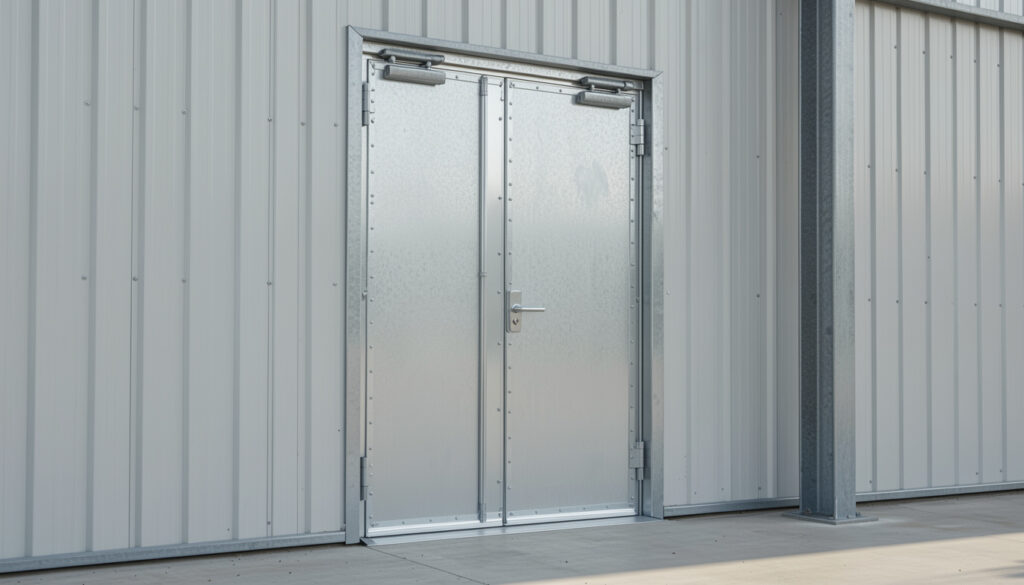
The Butler Series 700 Steel Walk Door is designed for applications where durability, security, weather resistance, and frequent use are important. It uses an 18-gauge galvanized steel door with an insulated polyurethane core, a reinforced 16-gauge galvanized welded frame, commercial-grade hardware, and a proprietary anchoring system.
For warehouses, manufacturing facilities, distribution centers, and other high-traffic buildings, the Series 700 provides a more robust personnel entrance than a basic light-duty door.
Key Takeaways
- The Butler Series 700 is a heavy-duty commercial and industrial steel walk door.
- The door uses 18-gauge galvanized A60 steel construction.
- An insulated polyurethane core provides an R-11 thermal rating.
- The welded frame uses 16-gauge galvanized A60 steel.
- Commercial Steel Door Institute standards apply to the door and frame.
- A Schlage Grade 2 lever lock is included as standard.
- Grade 1 locks, exit devices, automatic closers, and latch guards are available as options.
- Ball-bearing hinges include security non-removable pins.
- The door includes an aluminum threshold and weather-sealing components.
- Series 700 doors are available in 3′-0″ × 7′-0″, 4′-0″ × 7′-0″, and 6′-0″ × 7′-0″ configurations, with custom sizes available.
What Is the Butler Series 700 Steel Walk Door?
The Series 700 is a heavy-duty steel personnel door designed for commercial and industrial applications.
Unlike large overhead doors, which are primarily used for vehicles and equipment, a walk door provides a dedicated entrance for people.
The Series 700 is particularly suited for buildings where the personnel entrance is expected to withstand frequent daily use.
Its construction includes:
- 18-gauge galvanized steel door
- Polyurethane insulated core
- 16-gauge galvanized welded frame
- Commercial-grade lock
- Ball-bearing hinges
- Aluminum threshold
- Door sweep
- Weatherseal
- Proprietary subjamb anchoring system
The combination is designed to provide a durable entrance while integrating with Butler building wall systems.
Why Heavy-Duty Walk Doors Matter
A personnel door may be opened dozens of times per day in a busy commercial building.
Employees may use it to enter and exit the facility, while maintenance personnel may use it to access mechanical rooms, warehouses, production areas, and other parts of the building.
Over time, repeated operation places stress on:
- Hinges
- Locks
- Frames
- Door closers
- Thresholds
- Fasteners
- Weatherstripping
A heavy-duty door is designed to handle this repeated use better than a lightweight residential or utility door.
For high-traffic environments, selecting the door based on expected use rather than simply its initial purchase price can reduce premature replacement and maintenance issues.
Series 700 Door Construction
The Series 700 door uses 18-gauge galvanized A60 steel with an insulated polyurethane core. The door has an R-11 insulation rating and an interlocking seam construction. Butler states that the doors meet commercial Steel Door Institute standards.
The galvanized steel provides corrosion resistance while the polyurethane core contributes to the thermal performance of the door.
This construction is particularly useful for buildings where the interior is conditioned and the personnel entrance forms part of the exterior building envelope.
Reinforced Steel Frame
A durable door requires more than a strong door leaf.
The frame provides the structural interface between the door and the building wall.
The Series 700 uses a 16-gauge galvanized A60 welded frame with a standard 5¾-inch frame profile. The frame incorporates an interlocking mitered-corner connection that is welded after assembly.
This reinforced frame is intended to provide the rigidity required for a commercial and industrial entrance.
A strong frame can also help maintain proper door alignment over time.
Series 700 Proprietary Subjamb System
One of the distinguishing features of the Series 700 is its proprietary offset subjamb and jamb anchor system.
The system uses a 16-gauge galvanized subjamb along with polyethylene block anchors designed to stiffen the jambs.
The configuration is self-trimming, which eliminates the need for separate jamb trim in the applicable installation.
Proper anchoring is important because the frame transfers loads from the door into the surrounding building structure.
Insulated Door Core
The Series 700 uses a polyurethane insulated core with an R-11 rating.
The insulation is important when the door separates conditioned interior space from exterior conditions.
A personnel door can become a weak point in the building envelope if it is poorly insulated or improperly sealed.
The insulated core helps reduce heat transfer through the door itself, while the weatherseal and threshold help address air and water infiltration around the perimeter.
Series 700 Locking System
The standard Series 700 configuration includes a Schlage Grade 2 AL53PD-626-SAT lever lock.
The lock meets ANSI A156.2 Series 4000 Grade 2 requirements and includes a free-wheeling vandal-resistant lever. The lock is also through-bolted for additional strength.
For facilities with greater security or traffic requirements, additional locking hardware can be specified.
Available options include:
- Schlage Grade 1 lever lock
- Schlage Grade 1 mortise lever lock
- Heavy-duty exit devices
- Latch guards
The appropriate configuration depends on the building’s security requirements and occupancy.
Commercial-Grade Door Hardware
Industrial personnel doors experience substantial hardware wear because of repeated operation.
The Series 700 uses ball-bearing hinges with security non-removable pins.
Ball-bearing hinges are appropriate for heavy doors because they are designed to support smooth operation under repeated loading.
Non-removable hinge pins also provide additional security by making it more difficult to remove the door from the hinge side when the door is closed.
Weather Sealing and Threshold
A personnel door is an opening in the building envelope, so sealing around the door is critical.
The Series 700 includes:
- 5¾-inch aluminum threshold
- Dual-finger TPE sweep
- Urethane foam weatherseal
- Weather-resistant door construction
These components work together to reduce unwanted air and water movement around the entrance.
A properly adjusted sweep and weatherseal are particularly important for exterior doors exposed to wind and rain.
Series 700 Door Sizes
The Butler product listing identifies the following standard Series 700 configurations:
- 3′-0″ × 7′-0″
- 4′-0″ × 7′-0″
- 6′-0″ × 7′-0″
Custom sizes are also available for applicable applications.
The correct size depends on the building opening, traffic requirements, accessibility requirements, and intended use.
When replacing an existing door, the existing rough opening should be measured rather than assuming that the nominal door size is the actual opening dimension.
Single and Double Door Configurations
The Series 700 can accommodate both single- and double-door applications.
A single door is generally suitable for standard personnel traffic.
Double doors provide a wider opening and can be useful where larger items, equipment, or groups of people need to pass through.
Double-door configurations can include one active leaf and one inactive leaf, or configurations where both leaves operate depending on the hardware and application.
The required swing configuration should be determined before ordering.
Door Swing Configuration
Door swing is an important consideration that is sometimes overlooked during replacement projects.
The Series 700 provides multiple swing configurations for both single and double doors.
The correct swing depends on:
- Interior layout
- Exterior clearance
- Traffic flow
- Emergency egress
- Equipment locations
- Adjacent walls
- Building codes
Before ordering a replacement, document whether the existing door swings inward or outward and whether the hinges are on the left or right side.
Common Problems With Steel Walk Doors
Door Sagging
A heavy door that begins dragging against the threshold may have hinge, frame, or alignment problems.
Difficult Operation
Increased resistance when opening or closing can indicate damaged hardware, misalignment, or a deteriorated frame.
Failed Weatherseal
Damaged or compressed weatherstripping can allow air and water to enter around the door.
Lock Problems
A worn lock may become difficult to operate or fail to secure the door correctly.
Damaged Threshold
Repeated traffic can damage the threshold or cause it to become loose.
Hinge Wear
Frequent use can eventually cause hinge components to wear, especially if the door is exposed to heavy traffic.
Frame Damage
Impact from equipment, carts, forklifts, or other vehicles can deform the frame and prevent proper door operation.
Corrosion
Although galvanized steel provides corrosion resistance, prolonged exposure to moisture or damaged coatings can eventually result in corrosion.
Signs Your Series 700 Door Needs Replacement
A commercial steel walk door should be inspected when it begins showing signs of deterioration.
Potential warning signs include:
- Door no longer closes correctly
- Door rubs against the frame
- Large gaps around the perimeter
- Damaged weatherstripping
- Broken lock
- Loose hinges
- Bent frame
- Corrosion
- Damaged threshold
- Cracked or deteriorated seals
- Door difficult to open
- Door difficult to secure
Some issues can be corrected through hardware replacement or adjustment.
However, extensive frame damage, corrosion, or structural deterioration may justify replacing the complete door assembly.
Series 700 Doors for Warehouses
Warehouses often have multiple access points for employees, supervisors, maintenance workers, and contractors.
These doors may be used frequently throughout the day.
The Series 700’s heavy-duty steel construction and commercial-grade hardware make it suited to environments where the personnel door is expected to withstand repeated use.
For warehouses, door location should also be considered in relation to:
- Loading areas
- Forklift traffic
- Employee entrances
- Emergency exits
- Offices
- Shipping and receiving areas
The door should remain accessible without interfering with material-handling operations.
Series 700 Doors for Manufacturing Facilities
Manufacturing buildings can expose personnel doors to demanding conditions.
The surrounding environment may contain:
- Machinery
- Dust
- Moisture
- Temperature fluctuations
- Heavy traffic
- Equipment movement
A durable steel door can provide a more appropriate personnel entrance for these conditions than a light-duty door.
Hardware selection should be based on the actual level of use.
For especially high-traffic applications, options such as Grade 1 locks, exit devices, and heavy-duty automatic closers may be appropriate.
Series 700 Doors for Distribution Centers
Distribution centers frequently have high employee traffic and multiple shifts.
Personnel doors may be opened and closed continuously throughout the day.
In these environments, door durability and hardware reliability are particularly important.
The Series 700 can be configured with commercial-grade locking and exit hardware to accommodate different access requirements.
Series 700 Doors and Security
Security requirements vary considerably between facilities.
A warehouse storing general merchandise may have different requirements than a manufacturing facility handling expensive equipment or restricted materials.
The door assembly should therefore be evaluated as a complete system.
Security considerations can include:
- Lock grade
- Exit hardware
- Hinge security
- Frame strength
- Door construction
- Access-control systems
- Latch protection
- Surrounding wall construction
The Series 700 provides several hardware options for applications requiring additional security.
Series 700 Door Lite Kits
Some applications require visibility through the personnel door.
The Series 700 offers optional lite kits in 24 × 30-inch and 9 × 30-inch configurations.
A door lite can provide visibility between rooms or allow occupants to see approaching personnel before opening the door.
The appropriate configuration depends on the building’s use and visibility requirements.
Automatic Closers
A busy commercial door may need to close automatically after each use.
The Series 700 offers LCN automatic closer options ranging from moderate-duty to extra-heavy-duty configurations.
An automatic closer can be useful for:
- Employee entrances
- Security-controlled areas
- High-traffic corridors
- Exterior entrances
- Fire and life-safety applications where applicable
The closer should be selected and adjusted according to the door’s size, weight, traffic, and applicable requirements.
Exit Devices and Panic Hardware
Facilities where emergency egress is important may require exit devices.
The Series 700 offers Von Duprin and Falcon exit-device options, including heavy-duty Grade 1 rim exit devices.
The correct exit hardware should be selected according to occupancy, egress requirements, and applicable building and fire codes.
A panic device should not be added solely because a door is used frequently; the specific building requirements need to be evaluated.
Series 700 Door Finishes
The Series 700 door and frame receive a baked-on beige primer coat that meets ANSI A250 standards.
The finish is tested for characteristics including salt spray, humidity, and adhesion.
Butler also indicates that its personnel doors are available in Butler-Cote color options, allowing the door to coordinate with the building’s overall exterior appearance.
Replacing an Existing Series 700 Door
When replacing an existing Series 700 door, accurate information is important.
Before requesting a replacement, document:
- Door width
- Door height
- Rough opening
- Frame dimensions
- Door swing
- Hinge side
- Lock type
- Threshold
- Door closer
- Lite kit
- Exit device
- Existing wall system
- Photos of the complete door
A photograph of the door from the exterior and interior can help identify the existing configuration.
Close-up photographs of the hinges, lock, threshold, frame, and identification information are also useful.
Measuring a Replacement Walk Door
Do not rely only on the nominal door size.
For example, a door described as 3′-0″ × 7′-0″ does not necessarily mean that the rough opening is exactly those dimensions.
Measure the existing opening carefully.
Record:
- Width at the top
- Width at the middle
- Width at the bottom
- Height on both sides
- Frame depth
- Threshold condition
If measurements differ, the opening may not be square or the existing frame may be damaged.
Series 700 Doors and Butler Wall Systems
A personnel door must be compatible with the surrounding building wall.
The Series 700 is designed to integrate with Butler wall systems, but the specific existing wall configuration still needs to be verified during replacement.
The wall opening, structural framing, subjambs, trim, and door frame all work together.
This is why replacing an OEM building component with a generic door can sometimes create unnecessary field modifications.
A properly matched replacement can simplify installation and preserve the intended building configuration.
Installation Considerations
A steel walk door should be installed so the frame remains square, level, and properly anchored.
The installer should verify:
- Frame alignment
- Door clearance
- Hinge operation
- Lock engagement
- Threshold position
- Weatherseal contact
- Door swing
- Closer adjustment
A door that is installed incorrectly can develop operating problems even if the door itself is high quality.
Proper installation is therefore part of the door system’s long-term performance.
Maintaining a Series 700 Steel Walk Door
Routine inspection can identify small problems before they become larger failures.
Inspect:
- Hinges
- Lock
- Door closer
- Weatherseal
- Sweep
- Threshold
- Frame
- Fasteners
- Door alignment
- Finish
Keep hardware properly maintained according to the manufacturer’s recommendations.
If the door begins dragging, binding, or failing to latch, address the issue rather than continuing to force the door.
Repeated operation with misaligned hardware can increase damage to the door and frame.
Things to Know
- Series 700 is designed for heavy-duty commercial and industrial applications.
- The door uses 18-gauge galvanized A60 steel with an R-11 polyurethane insulated core.
- The welded frame uses 16-gauge galvanized A60 steel.
- The standard lock is a Schlage Grade 2 commercial lever lock.
- Grade 1 locking and exit-device options are available.
- Ball-bearing hinges use security non-removable pins.
- The door includes a 5¾-inch aluminum threshold and weather-sealing components.
- Optional 24 × 30-inch and 9 × 30-inch lite kits are available.
- Automatic closer options range from moderate-duty to extra-heavy-duty.
- Accurate measurements are essential when replacing an existing walk door.
- Door swing and hardware configuration should be documented before ordering.
- The surrounding Butler wall system should be identified before selecting a replacement.
Frequently Asked Questions
Q: What is the Butler Series 700 Steel Walk Door used for?
The Series 700 is designed for heavy-duty personnel access in commercial and industrial buildings.
It is particularly suited for warehouses, manufacturing facilities, distribution centers, and other high-traffic applications.
Q: How thick is the Series 700 door?
The Series 700 door uses 18-gauge galvanized A60 steel.
Q: Is the Series 700 door insulated?
Yes.
The door uses a polyurethane insulated core with an R-11 rating.
Q: What type of frame does the Series 700 use?
The Series 700 uses a 16-gauge galvanized A60 welded frame with a standard 5¾-inch frame profile.
Q: What lock comes standard with the Series 700?
The standard configuration includes a Schlage Grade 2 AL53PD-626-SAT lever lock.
Q: Can I get a higher-security lock?
Yes.
Grade 1 lever and mortise lock options are available for applications requiring additional security and durability.
Q: Are exit devices available for the Series 700?
Yes.
Heavy-duty Von Duprin and Falcon exit-device options are available for applicable configurations.
Q: Can I add a window to a Series 700 door?
Yes.
Optional lite kits are available in 24 × 30-inch and 9 × 30-inch configurations.
Q: What sizes are available?
Standard configurations include 3′-0″ × 7′-0″, 4′-0″ × 7′-0″, and 6′-0″ × 7′-0″, with custom sizes available for applicable applications.
Q: Can the Series 700 be used as an exterior door?
Yes.
Its galvanized steel construction, insulated core, threshold, sweep, and weatherseal make it suitable for exterior commercial and industrial applications when properly installed.
Q: How do I replace an existing Butler walk door?
Start by measuring the existing opening and documenting the door’s size, swing, frame, hardware, threshold, and wall system.
Photographs of the existing installation are also useful when determining the correct replacement configuration.
The Bottom Line on Butler Series 700 Steel Walk Doors
The Butler Series 700 Steel Walk Door is designed for buildings where a personnel entrance needs to withstand frequent use while providing security, insulation, and weather resistance.
Its 18-gauge galvanized steel door, R-11 polyurethane core, 16-gauge welded frame, commercial-grade hardware, reinforced anchoring system, and weather-sealing components make it a strong choice for demanding commercial and industrial environments.
For replacement projects, the most important step is accurately documenting the existing door and opening. Door size alone is not enough. Swing direction, frame dimensions, hardware, threshold, wall system, and existing conditions should all be considered before ordering.
If your Butler building has a damaged, outdated, or difficult-to-operate personnel door, a properly matched Series 700 replacement can restore dependable access while maintaining the performance and appearance of the building.
Need a replacement Butler Series 700 Steel Walk Door? Request a Quote and provide your door dimensions, swing configuration, hardware details, and photos of the existing installation.