

Commercial buildings often need an overhead door that can handle frequent use without taking up valuable interior or exterior space. For warehouses, service areas, storage facilities, and other commercial applications, a slat door can provide a practical solution for openings that require reliable access and security.
The Commercial Slat Door Series 300 is designed for commercial applications where a durable rolling door is needed. Unlike a sectional overhead door, a slat door rolls into a compact coil above the opening, allowing the doorway to remain clear when the door is fully raised.
This configuration can be particularly useful in buildings where ceiling clearance, interior space, or operating conditions make a conventional sectional door less suitable.
Key Takeaways
- The Series 300 is a commercial slat door designed for overhead building access.
- Its rolling design allows the door to coil above the opening.
- It can preserve usable space inside and around the doorway.
- Slat doors are suitable for many warehouse, commercial, service, and industrial applications.
- The door can provide controlled access while protecting the opening when closed.
- Opening dimensions, headroom, sideroom, and operating requirements should be confirmed before ordering.
- Regular maintenance of the slats, guides, barrel, hardware, and operating mechanism is important.
- Frequent-cycle applications require appropriately specified hardware and operating equipment.
- Impact damage to the guides or slats can interfere with proper door operation.
- Accurate measurements are particularly important when replacing an existing commercial slat door.
What Is a Commercial Slat Door?
A commercial slat door is a rolling overhead door constructed from interconnected horizontal slats.
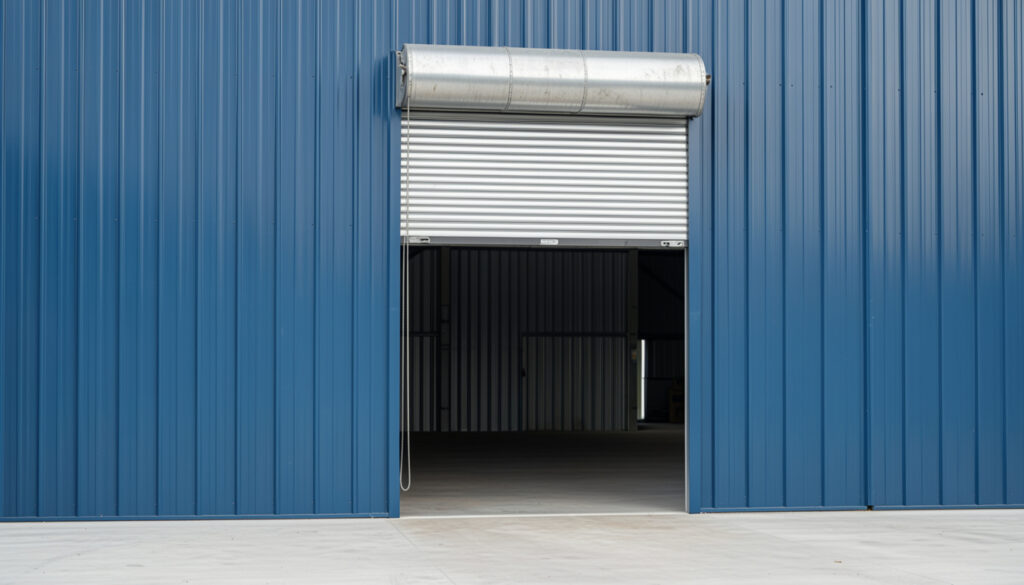
When the door opens, the slats travel upward and roll around a barrel positioned above the doorway.
This differs from a sectional door, where rigid sections move along horizontal and vertical tracks before resting above the opening.
The rolling configuration gives slat doors a compact operating footprint.
That can make them useful in buildings where space above or behind the opening is limited.
How a Slat Door Works
A rolling slat door operates through several primary components.
The slats form the moving curtain.
Vertical guides on either side of the opening control the movement of the curtain as it travels upward.
At the top of the opening, the curtain wraps around a barrel.
The barrel stores the door in a compact roll when the opening is fully open.
Depending on the configuration, the door can be operated manually or through a powered operator.
Each component needs to remain properly aligned for reliable operation.
Why Choose a Slat Door?
The biggest advantage of a rolling slat door is its compact operating design.
A sectional door requires tracks extending above and behind the opening.
A rolling slat door instead stores vertically around a barrel.
This can provide advantages where:
- Ceiling space is limited
- Interior equipment occupies the area above the opening
- The building has limited backroom
- The opening needs to remain visually simple
- The door is installed in a high-traffic commercial area
The correct choice depends on the building’s available space and operating requirements.
Series 300 for Warehouses
Warehouses frequently require multiple access points.
Large openings may be dedicated to trucks and forklifts, while smaller commercial openings can be used for equipment, deliveries, or other access requirements.
A slat door can provide a durable barrier when the opening is not being used.
Because the door rolls into a compact coil, it can also preserve valuable overhead space for lighting, storage, mechanical equipment, or other building systems.
Series 300 for Commercial Facilities
Commercial facilities often need doors that can withstand repeated daily operation.
A service entrance may be opened several times throughout the day as employees move equipment and materials through the building.
A slat door can provide a practical combination of:
- Durability
- Security
- Space efficiency
- Controlled access
- Simple operation
The door should still be matched to the expected cycle frequency and operating environment.
A door intended for occasional use should not automatically be treated as suitable for continuous high-cycle operation.
Series 300 for Service Areas
Automotive and equipment service facilities often require doors that provide easy access while protecting the building when closed.
A rolling slat door can be useful for:
- Service bays
- Equipment rooms
- Maintenance areas
- Storage rooms
- Loading areas
The appropriate door size should be based on the vehicles or equipment that need to pass through the opening.
Slat Door vs. Sectional Door
Both door types provide overhead access, but their operating mechanisms are different.
| Feature | Commercial Slat Door | Sectional Overhead Door |
|---|---|---|
| Door construction | Interlocking slats | Horizontal sections |
| Storage | Rolls around barrel | Rests along tracks |
| Overhead space | Compact | Requires track clearance |
| Visibility | Depends on configuration | Full-view options available |
| Insulation | Depends on model | Available in insulated configurations |
| Best advantage | Space efficiency | Versatile large-opening access |
| Maintenance | Curtain, guides, barrel, operator | Sections, rollers, tracks, springs |
Neither system is universally superior.
A slat door is often attractive where compact storage and straightforward operation are priorities.
A sectional door may be preferable when insulation, glazing, or specific track configurations are more important.
Slat Construction
The door curtain consists of connected horizontal slats.
These components move repeatedly every time the door opens and closes.
The slats need to remain properly connected and aligned so the curtain can travel smoothly through the guides.
Damage to individual slats can interfere with the movement of the entire door.
For that reason, impact damage should be addressed promptly rather than allowing the damaged section to continue operating indefinitely.
Vertical Guides
The guides on either side of the opening direct the curtain as it moves.
They also help keep the door aligned with the opening.
Bent, obstructed, or damaged guides can cause:
- Binding
- Excessive noise
- Uneven movement
- Curtain damage
- Increased operating resistance
Guide alignment should therefore be checked whenever a rolling door begins operating differently from normal.
Barrel and Curtain Assembly
The barrel is positioned above the opening and provides the storage point for the curtain.
When the door is raised, the slats wrap around the barrel.
The relationship between the barrel, curtain, and guides is important to the operation of the entire assembly.
Problems in one component can affect the others.
For example, a misaligned curtain may not roll evenly around the barrel, creating additional friction and mechanical stress.
Manual vs. Powered Operation
The operating method should be selected based on the size, weight, and frequency of use.
Manual operation may be appropriate for smaller openings with relatively low traffic.
Powered operation is generally more practical when:
- The door is large
- The curtain is heavy
- The door cycles frequently
- Employees operate the door throughout the day
- The opening is part of a busy service area
The operator should be properly matched to the door and expected cycle frequency.
High-Traffic Applications
Not every commercial door experiences the same amount of use.
A storage building may open its door only a few times per day.
A busy service facility may operate the same door dozens of times.
This distinction matters because high-cycle operation increases wear on:
- Slats
- Guides
- Bearings
- Springs
- Operators
- Hardware
When specifying a replacement door, provide an accurate estimate of daily operating cycles.
Security Considerations
A closed commercial slat door provides a physical barrier across the opening.
Security requirements can vary considerably between buildings.
Consider:
- Locking method
- Door location
- Access frequency
- Building occupancy
- Stored materials
- Visibility
- Operator controls
A warehouse storing valuable equipment may require a different security strategy from a basic maintenance building.
The door should be integrated with the facility’s broader access-control system where necessary.
Weather Protection
Exterior slat doors are exposed to wind, rain, dust, and temperature changes.
The door assembly and surrounding opening should be evaluated for weather exposure.
Potential problem areas include:
- Side guides
- Bottom edge
- Wall transitions
- Head of opening
- Damaged slats
- Gaps around the frame
Weather sealing requirements depend on the door configuration and building application.
Insulation Considerations
Slat doors are available in different construction types depending on the application.
If the opening separates conditioned and unconditioned spaces, thermal performance should be considered.
However, a frequently operated door can still have a significant effect on building energy use because every opening cycle allows interior and exterior air to exchange.
For conditioned commercial buildings, consider:
- Door insulation
- Opening frequency
- Air leakage
- Weather seals
- Building pressure
- Interior temperature
The door should be evaluated as part of the overall building envelope.
Common Problems With Commercial Slat Doors
Damaged Slats
Impact from vehicles, equipment, or other objects can bend individual slats and interfere with curtain movement.
Bent Guides
A damaged guide can cause the curtain to bind or operate unevenly.
Excessive Noise
Grinding, rattling, or scraping can indicate worn components or alignment problems.
Door Sticking
Resistance during operation may indicate damaged guides, slats, bearings, or operating hardware.
Uneven Rolling
A curtain that does not roll evenly around the barrel may have alignment or component problems.
Operator Failure
Powered doors can develop motor, control, or mechanical problems.
Worn Hardware
Repeated cycling can eventually wear bearings, fasteners, and other moving components.
Bottom Edge Damage
Impact or repeated contact with the floor can damage the bottom of the curtain.
Signs Your Slat Door Needs Repair
Pay attention to changes in the door’s normal behavior.
Warning signs include:
- Unusual grinding
- Increased operating resistance
- Jerky movement
- Door leaning to one side
- Damaged slats
- Bent guides
- Door failing to close completely
- Door failing to open fully
- Excessive vibration
- Operator problems
These symptoms should be investigated before continued operation causes additional damage.
Signs Your Slat Door Needs Replacement
A complete replacement may be appropriate when the door has extensive:
- Curtain damage
- Guide damage
- Corrosion
- Structural deformation
- Repeated operating failures
- Obsolete hardware
- Severe impact damage
Replacement may also make sense when the building’s requirements have changed.
For example, a facility that now operates the door substantially more frequently may require a configuration designed for higher cycle rates.
Replacing an Existing Series 300 Door
Replacement begins with accurate field information.
Measure:
- Opening width
- Opening height
- Headroom
- Sideroom
- Backroom
- Existing barrel location
- Guide dimensions
- Curtain dimensions
- Operating method
Photograph the existing door from both sides.
Close-up photographs of the guides, barrel, curtain, bottom edge, operator, and surrounding wall can also be useful.
Measuring the Opening
The opening should be measured at multiple locations.
Check:
- Width at the top
- Width at the middle
- Width at the bottom
- Height on both sides
- Floor condition
If the opening is not square, that should be documented before ordering.
A replacement door must be compatible with the actual opening rather than an assumed nominal dimension.
Headroom and Sideroom
Rolling doors require sufficient space for their barrel and guides.
Headroom refers to the available space above the opening.
Sideroom refers to the space available beside the opening for the guides and related hardware.
These measurements are especially important in existing buildings where structural members, lighting, ductwork, electrical equipment, or other systems may interfere with the installation.
Floor Conditions
The floor beneath the door is also important.
An uneven or damaged floor can prevent the door from closing evenly.
Check for:
- Cracks
- Uneven surfaces
- Floor slopes
- Drainage channels
- Obstructions
- Damaged concrete
The bottom of the door needs to interface properly with the floor or threshold condition.
Door Maintenance
Regular maintenance can help identify problems before they become major failures.
Inspect:
- Slats
- Guides
- Fasteners
- Bearings
- Bottom bar
- Operator
- Locks
- Seals
- Curtain alignment
Keep the guides clear of debris.
Inspect the door after any impact event, even if the visible damage appears minor.
A small bend in the guide can eventually cause larger operating problems.
Cleaning and Inspection
Commercial doors accumulate dust, dirt, and debris over time.
The guides and moving components should be kept clean according to the manufacturer’s maintenance requirements.
Visual inspection should also look for:
- Corrosion
- Loose fasteners
- Damaged slats
- Worn components
- Coating deterioration
A clean door is easier to inspect and can make developing problems easier to identify.
Safety Considerations
Rolling doors contain moving and potentially high-tension components.
Do not attempt to disassemble springs, barrels, operators, or other mechanically loaded components without the appropriate training and equipment.
Potential hazards include:
- Falling door components
- Pinch points
- Unexpected movement
- Mechanical failure
- Electrical hazards
Maintenance and repairs should be performed by qualified personnel when the work involves components that present significant mechanical or electrical hazards.
Things to Know
- The Series 300 is a commercial slat door designed for overhead building access.
- Its rolling curtain stores around a barrel above the opening.
- The compact design can preserve overhead and interior space.
- It can be useful for warehouses, service facilities, storage areas, and commercial buildings.
- Opening dimensions, headroom, and sideroom should be verified before ordering.
- High-cycle applications should be evaluated according to expected daily usage.
- Damaged slats or guides can interfere with reliable operation.
- Weather exposure should be considered for exterior installations.
- Insulation requirements depend on the specific application and door configuration.
- Regular inspection of the curtain, guides, hardware, and operator can help prevent unexpected failures.
- Existing doors should be photographed and measured before replacement.
- Repairs involving high-tension or powered components should be handled by qualified personnel.
Frequently Asked Questions
Q: What is a Commercial Slat Door Series 300?
The Series 300 is a commercial rolling slat door designed to provide controlled overhead access for commercial and industrial buildings.
Its curtain rolls into a compact coil above the opening.
Q: What is the difference between a slat door and a sectional door?
A slat door rolls around a barrel, while a sectional door moves through a track system and stores horizontally above the opening.
A slat door can therefore be advantageous where overhead and interior space are limited.
Q: Where are commercial slat doors used?
They can be used in warehouses, service facilities, storage areas, commercial buildings, maintenance facilities, and industrial applications.
Q: Can a slat door be motorized?
Yes, depending on the door configuration and operating requirements.
Powered operation is particularly useful for larger doors and facilities with frequent daily cycles.
Q: How do I measure for a replacement slat door?
Measure the opening width and height, along with the available headroom, sideroom, and backroom.
The existing barrel, guides, curtain, and operating system should also be documented.
Q: What causes a rolling slat door to stick?
Common causes include damaged guides, bent slats, debris, alignment problems, worn hardware, or operating-system issues.
Q: Can a damaged slat be replaced?
Depending on the door configuration and extent of damage, individual components may be repairable.
A complete replacement may be more appropriate when damage is extensive or the existing door is near the end of its service life.
Q: How often should a commercial slat door be inspected?
Inspection frequency should reflect the door’s usage and operating environment.
High-traffic doors generally require more frequent inspection than doors used only occasionally.
Q: Are slat doors insulated?
Insulation depends on the specific door construction and configuration.
If thermal performance is important, the door should be specified accordingly and evaluated together with the building’s other envelope components.
Q: Are commercial slat doors secure?
A closed slat door can provide a substantial physical barrier across a commercial opening.
The appropriate locking and access-control system depends on the security requirements of the facility.
The Bottom Line on Commercial Slat Door Series 300
The Commercial Slat Door Series 300 provides a practical overhead access solution for commercial and industrial buildings where space efficiency, durability, and controlled access are important.
Its rolling design allows the door curtain to store compactly above the opening rather than requiring the extended track arrangement associated with many sectional doors.
For warehouses, service centers, storage areas, maintenance buildings, and commercial facilities, this can make the Series 300 a useful choice when the opening does not require the features of a full-view or sectional door.
For replacement projects, focus on the details that determine compatibility: opening dimensions, headroom, sideroom, backroom, existing guides, barrel configuration, operating method, and surrounding wall construction.
Need a replacement Commercial Slat Door Series 300? Request a Quote and provide your existing opening measurements and photos of the current door.