

Commercial and industrial buildings need doors that can provide reliable access while protecting the building when the opening is closed. For warehouses, storage areas, service facilities, and other metal building applications, a rolling sheet door can provide a practical combination of security, durability, and space-efficient operation.
The Original Sheet Door Tereza Series 200 is a rolling steel door designed for commercial and industrial applications. The system is available in several configurations, including commercial, industrial, insulated, and windlocked models.
Unlike a sectional overhead door, the Series 200 uses a continuous steel curtain that rolls upward into a compact assembly above the opening. This makes it useful where a building requires overhead access without the extended track arrangement associated with many sectional doors.
Key Takeaways
- The Series 200 is a rolling sheet door designed for commercial and industrial applications.
- It uses a continuous galvanized steel curtain rather than sectional door panels.
- The system includes commercial, industrial, insulated, and windlocked configurations.
- Its rolling design minimizes the amount of overhead space required for door storage.
- Greaseless nylon bearings help reduce routine bearing maintenance.
- Lock-seamed curtain sections allow individual damaged sections to be replaced when repair is practical.
- An EPDM weather seal helps protect the bottom of the opening against weather, dirt, insects, and rodents.
- The standard galvanized steel curtain provides a durable barrier for commercial openings.
- Optional features include vision lites, vents, wicket doors, electric operators, and electric sensing edges.
- Accurate opening measurements are essential when replacing an existing Series 200 door.
What Is the Original Sheet Door Series 200?
The Original Sheet Door Series 200 is a rolling steel door designed around a relatively straightforward operating concept.
A continuous galvanized steel curtain travels vertically through guides and rolls around a drum assembly above the opening.
The system is offered in several configurations:
- Model 211 Commercial
- Model 231 Industrial
- Model 232 Insulated
- Model 233 Windlocked
- Model 234 Insulated/Windlocked
The different configurations allow the door to be matched to the building’s operating and environmental requirements.
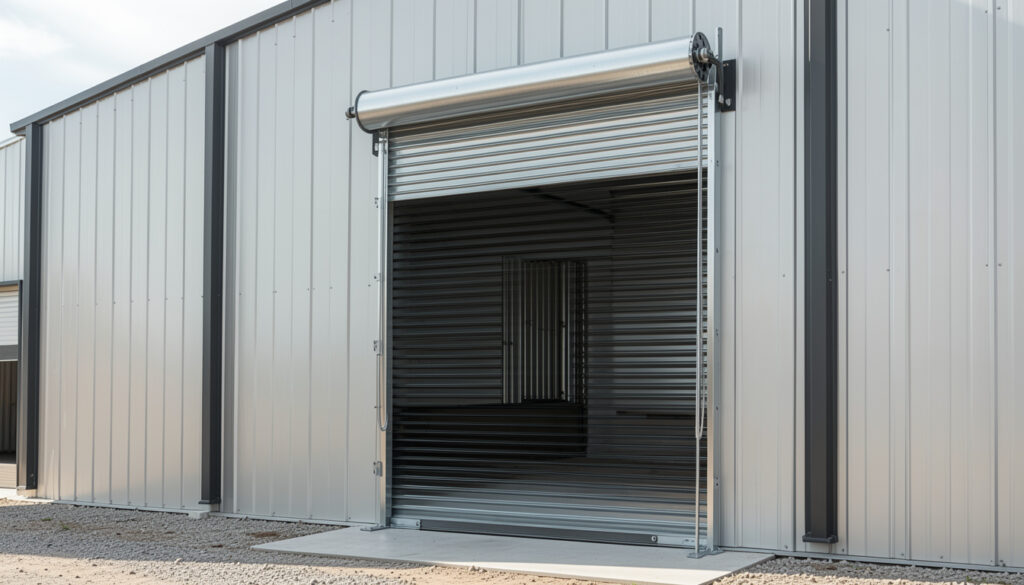
How the Series 200 Works
The Series 200 operates using a rolling curtain system.
When the door is closed, the galvanized steel curtain covers the building opening.
When the door is opened, the curtain travels through the vertical guides and rolls around the drum assembly positioned above the opening.
The drum assembly contains the counterbalancing mechanism that helps control the movement of the curtain.
This design eliminates the need for the long horizontal tracks used by many sectional overhead doors.
That can be particularly useful when the space above or behind the opening needs to remain available for other building components.
Why Choose a Rolling Sheet Door?
The primary advantage of a rolling sheet door is its relatively compact operating footprint.
A sectional door requires track space above the opening and often extends farther into the building.
A rolling sheet door instead stores its curtain around a drum.
This can help preserve space for:
- Lighting
- HVAC equipment
- Storage
- Structural components
- Electrical systems
- Interior equipment
For existing buildings where overhead clearance is limited, the rolling configuration can be especially useful.
Commercial Model 211
The Model 211 is the commercial configuration of the Series 200 family.
It is intended for commercial applications where a dependable rolling door is required.
Potential applications include:
- Storage facilities
- Commercial warehouses
- Service areas
- Maintenance buildings
- Equipment rooms
- General commercial openings
The appropriate configuration should always be determined by the actual opening size, usage, environmental conditions, and operating requirements.
Industrial Model 231
The Model 231 is the industrial configuration within the Series 200 family.
Industrial buildings can subject doors to more demanding operating environments than basic storage facilities.
Potential conditions include:
- Frequent operation
- Equipment traffic
- Dust
- Moisture
- Temperature fluctuations
- Accidental impact
The door should be evaluated according to the expected operating conditions rather than simply selecting a model based on the building type.
Insulated Model 232
The Model 232 provides an insulated configuration for applications where thermal separation is more important.
This can be useful when the door separates conditioned and unconditioned areas.
For example, a warehouse may contain:
- Heated offices
- Temperature-controlled storage
- Mechanical spaces
- Conditioned production areas
In these applications, an insulated rolling door can provide greater thermal performance than a basic non-insulated sheet door.
However, overall energy performance depends on the complete door assembly, including the seals, guides, installation, and frequency of operation.
Windlocked Model 233
Some buildings are exposed to significant wind forces.
The Model 233 Windlocked configuration is intended for applications where additional resistance to wind movement is required.
Wind requirements depend on the building location, opening size, exposure, and applicable design criteria.
The appropriate door configuration should therefore be selected according to the project’s actual wind requirements rather than assuming a standard door will provide sufficient resistance.
Insulated and Windlocked Model 234
The Series 200 family also includes the Model 234, which combines insulated and windlocked characteristics.
This can be useful when the project requires both improved thermal separation and increased wind resistance.
Buildings in challenging climates may need to address multiple performance requirements simultaneously.
The final door configuration should be based on the building’s environmental conditions, opening dimensions, and applicable specifications.
Galvanized Steel Curtain
The Series 200 uses a continuous galvanized steel curtain.
The manufacturer specifies a .021-inch galvanized steel curtain as a standard feature of the system.
The steel curtain forms the primary barrier across the opening when the door is closed.
Galvanized steel also provides corrosion resistance compared with unprotected steel, making it appropriate for many commercial and industrial applications.
The curtain should still be inspected periodically for:
- Impact damage
- Corrosion
- Deformation
- Loose components
- Coating deterioration
Lock-Seamed Curtain Sections
One useful feature of the Series 200 is its lock-seamed curtain construction.
The sections are mechanically connected, and if a section becomes damaged beyond practical repair, the individual section can be replaced.
This can be advantageous compared with replacing an entire door curtain because of localized damage.
However, whether individual components should be replaced depends on the extent of damage and the condition of the remaining door assembly.
Greaseless Nylon Bearings
The Series 200 uses greaseless nylon bearings.
These bearings are designed to provide long service life without the routine lubrication associated with many conventional metal-bearing systems.
Reducing lubrication requirements can simplify maintenance, particularly in facilities where multiple overhead doors are installed.
Even maintenance-reduced components should still be visually inspected for wear, damage, or abnormal operation.
Drum Assembly
The drum assembly houses the counterbalancing mechanism for the rolling curtain.
This assembly is essential to the door’s operation because it controls how the curtain rolls and unrolls.
Problems involving the drum or counterbalancing system can affect the door’s movement and may create a safety hazard.
Maintenance involving counterbalancing components should be performed by qualified personnel.
Weather Seal
The Series 200 incorporates an EPDM blade astragal along the bottom angle.
This weather seal helps create a barrier at the threshold against:
- Rain
- Dirt
- Insects
- Rodents
- Outside air
The condition of the bottom seal matters because even a durable steel curtain can allow unwanted infiltration if there is a significant gap between the door and the floor.
Single-Piece Guides
Roll-formed single-piece guides are standard on the Series 200.
The guides control the curtain as it travels vertically and help maintain proper alignment.
A damaged guide can cause the curtain to bind or move unevenly.
Inspect the guides after any impact involving vehicles, forklifts, carts, or other equipment.
Chain Operation
The Series 200 can use a smooth hand-chain operating system.
The hand chain provides a practical method for manually raising and lowering the door without requiring electrical power.
This can be useful for buildings where:
- Door use is moderate
- Electrical operation is unnecessary
- Simplicity is preferred
- Backup manual operation is desired
Electric operators are also available as an option.
Locking Assembly
The Series 200 includes a tamper-resistant slide-bolt locking assembly designed to accommodate two padlocks.
This provides a straightforward method of securing the opening when the building is unattended.
The appropriate locking arrangement depends on the facility’s security requirements and access-control strategy.
For buildings with electronic access control, additional hardware may be required.
Optional Features
The Series 200 can be configured with several optional features depending on the model and application.
Options include:
- Vision lites
- Vent cutouts
- Screened vents
- Wicket doors
- Electric operators
- Electric sensing edges
- Electric interlocks
- Weatherseals
- Steel building plates
- Dominator operators
These options allow the door to be adapted to different operating requirements.
Vision Lites
Vision lites can provide visibility through the door curtain.
This can be useful in facilities where employees need to see approaching vehicles or people before opening the door.
Visibility can also improve awareness around busy service or warehouse openings.
However, the appropriate vision-lite configuration should be selected according to the door’s intended application and security requirements.
Ventilation Options
Some facilities need controlled ventilation through an otherwise closed door.
Vent cutouts and screened vents are available options for the Series 200 family.
These can be useful in applications where airflow is needed without leaving the entire opening exposed.
The ventilation requirement should be evaluated together with building mechanical systems and applicable codes.
Wicket Doors
A wicket door provides pedestrian access through a larger rolling door assembly.
This can eliminate the need to raise the entire curtain when only personnel need to enter or exit.
For facilities with frequent pedestrian traffic through a larger opening, this can improve convenience and reduce unnecessary door cycling.
Electric Operators
Electric operation can make sense when the door is large, heavy, or frequently used.
Powered operation can be particularly useful in:
- Warehouses
- Distribution facilities
- Service centers
- Industrial buildings
- Loading areas
The operator should be properly matched to the door size and operating frequency.
Common Problems With Original Sheet Doors
Damaged Curtain
Forklifts, vehicles, and equipment can impact the curtain and deform individual sections.
Bent Guides
Impact or improper alignment can damage the vertical guides and cause the curtain to bind.
Worn Weather Seal
The bottom EPDM seal can deteriorate over time, creating gaps beneath the closed door.
Door Binding
Binding may indicate problems with the guides, curtain, drum, or alignment.
Excessive Noise
Unusual noise can indicate worn components or an operating issue.
Chain Operation Problems
A damaged or improperly functioning chain system can make manual operation difficult.
Locking Problems
A damaged slide bolt, padlock, or related hardware can prevent the door from being secured properly.
Drum or Counterbalance Issues
Problems with the counterbalancing mechanism can affect the door’s ability to open and close smoothly.
Signs Your Series 200 Door Needs Repair
Changes in normal operation should not be ignored.
Watch for:
- Uneven movement
- Excessive noise
- Door sticking
- Curtain damage
- Bent guides
- Loose hardware
- Damaged weather seal
- Difficulty locking
- Chain problems
- Door failing to open or close completely
Identifying these problems early can help prevent a relatively small component issue from developing into a larger door failure.
Signs Your Door Needs Replacement
A complete replacement may be more appropriate when the existing door has extensive:
- Curtain damage
- Corrosion
- Guide damage
- Structural deformation
- Counterbalance problems
- Repeated operating failures
- Obsolete hardware
Replacement can also make sense when the existing door no longer meets the building’s requirements.
For example, a facility may have increased its traffic or changed its operating conditions since the original door was installed.
Replacing an Existing Series 200 Door
Replacement starts with accurate measurements.
Document:
- Opening width
- Opening height
- Headroom
- Sideroom
- Backroom
- Existing guide dimensions
- Drum location
- Curtain dimensions
- Operating method
- Lock configuration
Photographs are also valuable.
Take photos of the exterior and interior of the door, along with close-up images of the guides, drum, curtain, bottom seal, chain, lock, and surrounding wall.
Measuring the Opening
Do not rely exclusively on the original door’s nominal size.
Measure the opening at multiple points.
Check:
- Width at the top
- Width at the middle
- Width at the bottom
- Height on both sides
- Floor condition
If the measurements are inconsistent, document the variation.
Existing metal building openings can change over time because of structural movement, impact, modifications, or previous repairs.
Headroom and Sideroom
The available space around the opening affects the installation.
Headroom is the space above the opening where the drum assembly and related components are installed.
Sideroom is the available space on either side for the guides and supporting hardware.
Check for potential interference from:
- Structural members
- Lighting
- Electrical equipment
- HVAC components
- Piping
- Interior finishes
These measurements should be confirmed before ordering the replacement door.
Door Maintenance
Routine inspection can help maintain reliable operation.
Inspect:
- Curtain
- Guides
- Drum
- Bearings
- Chain
- Lock
- Bottom seal
- Fasteners
- Operator
- Optional safety equipment
Keep the guides free from debris and inspect the curtain after impacts.
Do not force a door that is binding or operating abnormally.
Weather Seal Maintenance
The bottom weather seal is particularly important for exterior installations.
Inspect it for:
- Cracking
- Splitting
- Hardening
- Gaps
- Deformation
- Missing sections
A damaged seal can allow water, dirt, insects, and outside air to enter beneath the door.
Replacing a worn seal may be a relatively simple repair compared with replacing the entire door.
Safety Considerations
Rolling sheet doors contain moving mechanical components and counterbalancing systems.
Potential hazards include:
- Pinch points
- Falling components
- Unexpected movement
- Counterbalance failure
- Electrical hazards
Do not attempt to disassemble or modify the drum or counterbalancing mechanism without appropriate training.
Repairs involving mechanically loaded components should be performed by qualified personnel.
Things to Know
- The Series 200 is a rolling sheet door designed for commercial and industrial applications.
- The product family includes commercial, industrial, insulated, and windlocked configurations.
- The continuous galvanized steel curtain provides a durable barrier across the opening.
- Lock-seamed sections can allow localized curtain repairs when individual sections are damaged.
- Greaseless nylon bearings help reduce routine lubrication requirements.
- The EPDM bottom weather seal helps limit weather, dirt, insects, and rodent intrusion.
- Single-piece roll-formed guides help control curtain movement.
- Vision lites, vents, wicket doors, electric operators, and other options are available depending on configuration.
- Opening dimensions should be measured carefully before replacing an existing door.
- Windlocked configurations should be considered where project-specific wind requirements demand additional resistance.
- Insulated configurations can be appropriate where thermal separation is important.
- Counterbalance and other mechanically loaded components should be serviced by qualified personnel.
Frequently Asked Questions
Q: What is the Original Sheet Door Series 200?
The Original Sheet Door Series 200 is a rolling steel door designed for commercial and industrial building applications.
Its continuous steel curtain rolls around a drum above the opening.
Q: What Series 200 models are available?
The Series 200 family includes Model 211 Commercial, Model 231 Industrial, Model 232 Insulated, Model 233 Windlocked, and Model 234 Insulated/Windlocked configurations.
Q: What is the curtain made from?
The standard Series 200 curtain is constructed from galvanized steel, with the manufacturer specifying a continuous .021-inch galvanized steel curtain.
Q: Does the Series 200 require lubrication?
The system uses greaseless nylon bearings designed to operate without the routine lubrication associated with conventional metal bearings.
Q: Can the Series 200 be insulated?
Yes.
The product family includes an insulated Model 232 and an insulated/windlocked Model 234 configuration.
Q: Can I add windows to a Series 200 door?
Vision lites are available as an optional feature.
The appropriate configuration depends on the door model and project requirements.
Q: Can the Series 200 be motorized?
Yes.
Electric operators are available as an optional feature for applicable configurations.
Q: What causes a rolling sheet door to bind?
Common causes include damaged guides, bent curtain sections, debris, alignment problems, or issues with the drum and counterbalancing system.
Q: How do I measure for a replacement Series 200 door?
Measure the opening width and height, along with headroom, sideroom, backroom, guide dimensions, and the existing operating configuration.
Photographs of the existing installation should also be provided.
Q: Is the Series 200 suitable for Butler metal buildings?
Yes.
The Series 200 is offered as part of the Butler/Tereza roll-up door product selection for Butler building applications.
The Bottom Line on Original Sheet Door Series 200
The Original Sheet Door Tereza Series 200 is a practical rolling steel door solution for commercial and industrial metal buildings where durability, security, and efficient use of space are important.
Its continuous galvanized steel curtain, compact rolling operation, weather-sealing system, and available commercial, industrial, insulated, and windlocked configurations allow it to serve a broad range of building applications.
For warehouses, service facilities, storage buildings, maintenance areas, and industrial applications, the Series 200 can provide dependable access without requiring the extended track arrangement of a conventional sectional overhead door.
When replacing an existing door, focus on the details that determine compatibility: opening dimensions, headroom, sideroom, existing guides, drum configuration, curtain condition, operating method, and surrounding Butler wall construction.
Need a replacement Original Sheet Door Series 200? Request a Quote and provide your existing door measurements, configuration, and photos.