

The Butler Stylwall II Flat Panel is a concealed-fastener metal wall panel designed for commercial, industrial, and architectural applications where a clean exterior appearance is important.
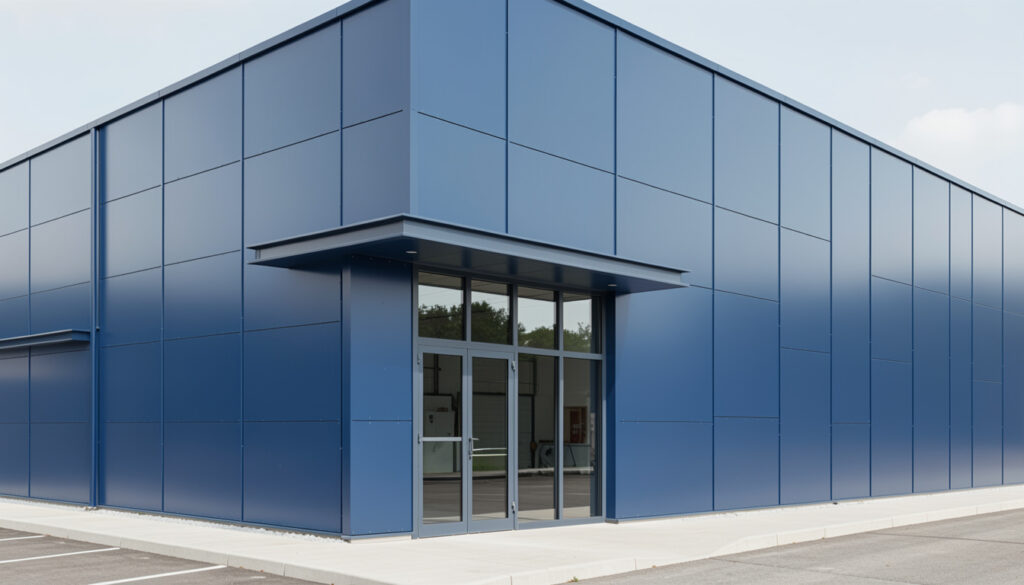
Unlike exposed-fastener wall panels, Stylwall II Flat uses concealed attachment to create a more uninterrupted facade. Its relatively flat profile provides a contemporary appearance that can complement storefronts, entrances, office areas, and other customer-facing portions of a metal building.
The system combines the durability of metal construction with the visual simplicity of a flat architectural wall surface, making it an option for projects where a conventional ribbed metal wall would be too utilitarian.
Key Takeaways
- Stylwall II Flat is a concealed-fastener metal wall panel system.
- Its flat profile creates a clean, contemporary exterior appearance.
- Concealed attachment eliminates visible rows of exterior fastener heads.
- The system is suited to commercial, industrial, and architectural applications.
- It can be used for feature walls and customer-facing portions of larger Butler buildings.
- Proper substrate and framing preparation are essential for a uniform installation.
- Panel joints and transitions require careful detailing to maintain weather resistance.
- The panel can be coordinated with Butler trims, doors, windows, and other building components.
- Exterior coating and color selection can significantly influence the final architectural appearance.
- Damaged panels should be evaluated before replacement to ensure the new panel matches the existing system.
What Is the Stylwall II Flat Panel?
The Stylwall II Flat Panel is a metal wall cladding system designed around a clean, relatively smooth exterior profile.
Its primary architectural characteristic is the absence of a pronounced exterior rib pattern.
That gives designers a surface that can appear more like a conventional architectural facade than a traditional metal building wall.
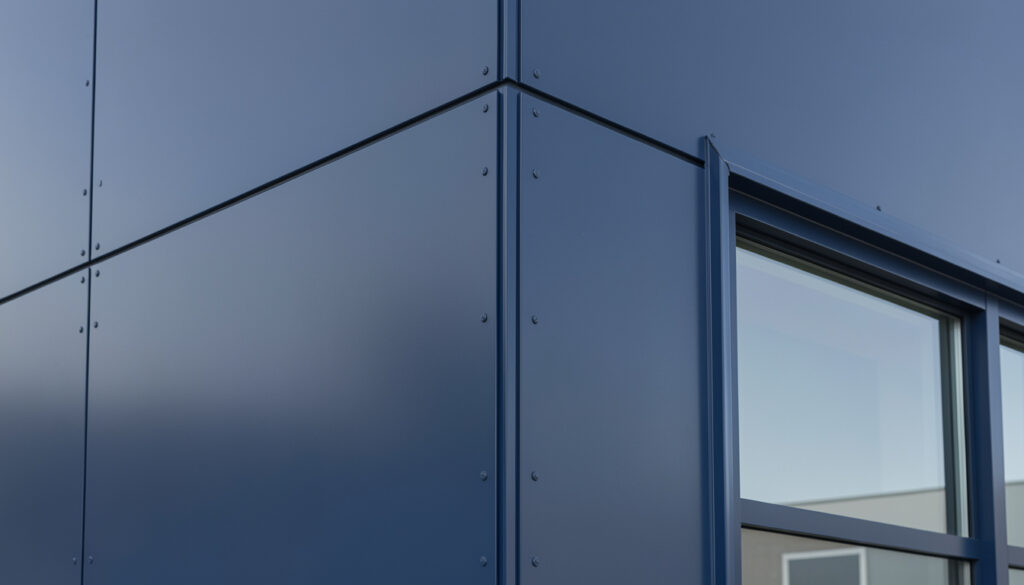
The concealed-fastener construction further reduces visual interruptions.
Instead of seeing screw heads across the exterior face, the attachment system is hidden within the panel assembly.
This makes Stylwall II Flat particularly useful for areas where the building’s exterior appearance matters.
Why Choose a Flat Metal Wall Panel?
Traditional ribbed metal wall panels provide a recognizable industrial appearance.
That is useful for warehouses, agricultural buildings, and many industrial facilities.
But some commercial buildings require something more refined.
A flat wall panel can provide:
- A smoother facade
- Fewer visual interruptions
- A contemporary appearance
- Better integration with glass and masonry
- A clean backdrop for architectural features
- A more finished appearance around entrances
The result is still a metal wall system, but the architecture becomes less dominated by the ribbed profile.
Concealed-Fastener Construction
One of the defining characteristics of Stylwall II Flat is its concealed-fastener attachment.
Exposed-fastener systems leave screw heads visible across the exterior surface.
Over time, these fasteners can also become noticeable because of:
- Coating changes
- Dirt accumulation
- Sealant deterioration
- Fastener replacement
- Thermal movement
With concealed fastening, the exterior face remains visually cleaner.
This is especially useful on prominent building elevations where rows of exposed screws would be visually distracting.
Flat Profile and Architectural Design
The flat profile allows Stylwall II to work with different architectural materials.
For example, a building may combine flat metal wall panels with:
- Glass
- Brick
- Stone
- Concrete
- Aluminum storefront
- Metal trim
- Architectural battens
The smooth metal surface provides a relatively neutral background for these materials.
This makes it possible to create visual contrast without introducing another highly textured wall profile.
Commercial Building Applications
Stylwall II Flat can be particularly useful on customer-facing commercial buildings.
Potential applications include:
- Office buildings
- Retail facilities
- Corporate facilities
- Commercial entrances
- Service centers
- Institutional buildings
- Mixed-use facilities
- Architectural feature walls
A building does not necessarily need to use Stylwall II across every elevation.
It can also be used selectively.
For example, a project may use a conventional metal wall system on the rear and side elevations while using Stylwall II Flat on the primary entrance facade.
This can provide an architectural upgrade without requiring the entire building to use the same wall profile.
Industrial Applications
Although the panel has an architectural appearance, it can also be appropriate for industrial facilities.
Manufacturing plants and distribution buildings often have large wall elevations that can benefit from a cleaner exterior appearance.
Stylwall II Flat can help reduce the visual dominance of a large metal wall.
It can also be combined with different panel systems to visually distinguish offices, entrances, and operational areas.
Stylwall II Flat vs. Ribbed Metal Wall Panels
The difference is primarily visual and architectural.
| Feature | Stylwall II Flat | Conventional Ribbed Panel |
|---|---|---|
| Exterior profile | Relatively flat | Pronounced ribs |
| Fasteners | Concealed | Often exposed |
| Appearance | Clean/contemporary | Industrial |
| Visible screw heads | Minimized | Common |
| Architectural flexibility | High | Moderate |
| Feature-wall applications | Well suited | Less common |
| Commercial facade | Strong fit | Application dependent |
The appropriate choice depends on the desired building appearance, performance requirements, budget, and existing wall system.
Panel Joints Matter
Even though the panel face is relatively flat, the joints between panels remain important.
The wall system needs to account for:
- Panel alignment
- Joint engagement
- Sealants
- Thermal movement
- Structural attachment
- Corners
- Openings
- Wall transitions
A poorly aligned flat panel can be more visually noticeable than a similar problem on a heavily ribbed panel.
This makes installation precision particularly important.
Installation Quality
Flat architectural wall panels require careful installation.
Small inconsistencies can become visible across a large facade.
Installers should pay close attention to:
- Panel alignment
- Joint spacing
- Fastener placement
- Substrate conditions
- Corner transitions
- Openings
- Trim
- Sealants
The wall should be inspected as installation progresses rather than waiting until the entire facade is complete.
Correcting alignment problems early is generally easier than removing completed sections later.
Corners and Transitions
Building corners can be challenging for any flat-profile wall system.
The transition needs to maintain both the architectural appearance and the weather-resistant function of the wall.
Important areas include:
- Outside corners
- Inside corners
- Wall intersections
- Roof-to-wall transitions
- Wall bases
- Window openings
- Door openings
Trim selection should be coordinated with the panel system to produce a clean transition.
Windows and Doors
Windows and doors create openings in an otherwise continuous wall assembly.
These areas require careful detailing because they interrupt:
- The panel surface
- Weather protection
- Air-control layers
- Structural attachment
The architectural appearance is also important.
A clean flat panel facade can be undermined by poorly detailed openings.
For this reason, Stylwall II Flat should be coordinated with the project’s storefront doors, windows, walk doors, and other access components during the design stage.
Exterior Finish and Color
The exterior finish is a major part of the architectural design.
A lighter color can make a building appear larger and reflect more solar radiation.
Darker colors can create stronger visual contrast and emphasize architectural elements.
The panel color can also coordinate with:
- Butler roof panels
- Trim
- Doors
- Windows
- Gutters
- Downspouts
- Architectural accents
For replacement projects, matching the existing color is particularly important.
A panel that is technically compatible but visually mismatched can stand out significantly from the surrounding facade.
Stylwall II Flat as a Feature Wall
A feature wall does not have to cover an entire building.
Stylwall II Flat can be concentrated around areas that receive the most visual attention.
These can include:
- Main entrances
- Reception areas
- Corporate signage
- Customer service areas
- Office sections
- Building corners
- Street-facing elevations
Using a flat panel selectively can create architectural contrast against more traditional metal building panels.
Weather Resistance
The exterior wall must protect the building from rain and wind-driven moisture.
The panel itself is only one part of this system.
Weather performance also depends on:
- Panel joints
- Sealants
- Flashing
- Trim
- Openings
- Roof connections
- Wall penetrations
- Installation quality
Particular attention should be paid to areas where different materials meet.
A wall panel can perform properly while an improperly detailed window or penetration creates the actual source of water intrusion.
Maintenance
Metal wall panels are generally relatively low maintenance, but periodic inspection is still appropriate.
Building owners should look for:
- Scratches
- Dents
- Coating damage
- Corrosion
- Loose components
- Failed sealants
- Open joints
- Water staining
- Damaged trim
Cleaning can also help preserve the appearance of the exterior finish.
The appropriate cleaning method depends on the coating used on the panel.
Repairing Damaged Panels
Damage to a flat metal wall can result from:
- Vehicle impacts
- Forklifts
- Construction equipment
- Severe weather
- Falling objects
- Improper maintenance
- Accidental contact
Small cosmetic damage may not require immediate panel replacement.
However, a puncture, severely deformed panel, or damaged joint may compromise the wall assembly.
The surrounding panels should also be inspected because impact forces can transfer beyond the visibly damaged area.
Replacing Stylwall II Flat Panels
Replacement work requires more than matching the visible appearance.
Before ordering a replacement panel, verify:
- Panel profile
- Panel dimensions
- Panel thickness
- Finish
- Color
- Joint configuration
- Existing framing
- Attachment method
- Trim
- Opening dimensions
This is especially important with older Butler buildings.
Building systems can change over time, and a visually similar panel may not properly integrate with an existing assembly.
Matching Existing Panels
Color matching can be particularly challenging on older buildings.
The original coating may have changed because of:
- UV exposure
- Weather
- Cleaning
- Environmental pollution
- Age
Even if the original color code is known, the new panel may appear slightly different from an older weathered panel.
For this reason, photographs and building information can be useful when determining a replacement solution.
Thermal Performance
Stylwall II Flat is primarily a wall cladding system.
The wall’s thermal performance depends on the complete assembly behind the exterior panel.
That can include:
- Fiberglass insulation
- Continuous insulation
- Vapor retarders
- Air barriers
- Structural framing
- Interior liners
The panel profile itself should therefore not be treated as the primary determinant of the wall’s R-value.
For a conditioned building, the entire wall assembly should be designed to meet applicable energy requirements.
Combining Stylwall II With Insulation
A conventional metal wall panel can be combined with an appropriate insulation system.
The exact configuration depends on the building design.
For example, a wall assembly may incorporate:
Stylwall II Flat → insulation → vapor/air-control layer → structural framing → interior liner
Each component performs a different function.
The exterior panel provides the visible weather-facing cladding.
The insulation provides thermal resistance.
The vapor and air-control layers manage moisture and air movement.
The framing provides structural support.
Flat Panel vs. Insulated Metal Panel
Stylwall II Flat and insulated metal panels can both provide clean architectural walls, but their construction is different.
An insulated metal panel integrates the insulation core into the panel itself.
A conventional metal wall panel such as Stylwall II Flat can use a separate insulation system behind the cladding.
| Factor | Stylwall II Flat | Insulated Metal Panel |
|---|---|---|
| Insulation integrated into panel | No | Yes |
| Concealed fasteners | Yes | Common |
| Flat architectural appearance | Yes | Available |
| Separate insulation system | Typically required | Integrated |
| Field-installed components | More | Fewer |
| Design flexibility | High | High |
Neither system is automatically better for every project.
The correct choice depends on thermal requirements, construction method, budget, appearance, and project schedule.
Common Problems With Stylwall II Flat Panels
Visible Alignment Problems
Because the panel surface is relatively flat, uneven installation can be noticeable across large elevations.
Damaged Panel Faces
Dents and scratches can be highly visible on smooth metal surfaces.
Failed Sealants
Deteriorated sealants around joints and transitions can contribute to moisture intrusion.
Incorrect Replacement Panels
A panel with the wrong dimensions or joint configuration may not properly connect to the existing system.
Color Mismatch
New panels can appear different from older weathered panels even when the original color specification is used.
Damaged Trim
Corner and opening trim can be damaged independently of the panel and should be inspected during repairs.
Water Intrusion
Poor detailing around windows, doors, penetrations, and transitions can create leaks.
Corrosion
Coating damage can expose the metal substrate and contribute to corrosion if left untreated.
Thermal Bridging
The wall assembly can experience heat transfer through steel framing even when insulation is installed.
Signs Your Stylwall II Wall Needs Inspection
Look for:
- Dented panels
- Scratched coatings
- Open joints
- Failed sealants
- Water stains
- Rust
- Damaged corners
- Loose trim
- Gaps around windows or doors
- Visible panel movement
Early inspection can help determine whether the problem is limited to the exterior panel or involves the underlying wall assembly.
Things to Know
- Stylwall II Flat is a concealed-fastener metal wall panel system.
- Its relatively flat profile creates a clean architectural appearance.
- The system is suitable for commercial, industrial, and architectural applications.
- Concealed fastening minimizes visible screw heads across the facade.
- Installation precision is especially important on flat-profile panels.
- Panel joints, corners, openings, and transitions require careful detailing.
- Wall insulation is a separate consideration from the exterior panel itself.
- The panel can be coordinated with Butler doors, windows, trims, and other building components.
- Color matching is important when replacing individual panels.
- Older panels may have weathered differently from newly manufactured replacement panels.
- Routine inspection can identify damaged coatings, joints, trim, and sealants.
- The complete wall assembly should be evaluated for thermal and moisture performance.
Frequently Asked Questions
Q: What is Stylwall II Flat?
Stylwall II Flat is a concealed-fastener metal wall panel designed to provide a clean, relatively smooth architectural exterior.
It is suitable for commercial, industrial, and other building applications where appearance is important.
Q: Does Stylwall II Flat have exposed screws?
No.
The system uses concealed fastening, which minimizes visible fastener heads on the exterior.
Q: Is Stylwall II Flat completely smooth?
It has a relatively flat exterior profile, but the finished wall still includes panel joints and architectural transitions.
The result is considerably less visually ribbed than a conventional exposed-fastener metal wall panel.
Q: Can Stylwall II Flat be used on an existing Butler building?
Yes, when the replacement or retrofit configuration is compatible with the existing structure.
The existing panel dimensions, profile, attachment method, framing, and trim should be verified first.
Q: Can Stylwall II Flat be used on commercial buildings?
Yes.
Its concealed-fastener design and clean appearance make it particularly suitable for commercial and architectural building elevations.
Q: Does Stylwall II Flat provide insulation?
The exterior panel itself should not be treated as the building’s primary insulation system.
Thermal performance depends on the complete wall assembly, including the selected insulation and other enclosure components.
Q: Can Stylwall II Flat be combined with insulation?
Yes.
A separate insulation system can be incorporated behind the exterior wall panel depending on the building design and thermal requirements.
Q: How do I replace a damaged Stylwall II Flat panel?
First verify the existing panel’s dimensions, profile, joint configuration, finish, and attachment system.
Matching these characteristics is essential for a proper replacement.
Q: Why does a new replacement panel look different from the existing panels?
Weathering and UV exposure can change the appearance of older metal panels over time.
Even a new panel with the original specified color may appear different from an aged panel.
Q: What causes leaks around flat wall panels?
Leaks can originate from panel joints, sealants, flashing, windows, doors, penetrations, or transitions rather than the panel face itself.
The entire affected area should be inspected before replacing panels.
The Bottom Line on Stylwall II Flat Panel
Stylwall II Flat provides a clean, concealed-fastener alternative to conventional ribbed metal wall panels.
Its flat architectural profile, concealed attachment, commercial appearance, and compatibility with other Butler building components make it useful for prominent building elevations, entrances, feature walls, offices, and other areas where appearance matters.
The system is particularly effective when a project needs the durability and construction advantages of metal while avoiding the highly industrial appearance of exposed-fastener ribbed panels.
For replacement work, matching the existing panel profile, dimensions, joint configuration, finish, and attachment system is critical. A technically similar panel may not properly integrate with an existing Butler wall.
If you need a replacement Stylwall II Flat panel or want to verify the appropriate wall component for your Butler building, Request a Quote and provide your building information, measurements, and photos.