

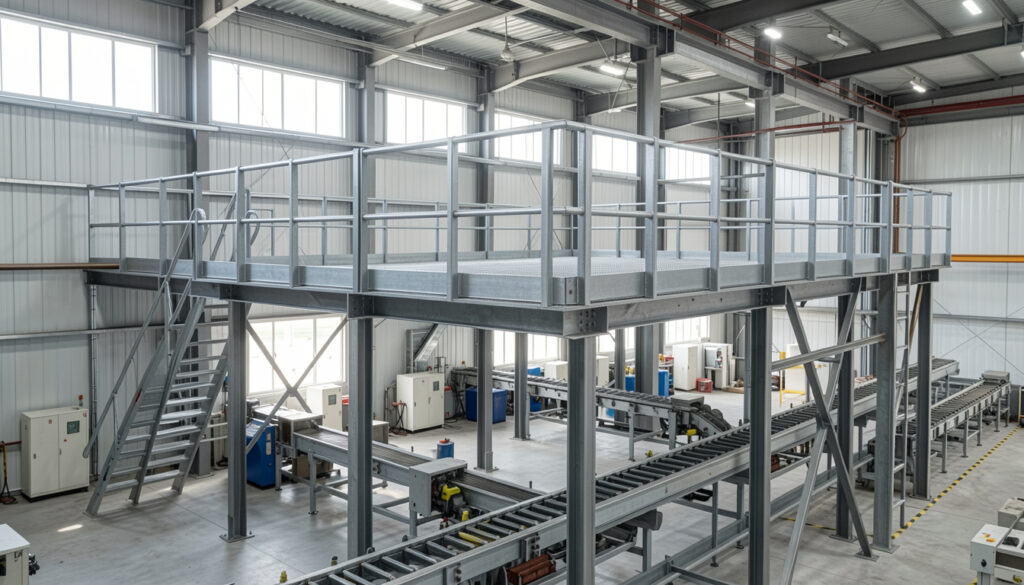
Industrial catwalks provide elevated walkways inside commercial and industrial metal buildings, giving maintenance personnel, technicians, and equipment operators safer access to areas that would otherwise be difficult to reach.
In a large metal building, equipment, conveyors, mechanical systems, lighting, utilities, and other building components may be positioned above normal floor level. Without a properly designed access system, routine inspection and maintenance can require temporary platforms, ladders, or other less efficient methods.
A properly engineered industrial catwalk creates a dedicated elevated access route while integrating with the building’s existing structural framing.
Butler-compatible catwalk systems can incorporate open-grating walkways, guardrails, toe boards, access gates, mounting hardware, and other safety components into one coordinated system. The current Butler Building Parts catwalk system is designed for commercial and industrial applications and offers standard walkway widths from 18 to 36 inches, with customized dimensions available.
Key Takeaways
- Industrial catwalks provide elevated access for maintenance, inspection, and equipment service.
- A catwalk should be designed as part of the building’s structural system rather than treated as a simple platform.
- Open grating provides a high-traction walking surface while allowing light, air, dust, and small debris to pass through.
- Guardrails and toe boards help reduce fall and falling-object hazards.
- Catwalk support systems must account for the loads transferred into the building’s structural framing.
- Butler-compatible catwalks can integrate with primary frame columns, roof trusses, or other structural supports.
- Catwalks can be useful around conveyors, mechanical equipment, storage systems, and overhead utilities.
- Existing catwalks should be inspected for corrosion, damaged grating, loose connections, and other deterioration.
- Replacement or expansion work should consider both worker safety and structural requirements.
- The appropriate catwalk configuration depends on the building layout, intended use, access requirements, and loading conditions.
What Is an Industrial Catwalk?
An industrial catwalk is an elevated walkway designed to provide personnel access within an industrial or commercial facility.
Unlike a temporary work platform, a permanent catwalk is integrated into the building and designed for recurring access.
A typical catwalk system can include:
- Elevated walkway
- Open steel or aluminum grating
- Guardrails
- Mid-rails
- Toe boards
- Access gates
- Support brackets
- Hanger rods
- Structural anchors
- Access ladders or safety posts
The exact configuration depends on the building and intended application.
Butler Building Parts describes its industrial catwalk systems as modular systems that can connect to primary frame columns, roof trusses, or interior structural supports.
Why Industrial Catwalks Are Important
Maintenance activities often require workers to access areas that are not reachable from the main floor.
For example, a facility may have:
- Conveyor systems
- HVAC equipment
- Electrical equipment
- Mechanical systems
- Lighting
- Piping
- Storage equipment
- Production machinery
- Overhead utilities
Without permanent access, workers may need to repeatedly set up temporary equipment to reach these areas.
A dedicated catwalk provides a predictable access route and can make recurring inspection and maintenance tasks more efficient.
It also allows the access system to be designed around the building’s actual layout rather than relying on improvised solutions.
Catwalks and Metal Building Structural Framing
An industrial catwalk does not exist independently from the building.
The walkway, personnel, equipment, and other loads are transferred through the catwalk’s support system into the building’s structural framing.
Depending on the design, supports may connect to:
- Primary frame columns
- Roof trusses
- Structural beams
- Interior framing
- Other engineered support points
This makes structural coordination essential.
The building’s framing must be capable of supporting the additional loads introduced by the catwalk system.
A catwalk should therefore not simply be attached to whichever structural member is easiest to reach.
The connection needs to be evaluated according to the building’s structural design and the intended catwalk loading.
Open-Grating Catwalk Floors
Open grating is commonly used for industrial walkways because it provides several practical advantages.
The open design allows:
- Light to pass through
- Air to circulate
- Small debris to fall through
- Liquids to drain through
- Lower areas to remain more visible
It can also provide a high-traction walking surface appropriate for industrial environments.
But the specific grating type should be selected according to the expected loads and operating conditions.
For facilities where small objects could fall onto workers or equipment below, additional protection may be necessary depending on the application.
Catwalk Guardrails and Fall Protection
An elevated walkway requires appropriate edge protection.
Catwalk systems can incorporate continuous top rails, mid-rails, toe boards, and access gates.
These components serve different purposes.
Guardrails help reduce the risk of personnel falling from the elevated walkway, while toe boards help reduce the possibility of tools or other objects sliding from the edge.
The exact safety requirements depend on the installation, jurisdiction, and applicable workplace regulations.
For commercial and industrial facilities, the catwalk should be designed and installed with applicable OSHA requirements and local requirements in mind.
Common Problems With Industrial Catwalks
Corrosion
Catwalk components exposed to moisture or corrosive environments can deteriorate over time.
Pay particular attention to connections, support brackets, grating, and areas where water or contaminants can accumulate.
Damaged Grating
Grating can become bent, cracked, or otherwise damaged from impact or excessive loading.
Damaged walking surfaces should be evaluated before continued use.
Loose Connections
Bolted or mechanically connected components can loosen over time because of vibration, repeated loading, or deterioration.
Damaged Guardrails
Bent or loose guardrails can compromise the safety of an elevated walkway.
Structural Overloading
Adding equipment, storage, or other loads to a catwalk can exceed its original design assumptions.
The catwalk should not be treated as additional storage space unless it has been specifically designed for those loads.
Improper Modifications
Cutting, drilling, removing supports, or modifying connections without engineering review can compromise the catwalk or the building supporting it.
Where Are Industrial Catwalks Used?
Industrial catwalks can be useful in a wide range of facilities.
Common applications include:
- Manufacturing plants
- Warehouses
- Distribution centers
- Agricultural facilities
- Equipment buildings
- Processing facilities
- Commercial buildings
- Industrial maintenance areas
They are particularly useful where workers need recurring access to elevated equipment.
A catwalk can also be configured around existing building features, allowing the access route to follow the facility’s operational requirements.
Catwalks for Conveyor Access
Conveyor systems are a common reason for installing elevated walkways.
A conveyor may extend through a building at a height that makes floor-level inspection impractical.
A catwalk can allow personnel to:
- Inspect conveyor components
- Perform routine maintenance
- Access motors and controls
- Monitor operations
- Reach equipment safely
The walkway should be positioned so that personnel have adequate clearance around the equipment and safe access points.
Catwalks for Mechanical and Building Systems
Mechanical systems can also require elevated access.
Examples include HVAC equipment, piping, electrical systems, and other building services.
A catwalk can provide a permanent maintenance route and reduce the need for temporary access equipment.
When planning a catwalk around mechanical systems, consider:
- Equipment clearance
- Maintenance access
- Headroom
- Emergency access
- Guardrail placement
- Equipment removal paths
The catwalk should support the building’s maintenance requirements without obstructing equipment operation.
Catwalks in Existing Butler Buildings
An existing Butler building may be a good candidate for a catwalk when operations have changed or new equipment has been installed.
However, adding a catwalk to an existing building requires more than selecting the desired walkway dimensions.
The existing structure should be evaluated for:
- Available attachment points
- Structural capacity
- Existing loads
- Frame configuration
- Clearance
- Access requirements
- Catwalk loads
The installation should be coordinated with the existing building rather than assuming that every structural member can support a new elevated walkway.
Catwalk Replacement and Repair
Older catwalks may develop problems after years of service.
Common reasons for replacement include:
- Corrosion
- Damaged grating
- Deteriorated connections
- Damaged guardrails
- Structural modifications
- Changes in facility operations
A replacement project should evaluate the complete system.
Replacing only damaged grating, for example, may not address corrosion in the supporting structure.
Likewise, replacing a guardrail without examining the connection points may leave the underlying problem unresolved.
Catwalk Expansion
Facility operations sometimes change after the original building is constructed.
A business may install new equipment, extend a conveyor system, or change how workers access machinery.
In these situations, an existing catwalk may need to be extended or reconfigured.
The new section should be evaluated as part of the overall system.
Important considerations include:
- Existing structural capacity
- New loads
- Connection points
- Walkway width
- Guardrail continuity
- Access points
- Equipment clearance
- Applicable safety requirements
A catwalk extension should not simply be attached to an existing structure without confirming that the existing system can accommodate the modification.
Catwalk Width and Configuration
The required catwalk width depends on its intended use.
A walkway used primarily for personnel access may have different requirements from one intended to accommodate equipment maintenance or material handling.
The current Butler Building Parts system lists standard widths from 18 to 36 inches, with customized dimensions available.
The final configuration should account for the actual operating environment and applicable requirements.
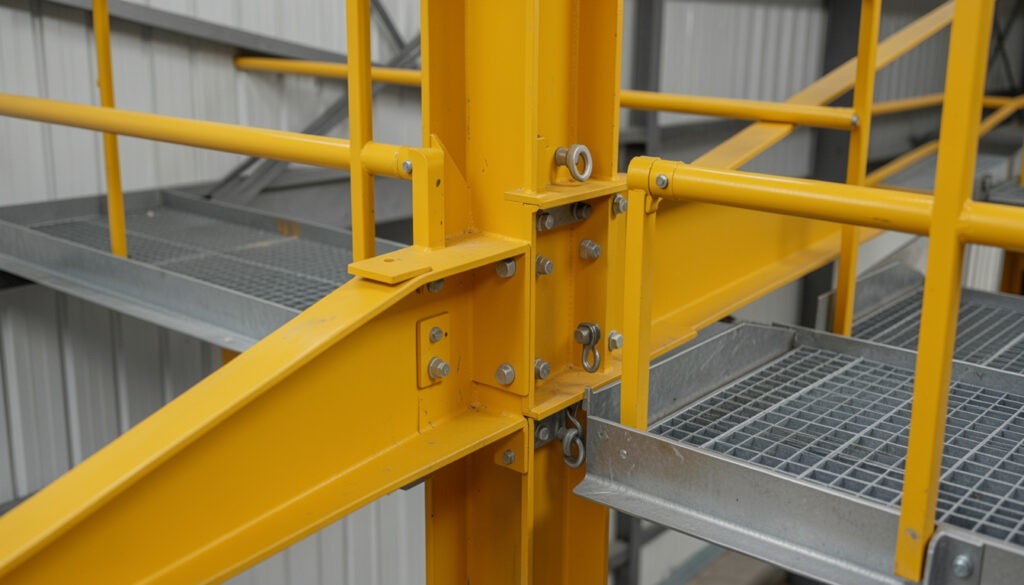
Catwalk Support Systems
The support method is one of the most important parts of a catwalk installation.
Support systems can use components such as:
- Hanger rods
- Column brackets
- Structural anchors
- Support frames
- Connection clips
The support configuration determines how loads are transferred into the building.
Butler Building Parts indicates that its catwalk systems can use hanger rods or column brackets to distribute loads into the existing building structure.
The appropriate support method depends on the building’s framing and the catwalk’s configuration.
Industrial Catwalks and Worker Safety
Worker safety should be considered from the beginning of the catwalk design.
A safe system needs more than a walking surface.
The overall access route should consider:
- Entry and exit
- Guardrails
- Toe boards
- Walkway surface
- Access ladders
- Gates
- Clearance
- Lighting
- Structural capacity
The goal is to create a predictable and controlled access route for workers performing routine tasks at elevation.
How to Identify a Replacement Catwalk
If you need replacement components for an existing Butler catwalk, collect as much information as possible.
Useful information includes:
- Building type
- Catwalk location
- Existing walkway width
- Catwalk length
- Grating type
- Support configuration
- Guardrail dimensions
- Connection details
- Photographs
- Damaged component measurements
If the existing catwalk was originally engineered as part of the building, original drawings can also be valuable.
Things to Know
- A catwalk is a structural system, not simply an elevated platform.
- The existing building framing must be considered when adding or replacing a catwalk.
- Guardrails and toe boards are important components of an elevated access system.
- Open grating can improve traction, drainage, airflow, and visibility.
- Do not exceed the designed loading capacity.
- Do not remove or modify structural supports without appropriate engineering review.
- Inspect grating, connections, supports, and guardrails regularly.
- Catwalk extensions should be evaluated as structural modifications.
- Applicable OSHA and local requirements should be considered during design and installation.
- Existing Butler building information can make replacement and expansion planning easier.
Frequently Asked Questions
Q: What is an industrial catwalk used for?
Industrial catwalks provide elevated access for workers performing maintenance, inspections, equipment service, and other recurring tasks.
Q: Can a catwalk be installed inside an existing Butler building?
Yes, but the existing structural framing should be evaluated before installation.
The catwalk support system must be compatible with the building and capable of transferring the intended loads safely.
Q: What are catwalks typically made from?
Industrial catwalks can use structural steel or aluminum, depending on the application and design requirements.
The walkway may incorporate open metal grating for traction and drainage.
Q: How wide should an industrial catwalk be?
The appropriate width depends on its intended use, access requirements, and applicable regulations.
Butler Building Parts currently lists standard catwalk widths from 18 to 36 inches, with customized dimensions available.
Q: Do industrial catwalks need guardrails?
Elevated walkways generally require appropriate fall protection and edge protection.
The exact requirements depend on the application and applicable OSHA and local regulations.
Q: Can I use an industrial catwalk for storage?
Not unless the catwalk has been specifically designed for the additional storage loads.
Adding equipment or stored materials can change the loads imposed on both the catwalk and the building structure.
Q: Can an existing Butler catwalk be expanded?
Potentially, yes.
The existing structure, connections, new loads, and proposed extension should be evaluated before modification.
Q: How often should a metal building catwalk be inspected?
Catwalks should be inspected regularly according to the facility’s safety and maintenance program, with additional inspections after impacts, severe weather, or significant modifications.
Q: What should I inspect on an old catwalk?
Inspect the grating, guardrails, toe boards, support brackets, connections, fasteners, and structural members for corrosion, deformation, looseness, or damage.
Q: Can damaged catwalk components be replaced individually?
In some cases, yes.
Individual grating, railing, or connection components may be replaceable, but the entire assembly should be evaluated when structural damage or significant corrosion is present.
The Bottom Line on Butler Building Industrial Catwalks
Industrial catwalks provide a permanent and controlled way to access elevated equipment and building systems inside commercial and industrial metal buildings. When properly designed, they can make routine maintenance and inspection more efficient while providing dedicated walking surfaces and fall-protection features.
For Butler buildings, the catwalk should be treated as part of the overall structural system. Its supports, connections, walkway, guardrails, and loading requirements all need to work with the existing building.
Whether you’re replacing an aging catwalk, repairing damaged components, or planning a new elevated access system, accurate building information and proper structural coordination are essential.
Need a Butler-compatible industrial catwalk or replacement components? Request a Quote and provide your building information, catwalk dimensions, photographs, and details about the intended application.