

Large metal buildings can accumulate significant amounts of heat, humidity, and stale air, particularly when there is limited natural airflow. Warehouses, manufacturing facilities, agricultural buildings, workshops, and other industrial structures can become uncomfortable and difficult to ventilate without a properly designed ventilation system.
Roof turbine vents provide a passive way to exhaust hot and stale air from a building without requiring an electric motor to operate the vent itself.
Butler roof turbine vents use wind-driven rotation and natural thermal airflow to continuously move air through the building. Current Butler turbine vent specifications include 12-inch, 20-inch, and 24-inch throat sizes, along with bird screens, wide flanges, and options for dampening where required.
Key Takeaways
- Roof turbine vents provide passive, wind-driven ventilation for metal buildings.
- They operate without requiring an electric motor.
- Turbine rotation helps exhaust hot and stale air from the building.
- They can help reduce heat accumulation and moisture buildup.
- Butler turbine vents are designed for integration with Butler roof systems.
- Available throat sizes include 12, 20, and 24 inches.
- Bird screens help prevent birds and other unwanted objects from entering the ventilation opening.
- Wide flanges help provide an appropriate transition between the turbine vent and roof assembly.
- Dampening can be included when required for the application.
- Turbine vents can be used in commercial, industrial, and agricultural buildings.
- Proper placement is important for effective building ventilation.
- Turbine vents should be considered as part of the building’s overall ventilation strategy.
What Is a Roof Turbine Vent?
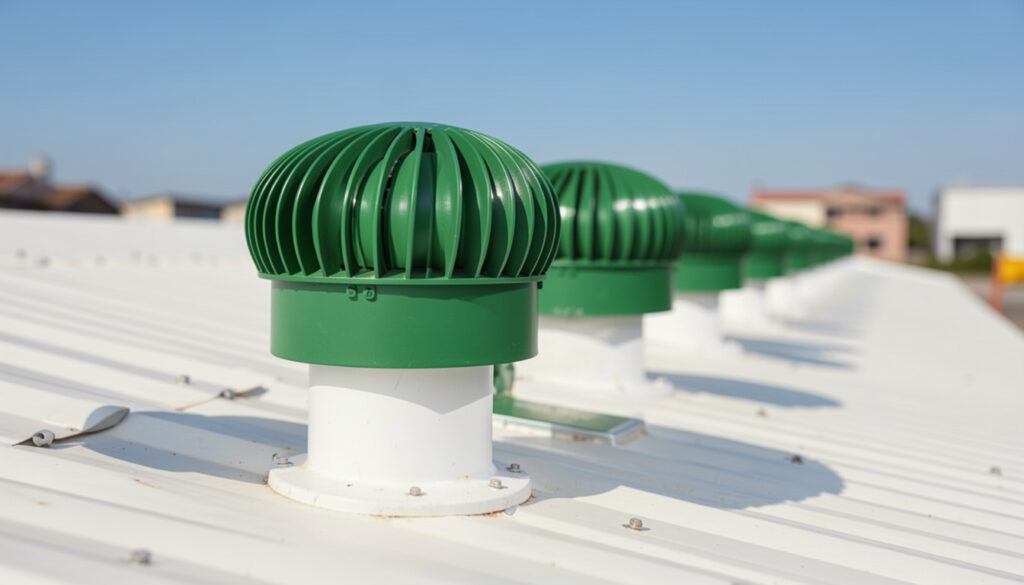
A roof turbine vent is a mechanical-looking ventilation device that uses wind energy and natural thermal airflow to exhaust air from a building.
The turbine contains multiple curved blades that rotate when exposed to moving air.
As the turbine turns, it helps pull air upward and out of the building.
Unlike powered exhaust fans, a turbine vent does not require an electrical connection to operate.
This makes it a useful option for buildings where passive ventilation is desirable or where reducing dependence on powered ventilation equipment is important.
How a Roof Turbine Vent Works
A turbine vent relies on two primary forces to move air:
- Wind-driven airflow
- Thermal buoyancy
When wind passes across the turbine, the blades rotate.
At the same time, warm air naturally rises toward the highest point of the building.
The turbine provides an outlet for that rising air.
This creates a passive ventilation path where hot interior air can escape through the roof while replacement air enters through lower-level openings, wall louvers, doors, or other ventilation openings.
The effectiveness of the system depends on the building’s size, roof configuration, turbine capacity, wind conditions, temperature difference, and available intake openings.
Wind-Driven Ventilation
Wind is one of the main forces that drives a turbine vent.
As air moves across the turbine blades, it causes the assembly to rotate.
This rotation helps draw air from the building and discharge it outside.
Because the turbine does not rely on an electric motor, it can continue operating whenever sufficient wind is available.
This makes turbine ventilation particularly attractive for buildings where passive ventilation is appropriate.
Thermal Buoyancy and Hot Air
Hot air naturally rises.
In a large metal building, solar radiation and internal equipment can cause substantial heat accumulation near the roof.
A roof turbine provides an outlet at the highest portion of the building where hot air naturally collects.
This can help remove accumulated heat from the upper portion of the building.
For this reason, roof turbine vents can be particularly useful in buildings with high ceilings and large roof volumes.
Reducing Heat Buildup
Metal buildings can become extremely warm when solar heat is absorbed by the roof and transferred into the building.
Internal heat sources can add to the problem.
Examples include:
- Manufacturing equipment
- Vehicles
- Machinery
- Lighting
- Occupants
- Compressors
- Industrial processes
Roof turbine ventilation can help remove some of this accumulated hot air.
It does not eliminate heat gain, but it can improve air movement and reduce heat accumulation when the ventilation system is properly designed.
Managing Moisture and Humidity
Ventilation also plays an important role in managing moisture.
Moisture can enter a building through:
- Outdoor humidity
- Occupants
- Industrial processes
- Washing operations
- Agriculture
- Condensation
If humid air becomes trapped inside the building, condensation can occur on colder surfaces.
A properly designed ventilation system can help remove humid interior air and replace it with outside air when environmental conditions are favorable.
However, turbine vents should not be considered a substitute for proper insulation, vapor control, or moisture management.
Turbine Vents for Warehouses
Warehouses are common applications for roof ventilation.
Large storage facilities can have significant amounts of unused air volume above the occupied floor.
Heat naturally rises into this upper area.
Roof turbine vents can provide an outlet for that accumulated warm air.
They can be particularly useful in:
- Distribution centers
- Equipment warehouses
- Agricultural storage buildings
- Industrial storage facilities
- Vehicle storage buildings
The effectiveness of the ventilation strategy depends heavily on whether sufficient replacement air can enter the building.
Turbine Vents for Manufacturing Buildings
Manufacturing facilities can generate substantial heat through machinery and production processes.
Turbine vents can help remove accumulated hot air from the upper portion of the building.
However, they should not be used as the sole ventilation method where manufacturing processes produce hazardous fumes, dust, gases, or other contaminants.
Those environments may require engineered mechanical exhaust systems designed specifically for the contaminants involved.
Turbine Vents for Agricultural Buildings
Agricultural buildings frequently require ventilation to manage heat and humidity.
Roof turbines can provide passive ventilation without requiring continuous electrical operation.
Potential applications include:
- Equipment storage
- Agricultural warehouses
- Workshops
- Farm buildings
- Livestock-related structures where appropriate
Ventilation requirements vary considerably by agricultural application.
Buildings housing animals require ventilation strategies based on animal type, occupancy, temperature, humidity, and air-quality requirements.
Turbine Vents for Workshops
Workshops can accumulate heat from equipment, vehicles, tools, and occupants.
A roof turbine can help remove hot air from the upper portion of the building.
This can complement lower-level intake openings, doors, windows, or wall louvers.
For workshops that use paints, solvents, welding equipment, or other potentially hazardous materials, however, the ventilation system should be designed around the specific hazards.
Passive vs. Powered Ventilation
One of the primary differences between turbine vents and exhaust fans is the way they create airflow.
Turbine vents use wind and thermal forces.
Powered exhaust fans use an electric motor.
Each approach has advantages.
Turbine vents can operate without electrical power and generally have fewer mechanical components.
Powered fans can provide more predictable airflow because their performance does not depend entirely on wind conditions.
For some buildings, the most effective strategy may combine passive and mechanical ventilation.
Advantages of Turbine Ventilation
Roof turbine vents can offer several practical advantages:
- No electric motor required
- Passive operation
- Continuous operation when wind is available
- Helps exhaust hot air
- Helps move humid interior air
- Relatively simple mechanical design
- Low electrical demand
- Suitable for large roof areas
- Can complement other ventilation systems
The actual performance depends on proper sizing, placement, and building airflow design.
Limitations of Turbine Vents
Turbine vents are not appropriate for every building.
Their performance can be limited by:
- Low wind conditions
- Insufficient intake openings
- Poor placement
- Inadequate vent capacity
- Building configuration
- High indoor contaminant loads
A turbine vent cannot remove more air than can reasonably enter the building to replace it.
This is why intake ventilation is just as important as exhaust ventilation.
The Importance of Replacement Air
Consider a building with several roof turbine vents but almost no openings where outside air can enter.
The turbines may rotate, but the building can develop negative pressure that restricts airflow.
For effective ventilation, the building needs an appropriate airflow path.
Replacement air can enter through:
- Wall louvers
- Intake vents
- Doors
- Windows
- Dedicated ventilation openings
The location and size of those openings should be considered when designing the ventilation system.
Turbine Vent Placement
Placement can significantly affect ventilation performance.
Because hot air rises, turbine vents are generally positioned toward the upper portions of the building’s roof.
The specific roof layout determines the best locations.
Factors to consider include:
- Roof geometry
- Building orientation
- Roof slope
- Internal partitions
- Heat-producing equipment
- Existing ventilation openings
- Prevailing wind
- Structural framing
For larger facilities, multiple turbine vents may be required to provide adequate ventilation coverage.
Multiple Turbine Vents
A large industrial building may require more than one turbine vent.
Using multiple vents can distribute exhaust capacity across a larger roof area.
However, the number of vents should not simply be selected based on roof size.
The ventilation requirement should be calculated based on building volume, heat generation, occupancy, airflow requirements, and available intake area.
Butler Roof System Compatibility
A turbine vent must be compatible with the roof where it will be installed.
Current Butler turbine vent information identifies the product as being designed for Butler metal roof system integration.
Proper integration helps maintain the weather-tight condition of the roof while providing the required ventilation opening.
The roof profile, opening dimensions, flashing, flange configuration, and installation details should be confirmed before installation.
Turbine Vent Throat Sizes
Current Butler turbine vents are available in:
- 12-inch throat size
- 20-inch throat size
- 24-inch throat size
The appropriate size depends on the building’s ventilation requirements and the required airflow capacity.
Larger is not automatically better.
The turbine size should be coordinated with the building’s overall ventilation design.
Bird Screens
Outdoor roof ventilation openings can become entry points for birds and other unwanted objects.
Butler turbine vents include bird screens as part of the available configuration.
The screen helps prevent birds and larger debris from entering the ventilation opening while still allowing air to pass through.
Screens should be inspected periodically because accumulated dust, insects, or debris can reduce airflow.
Wide Flanges
Butler turbine vents are available with wide flanges designed to facilitate integration with the roof assembly.
The flange provides the transition between the turbine vent and the surrounding roof.
This area requires careful installation because it is part of the building’s weather barrier.
Proper flashing and sealing are essential to prevent water from entering around the roof penetration.
Dampening Options
Current Butler turbine vent specifications indicate that dampening can be included when required.
Dampening may be useful where the application requires additional control of the turbine assembly.
The appropriate configuration should be determined based on the building and project requirements.
Industrial-Grade Construction
Roof turbine vents are exposed directly to outdoor conditions.
They must withstand:
- Wind
- Rain
- Sunlight
- Temperature changes
- Dust
- Seasonal weather
- Roof movement
Current Butler product information describes its turbine vents as using industrial-grade construction and precision-balanced turbine assemblies for long-term operation.
Roof Turbine Vents and Condensation
Condensation can be a concern in metal buildings when warm, humid interior air encounters cold surfaces.
Ventilation can help reduce moisture accumulation by allowing humid air to escape.
However, condensation control requires more than ventilation.
The building should also have appropriate:
- Insulation
- Vapor retarders
- Air sealing
- Roof design
- Interior humidity control
The turbine vent should therefore be considered one component of the overall building-envelope strategy.
Turbine Vents and Energy Efficiency
A turbine vent does not directly provide heating or cooling.
Its primary function is ventilation.
However, improving airflow can potentially reduce heat accumulation and improve interior conditions during appropriate weather conditions.
In naturally ventilated buildings, this can reduce the need for mechanical cooling during certain periods.
The actual energy savings depend on climate, building use, HVAC operation, insulation, and ventilation design.
Turbine Vents vs. Ridge Vents
Both turbine vents and ridge vents can exhaust hot air from the roof area, but they work differently.
A ridge vent creates a continuous or distributed exhaust opening along the roof ridge.
A turbine vent uses a rotating assembly to actively draw air through a specific roof penetration.
Turbine vents may be useful where individual roof exhaust points are preferred.
Ridge vents can provide more continuous ventilation along the building’s ridge.
The correct solution depends on the roof system and ventilation requirements.
Turbine Vents vs. Powered Exhaust Fans
Powered exhaust fans provide controlled mechanical airflow through electric motors.
Turbine vents rely on natural forces.
Powered fans generally provide more predictable airflow, while turbine vents can operate without electricity.
For facilities with significant heat or contaminant loads, powered ventilation may be necessary.
For buildings where passive ventilation is sufficient, turbine vents can provide a simpler alternative.
Replacing an Existing Turbine Vent
Older turbine vents can eventually experience:
- Corrosion
- Bearing wear
- Damaged blades
- Loose fasteners
- Failed flashing
- Damaged screens
- Excessive noise
- Poor rotation
A replacement may be appropriate when the turbine no longer operates smoothly or when the roof penetration has deteriorated.
Signs a Turbine Vent Needs Attention
Inspect the turbine if you notice:
- The turbine does not rotate in normal wind
- Excessive vibration
- Grinding or squeaking
- Bent blades
- Visible corrosion
- Damaged bird screen
- Loose components
- Water around the roof penetration
- Deteriorated flashing
- Reduced building airflow
A visual roof inspection can help identify whether the turbine itself or the surrounding roof assembly is responsible for the problem.
Measuring a Replacement Turbine Vent
Before ordering a replacement, document the existing installation.
Important information includes:
- Throat diameter
- Overall dimensions
- Roof profile
- Roof slope
- Flange dimensions
- Opening dimensions
- Fastener locations
- Existing flashing
- Bird screen configuration
Photographs of the turbine from several angles can also help identify the correct replacement configuration.
Installing a Roof Turbine Vent
Installation involves creating or using an appropriate roof opening and properly integrating the turbine with the roof assembly.
The installation should account for:
- Roof panel profile
- Structural framing
- Flashing
- Sealants
- Fasteners
- Roof slope
- Weather exposure
- Vent orientation
Because the installation creates a roof penetration, improper detailing can result in leaks even if the turbine itself is functioning correctly.
Common Problems With Roof Turbine Vents
Turbine Does Not Rotate
A seized bearing, damaged assembly, excessive friction, or insufficient wind can prevent normal rotation.
Excessive Noise
Grinding, squeaking, or rattling can indicate worn bearings, loose components, or damaged blades.
Water Leakage
Failed flashing, sealants, or fasteners around the roof penetration can allow water into the building.
Corrosion
Continuous exposure to moisture and weather can eventually deteriorate the turbine or surrounding components.
Clogged Bird Screen
Dust, insects, leaves, and other debris can restrict airflow through the ventilation opening.
Bent Blades
Impact or severe weather can deform turbine blades and affect balance.
Poor Ventilation
Insufficient intake openings, improper placement, or inadequate turbine capacity can limit overall airflow.
Loose Fasteners
Loose fasteners can create vibration, movement, and potential water-entry points.
Signs Your Roof Turbine Vent Needs Replacement
A turbine vent should be inspected or replaced when you notice:
- Persistent noise
- Failure to rotate
- Excessive vibration
- Bent or damaged blades
- Heavy corrosion
- Damaged bird screen
- Water leakage
- Deteriorated flashing
- Loose components
- Poor ventilation performance
Replacing a deteriorated turbine can restore proper roof ventilation while addressing problems around the roof penetration.
Maintaining Roof Turbine Vents
Routine inspection can extend the useful service life of a turbine vent.
Check:
- Turbine blades
- Bearings
- Bird screen
- Flange
- Fasteners
- Flashing
- Sealants
- Surrounding roof panels
Remove accumulated debris and inspect the turbine for abnormal movement or noise.
Because the vent is installed on the roof, inspections should always follow appropriate roof-access and fall-protection procedures.
Things to Know
- Butler roof turbine vents use wind-driven rotation and natural thermal airflow.
- They do not require an electric motor for normal wind-driven operation.
- Available throat sizes include 12, 20, and 24 inches.
- Bird screens are included to help prevent unwanted entry.
- Wide flanges are available for roof integration.
- Dampening can be included when required.
- Turbine vents are designed for integration with Butler roof systems.
- Proper intake ventilation is necessary for effective exhaust airflow.
- Turbine vents should be sized according to the building’s ventilation requirements.
- Roof penetrations require proper flashing and sealing to prevent leaks.
- Turbine vents are not a substitute for engineered mechanical exhaust where hazardous contaminants are present.
- Regular inspection can identify damaged blades, corrosion, bearing problems, and roof leaks before they become larger issues.
Frequently Asked Questions
Q: What does a roof turbine vent do?
A roof turbine vent exhausts hot and stale air from a building using wind-driven rotation and natural thermal airflow.
Q: Do turbine vents require electricity?
No.
Turbine vents operate using wind and natural airflow rather than an electric motor.
Q: What sizes are Butler turbine vents available in?
Current Butler product information lists 12-inch, 20-inch, and 24-inch throat sizes.
The appropriate size depends on the building’s ventilation requirements.
Q: Can turbine vents help reduce heat inside a metal building?
Yes.
By exhausting hot air that accumulates near the roof, turbine vents can improve airflow and help reduce heat buildup under appropriate conditions.
Q: Do turbine vents work when there is no wind?
They can still benefit from thermal airflow, but their primary rotating action is driven by wind.
Performance will vary depending on temperature differences, building pressure, and available airflow.
Q: Can a turbine vent prevent condensation?
It can help manage moisture by improving ventilation, but it does not independently prevent condensation.
Insulation, vapor retarders, air sealing, and humidity control may also be required.
Q: Are Butler turbine vents compatible with Butler metal roofs?
Yes.
Butler turbine vents are designed for integration with Butler roof systems.
Q: What is the purpose of the bird screen?
The bird screen helps prevent birds and larger debris from entering the ventilation opening while allowing air to pass through.
Q: How many turbine vents does a metal building need?
There is no universal number.
The required quantity depends on building size, ventilation requirements, heat generation, turbine capacity, roof configuration, and available intake openings.
Q: Can turbine vents replace exhaust fans?
Sometimes, but not always.
Turbine vents are appropriate for passive ventilation applications, while facilities requiring controlled or high-volume exhaust may need powered mechanical ventilation.
Q: How do I replace an existing Butler turbine vent?
Document the existing throat diameter, roof profile, roof slope, flange configuration, and opening dimensions before ordering a replacement.
Photos of the existing installation can also help identify the appropriate configuration.
The Bottom Line on Butler Roof Turbine Vents
Butler roof turbine vents provide a practical passive ventilation solution for metal buildings where natural airflow can help remove accumulated heat, humidity, and stale air.
Their wind-driven operation eliminates the need for an electric motor, while available 12-inch, 20-inch, and 24-inch throat sizes, bird screens, wide flanges, and optional dampening allow the system to be configured for different applications.
For the best results, turbine vents should not be considered in isolation. The building needs an appropriate path for replacement air, and the location and quantity of the vents should be coordinated with the building’s overall ventilation requirements.
For replacement projects, verify the existing turbine dimensions, roof profile, flange configuration, and roof opening before ordering. Proper flashing and sealing are equally important because the turbine creates a penetration through the roof.
Need a replacement Butler roof turbine vent? Request a Quote and provide your existing turbine dimensions, roof profile, and photos of the installation.