

Aircraft hangars and other large-span metal buildings require door systems capable of creating exceptionally wide openings without compromising the building’s structural performance. A conventional overhead door may work for smaller equipment, but aviation facilities often need much larger clearances for aircraft, helicopters, oversized vehicles, and specialized equipment.
Butler Building Hangar Doors are designed for large-opening applications where reliable access, structural compatibility, and long-term performance are critical.
Butler metal building systems are commonly used for aviation facilities because their clear-span structural design can create large unobstructed interiors. Hangar doors must work together with that structural system so aircraft can enter and exit without columns or other obstructions interfering with the opening.
Key Takeaways
- Hangar doors are designed for exceptionally large building openings.
- They can provide the clearance necessary for aircraft, helicopters, oversized vehicles, and industrial equipment.
- Proper coordination between the door system and the Butler structural frame is critical.
- Large hangar doors require careful consideration of opening dimensions, structural loads, wind conditions, and operating requirements.
- Hangar doors can be used for private aircraft facilities, commercial aviation buildings, maintenance operations, aviation museums, and industrial applications.
- Door operation should be selected according to the size and frequency of use.
- Weather protection is an important consideration because large openings can expose significant portions of the building envelope.
- Accurate field measurements are essential when replacing an existing hangar door.
- Structural conditions around the opening should be documented before ordering replacement components.
- Regular inspection and maintenance are important because hangar doors contain large moving assemblies.
What Is a Hangar Door?
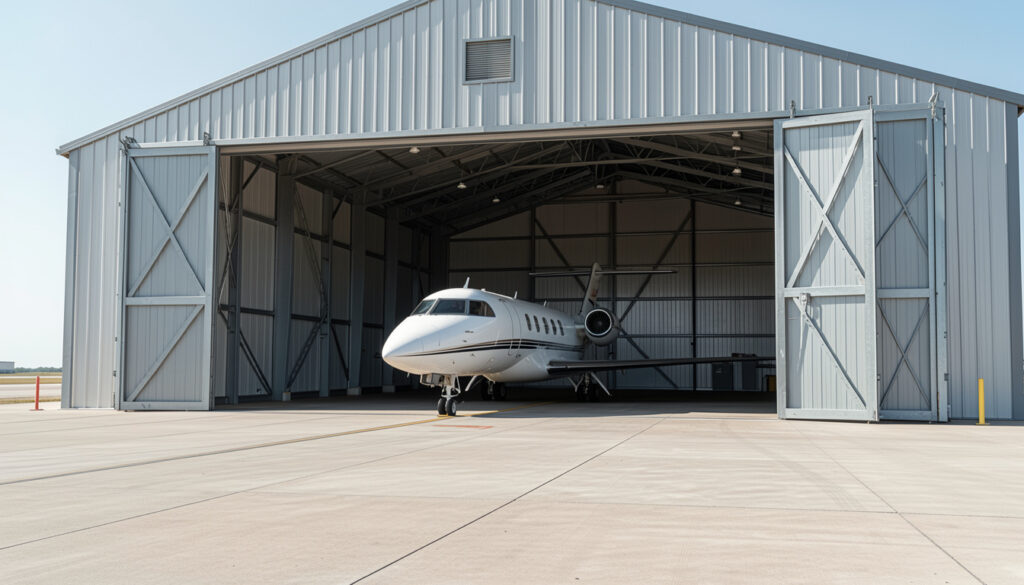
A hangar door is a large-scale door system designed to provide access through the exterior wall of an aircraft hangar or other oversized building.
Unlike standard personnel doors and commercial roll-up doors, hangar doors are designed around the dimensions of the equipment that needs to pass through the opening.
For aviation facilities, that can mean accommodating:
- Private aircraft
- Business jets
- Helicopters
- Military aircraft
- Commercial aircraft
- Maintenance equipment
- Ground-support equipment
The door must provide sufficient width and height while maintaining reliable operation.
The surrounding building structure must also be designed to support the loads associated with the large opening and door system.
Why Hangar Doors Require Specialized Design
A hangar door is not simply a larger version of a standard commercial overhead door.
As the opening becomes wider and taller, the engineering requirements increase.
The door system must account for:
- Door weight
- Wind loads
- Structural support
- Operating forces
- Deflection
- Track or movement system
- Weather exposure
- Aircraft clearance
- Building movement
The building structure and door system therefore need to be coordinated from the beginning of the project.
For replacement work, the existing conditions become equally important.
Large Clear Openings
The primary purpose of a hangar door is to create a large unobstructed opening.
Aircraft require clearance not only for their wingspan but also for:
- Tail height
- Wingtip clearance
- Ground equipment
- Tow vehicles
- Maintenance equipment
A door that is technically large enough may still be impractical if there is insufficient clearance around the aircraft.
For that reason, door dimensions should be established based on the largest equipment expected to use the facility.
Butler Metal Buildings and Hangar Applications
Butler metal building systems are suited to large-span applications because the structural system can provide substantial unobstructed interior space.
This makes them appropriate for:
- Aircraft hangars
- Aviation maintenance facilities
- Transportation buildings
- Industrial storage buildings
- Large equipment facilities
- Specialty vehicle storage
The hangar door opening must be coordinated with the building frame, roof system, wall system, and foundation.
A large door opening can affect the structural behavior of the surrounding wall, making proper engineering particularly important.
Hangar Doors for Private Aircraft
Private aircraft owners often need hangars that provide convenient daily access while protecting the aircraft from weather and unauthorized access.
The hangar door should accommodate the aircraft’s dimensions with adequate clearance.
Important considerations include:
- Wingspan
- Tail height
- Aircraft length
- Door opening width
- Door opening height
- Apron clearance
- Operating frequency
A hangar designed for a small single-engine aircraft has very different door requirements from one designed for a business jet.
Hangar Doors for Business Jets
Business jets require larger clearances than many general-aviation aircraft.
The door must accommodate the aircraft’s wingspan and vertical dimensions while allowing safe movement through the opening.
The facility may also need additional clearance for:
- Ground-support vehicles
- Aircraft tugs
- Maintenance equipment
- Personnel
- Fueling equipment
The door opening should therefore be planned around the complete operational environment rather than the aircraft dimensions alone.
Hangar Doors for Maintenance Facilities
Aircraft maintenance facilities may operate their hangar doors considerably more frequently than private aircraft storage buildings.
Maintenance operations can involve:
- Aircraft movement
- Ground-support equipment
- Maintenance vehicles
- Tool carts
- Personnel
- Service equipment
Frequent cycling places additional demands on the door’s operating system.
For these facilities, cycle frequency should be considered when selecting the door and operating equipment.
Industrial Applications
Hangar doors are not limited to aviation.
Large industrial buildings may need similarly oversized openings for:
- Mining equipment
- Construction machinery
- Large trucks
- Specialized vehicles
- Manufacturing equipment
- Oversized storage
In these situations, the same basic principle applies: the opening must provide sufficient clearance while the door system remains compatible with the building structure.
Hangar Door Operating Systems
Large hangar doors can use different operating approaches depending on the door design and application.
The operating system should be selected based on:
- Door size
- Door weight
- Opening frequency
- Available power
- Required opening speed
- Building configuration
- Emergency requirements
For a private hangar that opens occasionally, operating requirements may be relatively modest.
A commercial aviation facility with frequent aircraft movement may require a more robust system designed for repeated cycles.
Opening Speed
Opening speed can become important in commercial aviation and industrial facilities.
A door that takes a long time to open can interrupt aircraft movement and facility operations.
However, increasing operating speed also requires the door system and controls to be properly designed for that application.
The ideal operating speed depends on:
- Door size
- Door weight
- Traffic volume
- Safety requirements
- Operating environment
Speed should not be prioritized at the expense of controlled and reliable movement.
Weather Protection
A hangar door represents a large opening in the building envelope.
When closed, the door should help protect the facility from:
- Rain
- Wind
- Dust
- Temperature changes
- Moisture
- Debris
Weather performance depends on the door design and how it interfaces with the surrounding building.
Large doors require careful attention to perimeter conditions because even relatively small gaps can become significant when the opening is extremely large.
Wind Loads
Wind is an important consideration for large hangar doors.
The larger the door surface, the greater the potential effect of wind pressure.
The door system, surrounding framing, and building structure must therefore be evaluated according to the applicable wind design requirements for the project.
This is especially important in areas exposed to:
- Hurricanes
- Tornadoes
- Coastal winds
- High seasonal wind
- Severe storms
Wind requirements should be established during design rather than addressed after installation.
Structural Coordination
One of the most important aspects of a hangar door installation is coordination with the building structure.
The opening can affect:
- Wall framing
- Roof framing
- Bracing
- Headers
- Door support structure
- Foundation loads
The hangar door system must be compatible with the structural design.
For an existing Butler building, replacement work should begin with an evaluation of the current structural conditions around the opening.
Door Clearance
Aircraft clearance should be calculated carefully.
Allowances should be considered for:
- Wingspan
- Tail
- Landing gear
- Aircraft movement
- Wind conditions
- Ground equipment
A door opening should not be designed so tightly that normal aircraft movement becomes difficult.
Adequate clearance also provides a margin for operational variations.
Hangar Door Tracks and Movement
Depending on the door system, movement may involve tracks, rollers, guides, structural supports, or other mechanical components.
These components must remain properly aligned.
Misalignment can result in:
- Increased resistance
- Uneven movement
- Excessive noise
- Component wear
- Door binding
Because hangar doors can be extremely large and heavy, small alignment problems can become significant mechanical issues.
Security and Aircraft Protection
A hangar provides more than weather protection.
It also protects valuable aircraft and equipment from unauthorized access.
Security requirements may include:
- Locking systems
- Access controls
- Electronic monitoring
- Perimeter security
- Interior security systems
The door should be considered as part of the facility’s overall security strategy.
Energy Considerations
Aircraft hangars vary significantly in their heating and cooling requirements.
Some hangars remain largely unconditioned.
Others contain:
- Offices
- Maintenance areas
- Temperature-controlled workspaces
- Specialized equipment
- Occupied support areas
If the hangar is conditioned, door performance becomes more important because a large opening can contribute significantly to air infiltration.
Operational practices also matter.
Leaving a large hangar door open for extended periods can substantially increase heating and cooling demand.
Hangar Doors and Aircraft Safety
Aircraft movement requires a controlled environment.
The door opening should provide clear visibility and sufficient clearance.
Operators should ensure that:
- The door is fully open before aircraft movement
- The opening is unobstructed
- Personnel are clear of moving components
- Ground equipment is positioned safely
- The operating area is monitored
Door controls and safety systems should be appropriate for the facility’s operational requirements.
Common Problems With Hangar Doors
Door Misalignment
Large door assemblies can become difficult to operate when tracks, guides, or supporting components move out of alignment.
Operating Resistance
Increasing resistance can indicate worn components, alignment problems, debris, or mechanical issues.
Structural Movement
Changes in the building structure can affect the door opening and its operation.
Damaged Door Components
Aircraft, vehicles, ground equipment, or severe weather can damage door panels and operating components.
Weather Leakage
Gaps around the door perimeter can allow wind, rain, and outside air to enter the building.
Corrosion
Moisture exposure can eventually cause corrosion on steel components if protective coatings become damaged.
Operator Failure
Powered systems can experience mechanical, electrical, or control problems.
Excessive Noise
Grinding, rattling, or unusual movement may indicate worn or misaligned components.
Signs Your Hangar Door Needs Repair
Watch for changes in the door’s normal operation.
Warning signs include:
- Uneven movement
- Increasing operating noise
- Door binding
- Slow operation
- Excessive vibration
- Damaged seals
- Corrosion
- Visible structural damage
- Electrical or control problems
- Difficulty reaching the fully open or closed position
Because of the size and weight of hangar doors, problems should be investigated promptly.
Signs Your Hangar Door Needs Replacement
A complete replacement may be appropriate when the existing system has extensive:
- Structural damage
- Corrosion
- Track damage
- Operator failure
- Panel deterioration
- Repeated mechanical failures
- Obsolete operating components
Replacement may also be necessary when the aircraft or equipment using the facility has changed.
A door that was adequate for the original building use may not provide sufficient clearance for newer or larger aircraft.
Replacing an Existing Hangar Door
Replacement projects require considerably more information than a typical personnel-door replacement.
Document:
- Door opening width
- Door opening height
- Existing door dimensions
- Door type
- Operating system
- Structural framing
- Track or guide configuration
- Door weight, if available
- Available electrical service
- Wind requirements
- Surrounding wall and roof conditions
Photographs should show both the interior and exterior of the complete installation.
Close-up photos of the structural supports, operating equipment, tracks, guides, seals, and door panels are also valuable.
Measuring a Hangar Opening
Measure the opening at multiple points.
Check:
- Width at the top
- Width at the bottom
- Height at both sides
- Height at the center
- Vertical alignment
- Floor elevation
Large existing openings can change over time due to structural movement or previous modifications.
Do not assume that an old door’s nominal dimensions accurately represent the current opening.
Aircraft Clearance Planning
The door should be sized around the largest aircraft expected to use the hangar.
Consider the complete aircraft envelope rather than just the published wingspan and height.
Additional clearance may be required for:
- Aircraft movement
- Towing
- Ground-support equipment
- Maintenance
- Wind
- Operational visibility
The door should allow aircraft to move through the opening without unnecessary risk of contact.
Maintenance Requirements
Hangar doors require routine inspection because of their size and mechanical complexity.
Inspect:
- Door panels
- Tracks
- Rollers
- Guides
- Operating equipment
- Fasteners
- Structural supports
- Weather seals
- Electrical controls
- Safety devices
The maintenance schedule should reflect how frequently the door is operated and the environment in which it is installed.
A private aircraft hangar may have relatively low cycle frequency, while a commercial maintenance facility may operate the door many times each day.
Protecting Against Corrosion
Hangar doors located near coastal or humid environments can be particularly susceptible to corrosion.
Inspect:
- Door panels
- Structural steel
- Fasteners
- Tracks
- Hardware
- Exposed edges
- Damaged coatings
Any damaged protective coating should be addressed before corrosion spreads.
Cleaning can also help remove accumulated moisture-retaining dirt and contaminants.
Safety Considerations
Hangar doors are large mechanical systems and should not be treated like ordinary building doors.
Potential hazards include:
- Crushing points
- Falling components
- Unexpected movement
- Electrical hazards
- Structural failure
- Aircraft collision
Personnel should remain clear of moving components during operation.
Maintenance involving major structural, mechanical, or electrical components should be performed by appropriately qualified professionals.
Things to Know
- Hangar doors are specialized systems designed for very large building openings.
- Aircraft clearance should be established before finalizing the door dimensions.
- The door must be coordinated with the Butler structural frame and surrounding building systems.
- Wind loads can have a significant effect on large door assemblies.
- Operating frequency should influence the selection of the door’s operating equipment.
- Weather sealing becomes increasingly important as opening size increases.
- Hangar doors can also be used for oversized industrial equipment and vehicles.
- Existing openings should be carefully measured before replacement.
- Structural conditions around the opening should be documented during replacement planning.
- Regular inspection can identify alignment, corrosion, sealing, and operating problems early.
- Aircraft movement should only occur when the opening is fully clear and the door is safely positioned.
- Large door repairs should be handled by qualified personnel familiar with the specific system.
Frequently Asked Questions
Q: What are Butler Building Hangar Doors used for?
They are designed for large clear openings in aircraft hangars, aviation facilities, industrial buildings, and other structures requiring oversized access.
Q: How large can a hangar door be?
The required size depends on the building, door system, structural design, and equipment that must pass through the opening.
Large Butler building systems can accommodate very substantial clear-span applications, but the door dimensions must be engineered for the specific project.
Q: Are hangar doors only used for aircraft?
No.
They can also provide large-scale access for industrial equipment, oversized vehicles, maintenance operations, and specialty storage facilities.
Q: What should I consider when choosing a hangar door?
Consider the opening dimensions, aircraft or equipment size, wind loads, operating frequency, structural conditions, weather exposure, security requirements, and available operating space.
Q: Can a hangar door be motorized?
Yes, depending on the selected door system.
Powered operation is particularly useful for large doors and facilities where the opening is used frequently.
Q: Why is structural coordination important?
A large hangar opening can affect the surrounding building frame, and the door system introduces additional structural and operating requirements.
The door and building should therefore be coordinated as one system.
Q: How do I measure an existing hangar door?
Measure the opening width and height at multiple locations and document the surrounding structural framing, operating system, tracks, guides, and available clearance.
Detailed photographs are also strongly recommended.
Q: What causes a hangar door to operate unevenly?
Potential causes include misalignment, damaged tracks or guides, worn rollers, structural movement, mechanical problems, or debris.
Q: Do hangar doors require regular maintenance?
Yes.
Large moving door systems should be periodically inspected for mechanical wear, alignment, corrosion, weather-seal deterioration, and operating-system problems.
Q: Can I replace an old hangar door without replacing the building?
Potentially, depending on the existing structural opening and the compatibility of the replacement door system.
The existing framing and opening should be evaluated before selecting a replacement.
The Bottom Line on Butler Building Hangar Doors
Butler Building Hangar Doors are designed for facilities where ordinary commercial doors are not large enough to provide the required access.
For private aircraft hangars, business aviation facilities, maintenance buildings, industrial storage facilities, and oversized equipment buildings, a properly engineered hangar door can provide the clear opening necessary for safe and efficient movement.
The most important factors are opening size, aircraft or equipment clearance, structural compatibility, wind requirements, operating frequency, weather protection, and long-term maintenance.
For replacement projects, do not rely solely on the dimensions of the existing door. Measure the opening, document the surrounding structural conditions, photograph the existing operating system, and identify the equipment that needs to pass through the opening.
Need a replacement or new Butler Building Hangar Door? Request a Quote and provide your opening dimensions, existing door details, and project requirements.